

| Pixel | 2560×1920 px |
| Pixel size (µm) | 5.4×5.4 µm |
| Resolution | 5.0 megapixels |
| Signal to noise ratio | Greater than or equal to 56db |
| Sensitivity | DNA concentration below 20pg. |
| Camera | High-resolution digital CCD |
| Zoom lens | F = 1:1.2, 2/3” inch 6x zoom lens |
| Filter (nm) | 590 nm |
| UV Light transmission (W×L) | 250×200 mm |
| Visible light transmission (W×L) | 200×210 mm |
| Transmission UV wavelength | 302 nm |
| Reflectance UV wavelength | 254, 365 nm |
| Transmission UV lamp power | 302 nm (8W) |
| Reflectance UV lamp power | 11W (For both the wavelengths) |
| Dimensions (L×W×H) | 470×405×820 mm |
| Packing Dimensions (L×W×H) | 570×510×920 mm |
| Weight (kg) | 29.0 kg |
| Gross Weight (kg) | 39.0 Kg |
Our Gel Documentation System makes it easy to clearly visualize DNA and other biomolecules after electrophoresis, thanks to a high-resolution CCD camera. The user-friendly software lets you capture images, zoom in, and analyze your results in detail, helping in accurate and efficient documentation
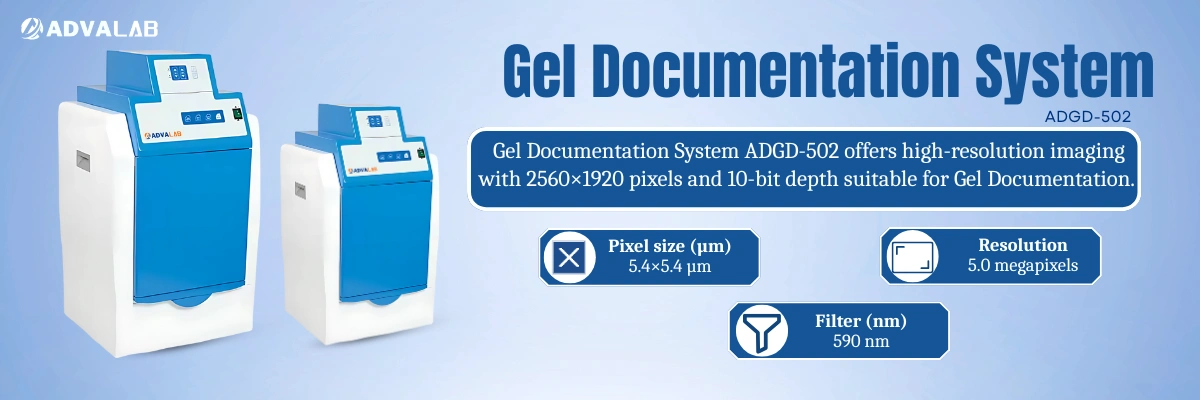

1. What is the resolution of the camera of Gel Documentation System ADGD-502?
The camera of Gel Documentation System ADGD-502 offers a resolution of 2560×1920 pixels, equivalent to 5.0 megapixels. It features 10-bit pixel density for detailed and accurate image capture. This ensures high-quality visualization of even faint gel bands. It's suitable for both qualitative and quantitative gel analysis.
2. Can the Gel Documentation System ADGD-502 detect low concentrations of DNA?
Yes, the Gel Documentation System ADGD-502 can detect double-stranded DNA stained with ethidium bromide at concentrations below 20 picograms. This sensitivity supports applications that require detection of very small DNA quantities. It allows clear visualization of faint or low-yield samples. This makes it valuable for experiments with minimal DNA output.
3. What type of lens is included in the Gel Documentation System ADGD-502?
The Gel Documentation System ADGD-502 includes a 2/3-inch lens with F=1:1.2 aperture and 6× optical zoom. This enables flexible magnification based on gel size and detail required. The lens performs well in low light, capturing dim bands clearly. Its zoom function allows close-up imaging without moving the gel.
4. What UV wavelengths does the Gel Documentation System ADGD-502 support?
The Gel Documentation System ADGD-502 supports UV transmission at 302 nm and reflectance at 254 nm and 365 nm. These options let users choose the best wavelength for their stain and gel type. This flexibility enhances contrast and band visibility. It supports a variety of experimental needs.
5. Does the Gel Documentation System ADGD-502 include a filter for image clarity?
Yes, the Gel Documentation System ADGD-502 has a multi-layer gel filter to reduce background noise. This enhances the clarity and contrast of DNA bands in images. It eliminates unwanted light interference that can distort results. The filter is especially helpful when capturing faint bands or multiple gels.
6. What is the purpose of a Gel Documentation System in a laboratory?
A Gel Documentation System is used to capture images of electrophoresis gels after the separation of DNA, RNA, or proteins. It allows scientists to record and analyze experimental results accurately. These systems help ensure reproducibility and proper documentation of lab work. They are essential tools in molecular biology research.
7. Can a Gel Documentation System be used for both research and teaching purposes?
Yes, Gel Documentation Systems are versatile enough for use in both research and educational settings. In research labs, they support accurate analysis and publication-quality images. In academic institutions, they help students visualize molecular biology processes. Their ease of use makes them suitable for all levels of expertise.
8. What are the advantages of using an Advalab Gel Documentation System?
Advalab systems provide high-resolution imaging for accurate gel analysis. Real-time image capture and intuitive controls enhance user efficiency. The systems are built for durability, ensuring consistent performance over time. They are suitable for both routine and advanced molecular biology workflows.

| Pixel | 1280×1024 px |
| Pixel Density | 10 bits |
| Pixel size (µm) | 5.4×5.4 µm |