
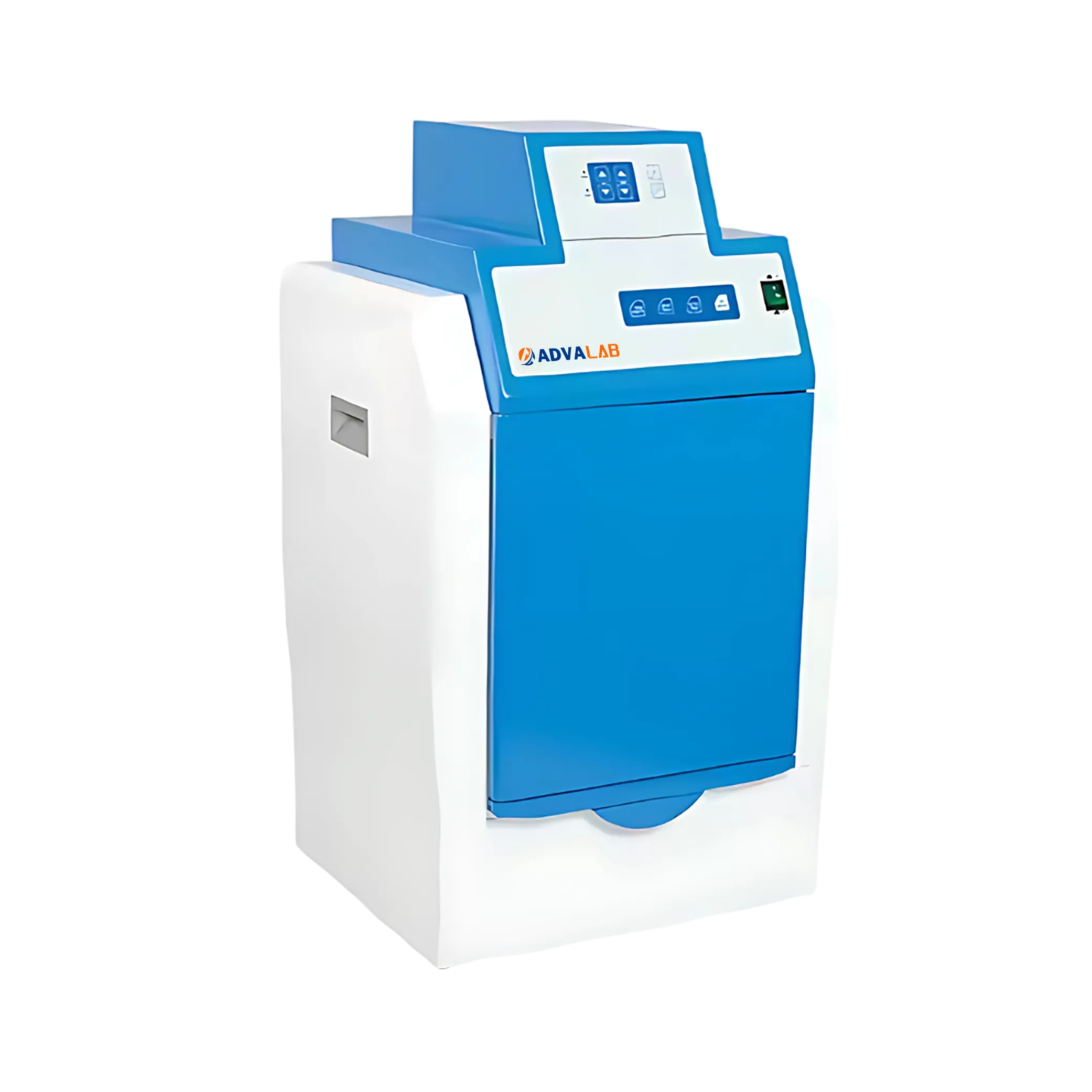
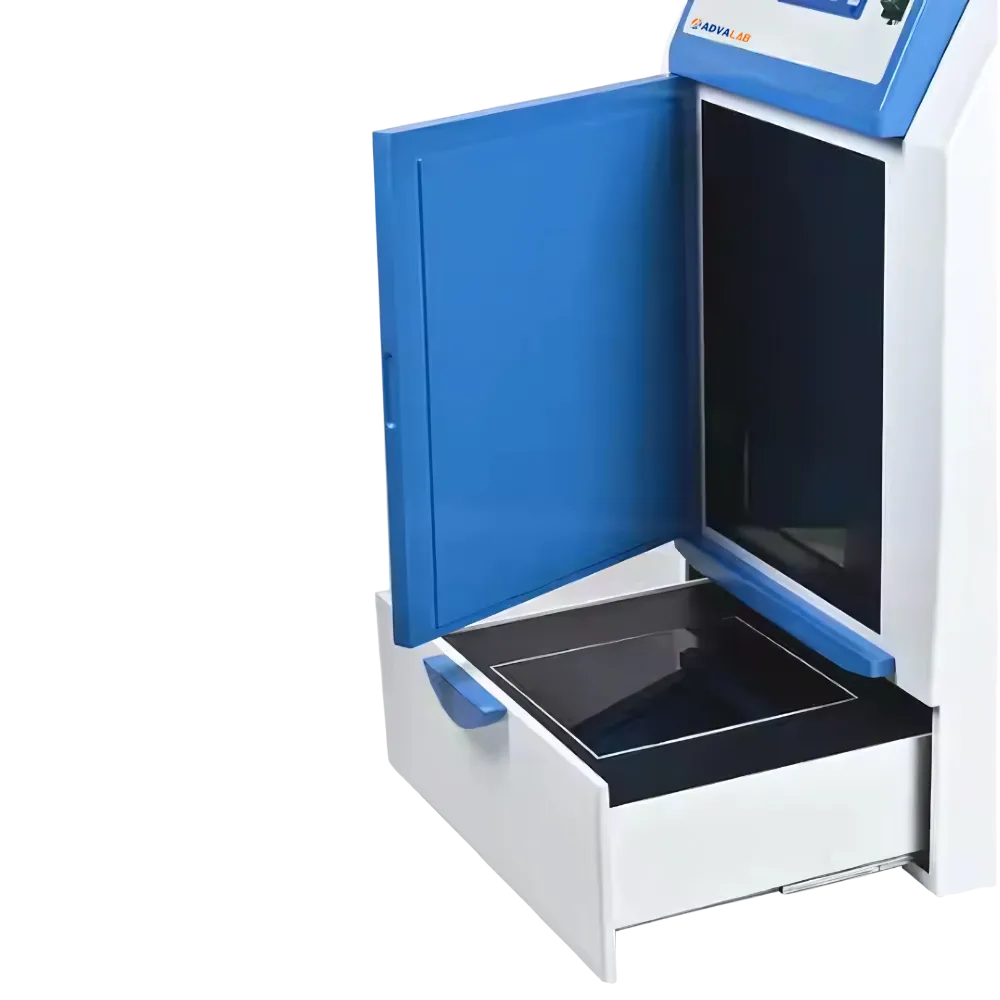
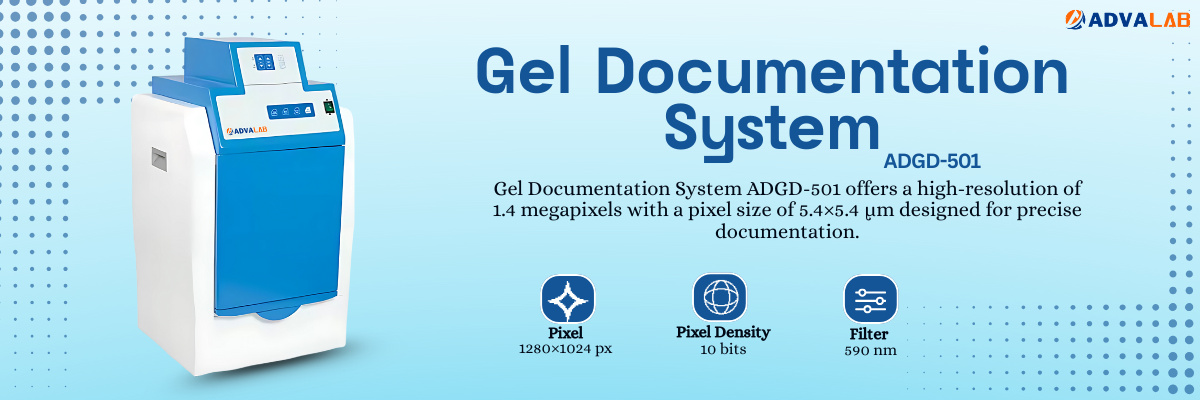
| Pixel | 1280×1024 px |
| Pixel Density | 10 bits |
| Pixel size (µm) | 5.4×5.4 µm |
| Resolution | 1.4 megapixels |
| Transmission UV wavelength (nm) | 302 nm |
| Signal to noise ratio | Greater than or equal to 56db |
| Sensitivity | DNA concentration below 20pg. |
| Camera | High-resolution digital CCD |
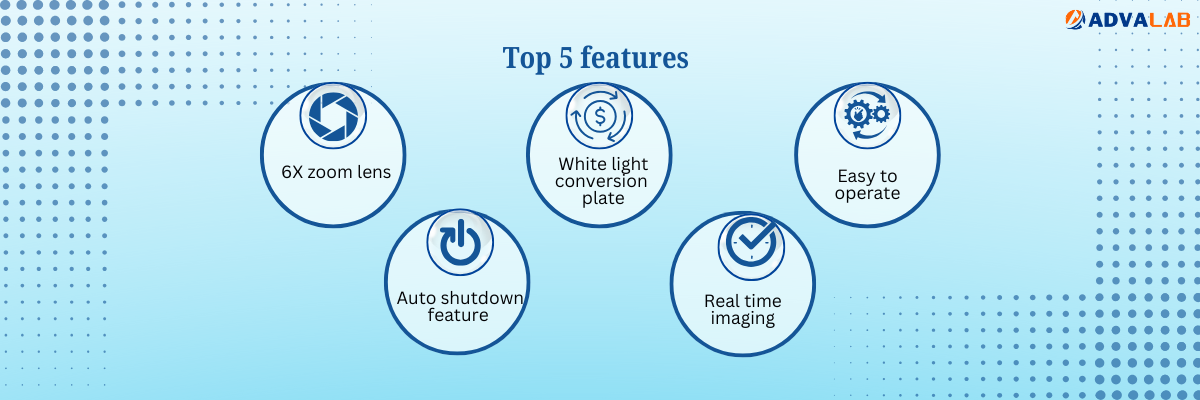
| Zoom lens | F = 1:1.2, 2/3” inch 6x zoom lens |
| Filter (nm) | 590 nm |
| UV Light transmission (W×L) | 250×200 mm |
| Visible light transmission (W×L) | 200×210 mm |
| Reflectance UV wavelength | 254, 365 nm |
| Transmission UV lamp power | 302 nm (8W) |
| Reflectance UV lamp power | 11W (For both the wavelengths) |
| Dimensions (L×W×H) | 470×405×820 mm |
| Weight (kg) | 29.0 kg |
Our Gel Documentation System is used in clear visualization of DNA and other biomolecules after electrophoresis, featuring image capture, analysis, and zooming for detailed observation. It is ideal for daily laboratory usage, making analysis of gels easier.
1. What is the Gel Documentation System ADGD-501 used for?
The Gel Documentation System ADGD-501 is used to visualize and document DNA, RNA or protein samples after gel electrophoresis. It uses UV light or blue light illumination in combination with a high-resolution CCD camera to capture fluorescent signals emitted from stained biomolecules, allowing researchers to record and analyze their experimental results effectively.
2. Which stains are compatible with the Gel Documentation System ADGD-501?
The Gel Documentation System ADGD-501 is compatible with a wide range of fluorescent dyes commonly used in molecular biology. These include ethidium bromide (EtBr), SYBR Green, SYBR Safe, GelRed, GelGreen, and Coomassie Blue (for visible light applications). This versatility makes it suitable for both nucleic acid and gel imaging. Documentation
3. Can I capture and save gel images in the Gel System ADGD-501?
Yes, the Gel Documentation System ADGD-501 allows real time image capture through the high-resolution CCD camera that it is equipped with, allowing users to capture clear and detailed images of stained gels in real time. Once the gel is placed and illuminated (typically using UV or blue light, depending on the dye), the camera transmits the image to the connected computer, where it can be viewed live on the software interface.
4. Does the Gel Documentation System ADGD-501 support multiple gel sizes?
Yes, the Gel Documentation System ADGD-501 area is designed such that it accommodates a variety of gel sizes typically used in molecular biology and biochemistry laboratories. The imaging platform are spacious enough to support mini gels to larger format gels. The camera and lens setup ensures uniform illumination and focus across the entire gel area.
5. Is any training required to operate the Gel Documentation System ADGD-501?
While the Gel Documentation System ADGD-501 is user friendly and safe, basic training or a short demonstration is recommended for first time users. This helps in ensuring proper gel placement, optimal exposure settings, and effective use of the software’s analysis tools. Lab technicians, research students, and faculty members with a basic understanding of electrophoresis can usually learn to operate the system effectively within 30-60 minutes.
6. Can the image be zoomed in for a closer inspection in the Gel Documentation System ADGD-501?
Yes, the Gel Documentation System ADGD-501 software includes a digital zoom function that allows users to enlarge specific regions of the gel image for detailed examination of the bands in the gel. This is specifically useful for analyzing faint or smeared bands or closely spaced fragments of DNA after electrophoresis.
7. What is the purpose of a Gel Documentation System in a laboratory?
A Gel Documentation System is used to capture images of electrophoresis gels after the separation of DNA, RNA, or proteins. It allows scientists to record and analyze experimental results accurately. These systems help ensure reproducibility and proper documentation of lab work. They are essential tools in molecular biology research.
8. Can a Gel Documentation System be used for both research and teaching purposes?
Yes, Gel Documentation Systems are versatile enough for use in both research and educational settings. In research labs, they support accurate analysis and publication-quality images. In academic institutions, they help students visualize molecular biology processes. Their ease of use makes them suitable for all levels of expertise.
9. What are the advantages of using an Advalab Gel Documentation System?
Advalab systems provide high-resolution imaging for accurate gel analysis. Real-time image capture and intuitive controls enhance user efficiency. The systems are built for durability, ensuring consistent performance over time. They are suitable for both routine and advanced molecular biology workflows.

| Pixel | 2560×1920 px |
| Pixel size (µm) | 5.4×5.4 µm |
| Resolution | 5.0 megapixels |