
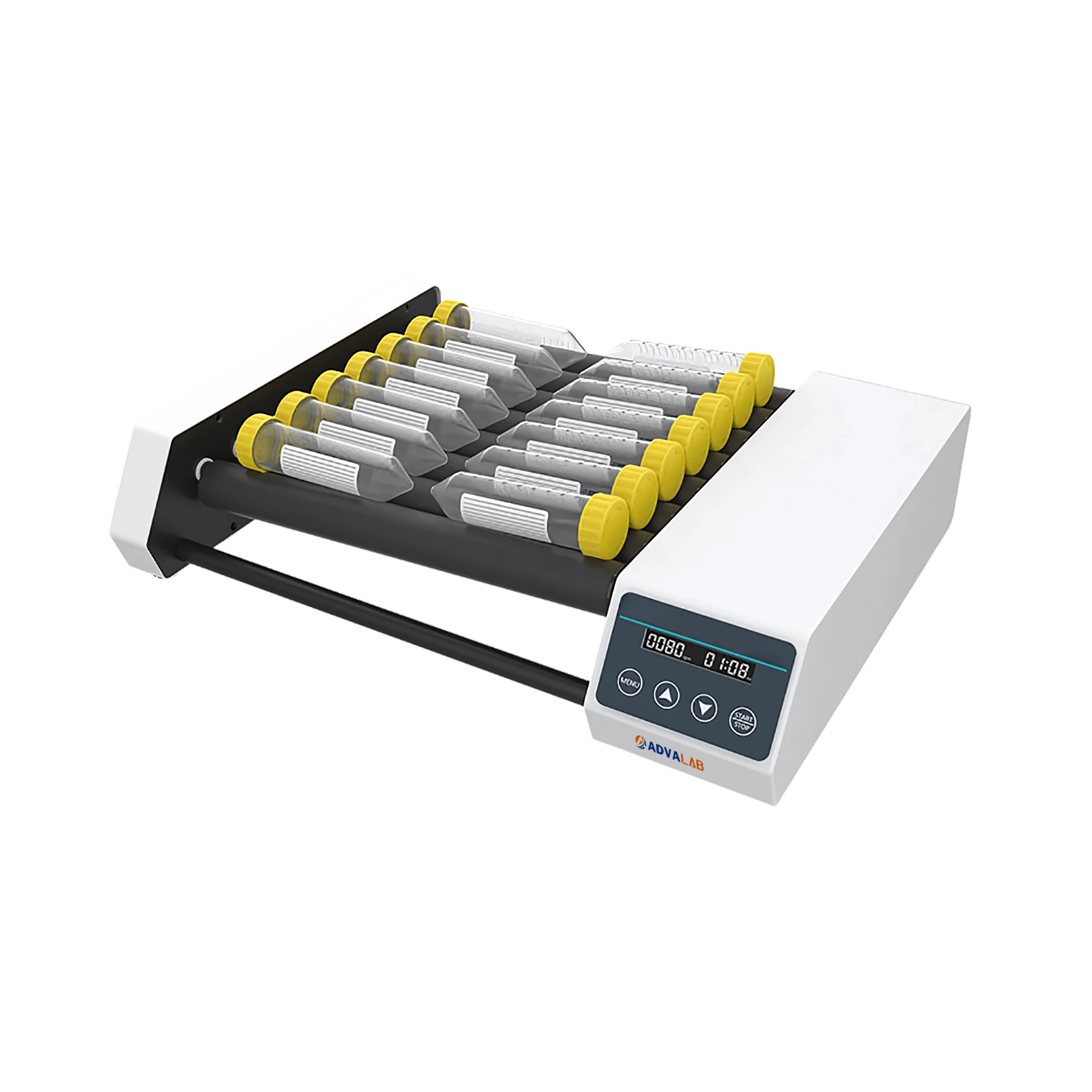
| Speed | 20 to 80 rpm |
| Display | LCD |
| Number of Rollers | 8 |
| Roller Length | 280 mm |
| Roller Centre Distance | 34 mm |
| Type | Horizontal rolling |
| Motor Type | Brushless motor |
| SPECS | φ 6to34 mm |
| Timing | 1min to 23h 59 min |
| Ambient Temperature | 5 to 40º C |
| Ambient Humidity | 80 % RH |
| Power Consumption | 25 W |
| Power Supply | AC 100 to 220 V 50/60 Hz |
| Dimensions (L×B×H) | 430×320×100 mm |
Our Roller Mixer ADRM-505 is widely used in clinical diagnostics, chemical industries, and food processing for mixing blood samples, reagents, and viscous liquids.
1. What is a roller mixer and what is it used for?
A roller mixer is a laboratory device designed to gently and efficiently mix samples contained in tubes, typically blood samples or other biological fluids. It consists of multiple rollers that rotate continuously, allowing tubes to roll and mix their contents without vigorous shaking or vortexing. This gentle mixing action is ideal for preventing cell damage or sample degradation, which can happen with more aggressive mixing methods. Roller mixers are commonly used in clinical laboratories, research labs, and diagnostic facilities for tasks such as mixing blood with anticoagulants, maintaining homogeneous suspensions, or blending reagents in a controlled manner.
2. How does a roller mixer work?
A roller mixer works by rotating several horizontal rollers that hold sample tubes. These rollers move in a uniform direction and speed, causing the tubes to rotate along their axis. This motion creates a gentle rolling action, which facilitates even mixing of the tube contents. The design minimizes splashing, foaming, or shearing of delicate biological samples. Most roller mixers allow for continuous or timed operation and some offer variable speed control, enabling customization based on sample type and volume. The smooth and consistent rolling is especially effective for substances that require prolonged or gentle mixing, such as cell cultures, blood samples, or viscous liquids.
3. What types of samples are suitable for roller mixers?
Roller mixers are ideal for mixing samples in cylindrical tubes, particularly when the contents require gentle handling. Blood samples, especially those mixed with anticoagulants like EDTA or heparin, are among the most common types of samples processed with roller mixers, as vigorous shaking could damage blood cells or lead to inaccurate test results. Additionally, roller mixers are suitable for mixing viscous fluids, suspensions, and reagents in biochemical or pharmaceutical settings. They're also used in microbiology for growing and maintaining cultures in solution.
4. What are the advantages of using a roller mixer over other mixing methods?
One of the key advantages of a roller mixer is its gentle mixing action, which preserves the integrity of delicate samples like blood cells or live cultures. Unlike vortex mixers or magnetic stirrers, roller mixers do not introduce bubbles or shear stress, which could interfere with sensitive biological processes or skew analytical results. They also allow for continuous operation, making them ideal for long-term mixing protocols. Additionally, roller mixers often have multiple rollers, enabling the simultaneous mixing of several samples, improving laboratory efficiency.
5. Can roller mixers be used for all types of tubes and containers?
While roller mixers are quite versatile, they are generally optimized for cylindrical tubes such as blood collection tubes, centrifuge tubes, and other similarly shaped containers. The rollers are designed to support these tubes securely and ensure consistent rotation. Using irregularly shaped or very large containers may result in uneven mixing or mechanical issues. However, some advanced roller mixers come with adjustable roller spacing or accessories to accommodate a wider variety of tubes and vessels. It’s important to check the device specifications and compatibility to ensure optimal performance and avoid damage to either the mixer or the samples.

| Speed Range | 20 to 99 rpm |
| Timing Range | 1 hr to 99h 59min / infinite |
| Operation Mode | Rolling and swinging |

| Speed | 20 to 80 rpm |
| Display | LCD |
| Type | Horizontal rolling |
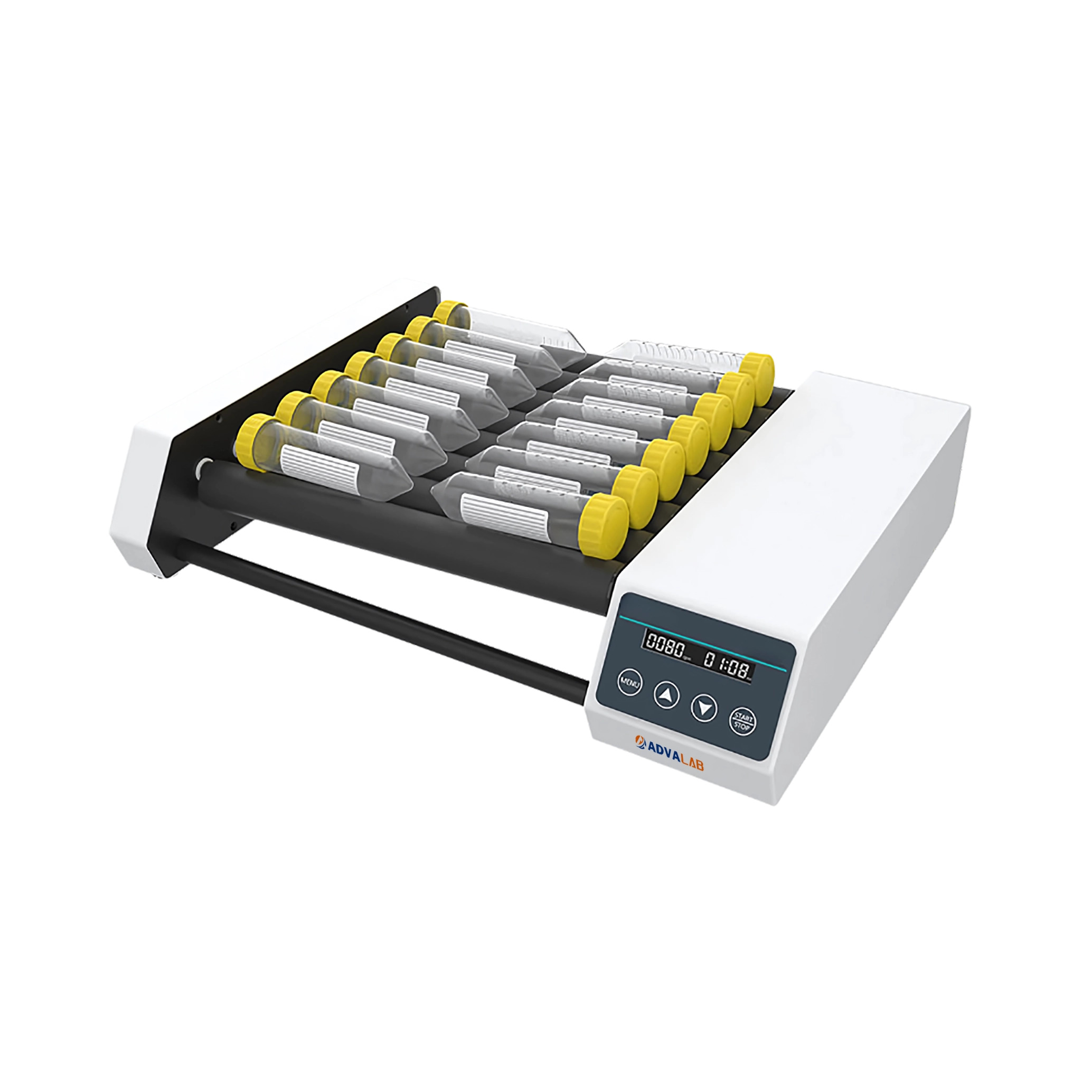
| Speed | 20 to 80 rpm |
| Number of Rollers | 8 |
| Roller Length (mm) | 280 |

| Speed | 20 to 80 rpm |
| Number of Rollers | 8 |
| Roller Length (mm) | 280 |

| Speed: | 10 rpm to 80 rpm |
| Tilt Angle Range: | 0° to 90° |
| Timer: | 1 min to 99 hr 59 min |

| Speed: | 20 to 80 rpm |
| Capacity: | Centrifuge tube: 50 ml × 8 or 15 ml × 16 or 1.5ml/2ml × 24 <br/> Blood collection tube: 10 ml × 16 or 2l/5ml × 24 |
| Control Mode: | Digital display and button |

| Shaking Speed: | 10 to 100 rpm |
| Maximum Load: | 6 kg |
| Time for Pause: | 1 to 5s |

| Speed: | 1 rpm to 99 rpm |
| Operation mode: | Circular motion |
| Timer: | 1min to 99 h 59 m |

| Speed: | 20 to 80 rpm |
| Capacity: | Centrifuge tube: 50 ml × 8 or 15 ml × 16 or 1.5ml/2ml × 24 <br/> Blood collection tube: 10 ml × 16 or 2l/5ml × 24 |
| Angle Range: | 40º to 80º |

| Speed: | 20 to 80 rpm |
| Type : | Non-stop run |
| Control Mode: | Knob |

| Speed: | 20 to 80 rpm |
| Type: | Non-stop run/timing |
| Control Mode: | Digital display and button |