

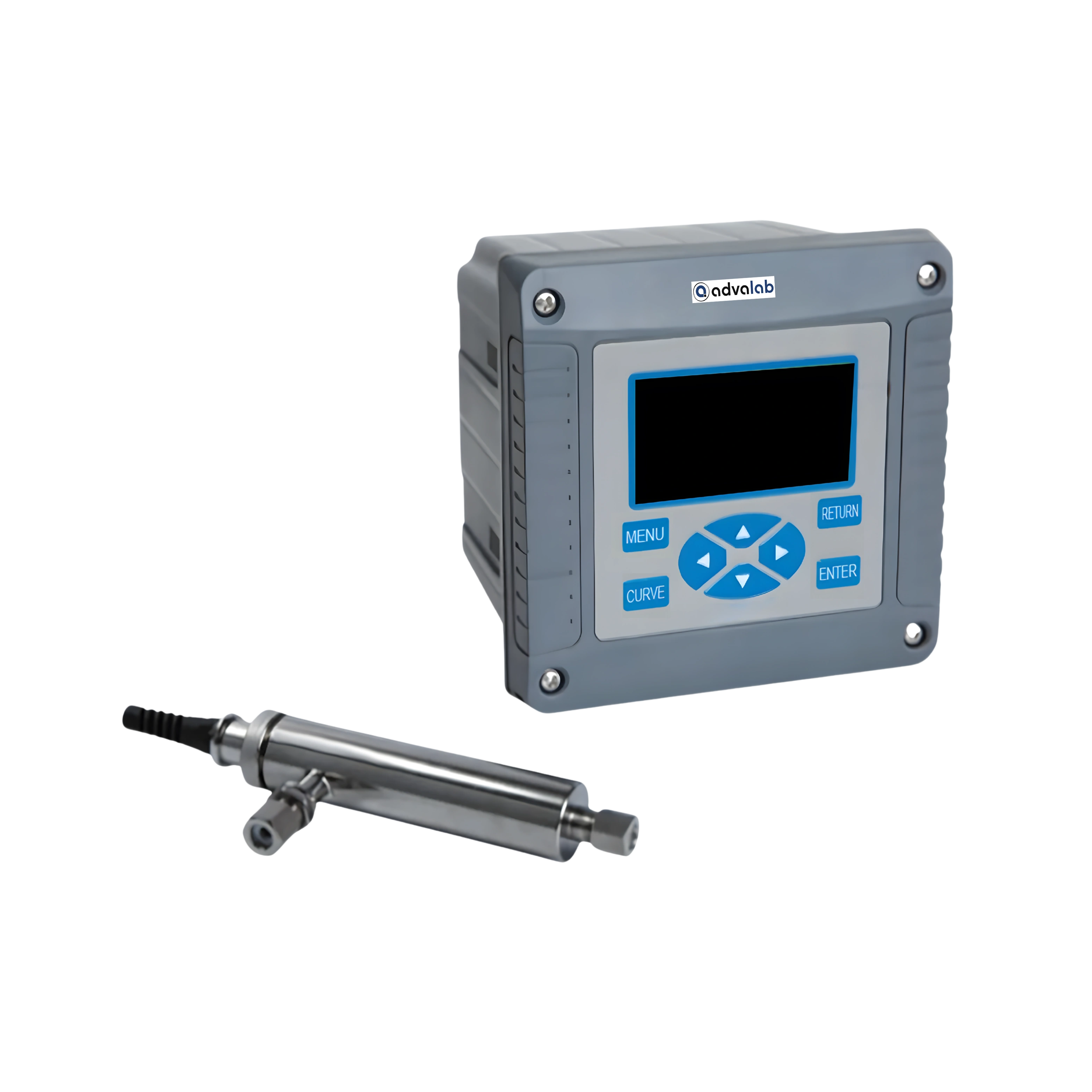
| Conductivity Measuring Range |
0.000 to 2.000 μS/cm |
| Conductivity Resolution | 0.001 μS/cm |
| Conductivity Accuracy | ±1.5% F.S. |
| Repeatability | ≤1.2% F.S. |
| TDS Measurement Range | 0.0 to 10000.0 mg/L |
| Salinity Measurement Range | 0.0 to 9999.99 ppm |
| Resistivity Measurement Range | 0.0 to 20.00 MΩ·cm |
| Temperature Sensor | Pt1000 |
| Temperature Compensation Range | 0 to 60 °C |
| Temperature Error | ±0.5 °C |
| Water Sample Temperature Range | 5 to 60 °C |
| Ambient Temperature Range | 5 to 45 °C |
| Ambient Humidity | ≤ 85% RH (non-condensing) |
| Water Sample Pressure | < 0.6 MPa |
| Storage & Transport Temperature | -25 to 55 °C |
| Display | 128 × 64 dot matrix LCD |
| Protection Class | IP65 |
| Power-Down Data Preservation | > 10 years |
| Current Output (Isolated) | (0 to 10) mA, (0 to 20) mA, (4 to 20) mA (optional), Load < 750Ω |
| Digital Signal Output | RS485 |
| Alarm Relay Output | 2 normally open points, AC 220V/3A or DC 30V/3A (user settable) |
| Dimensions (W × H × D) | 145 × 120 × 150 mm |
| Panel Cut-out (Opening Size) | 215 × 138 × 138 mm |
| Net Weight | 0.64 kg |
| Gross Weight | 1.7 kg |
Benchtop Conductivity Meter ADBCM-501 is ideal for monitoring conductivity in pharmaceutical manufacturing and food processing to ensure product quality. It also helps to maintain water purity in environmental monitoring and research laboratories.
1. What is a Benchtop Conductivity Meter and how does it work?
A Benchtop Conductivity Meter is a laboratory instrument used to measure the electrical conductivity of a liquid, which indicates the concentration of ions in a solution. It works by applying an electrical current between two electrodes submerged in the sample and measuring how easily the current flows. The higher the ion concentration, the higher the conductivity reading. This meter is more accurate and feature-rich than handheld versions, making them ideal for lab use
2. How do I calibrate a Benchtop Conductivity Meter?
Calibration involves using standard conductivity solutions of known values to ensure the meter provides accurate readings. The process typically starts by cleaning the probe, immersing it in the calibration solution, and adjusting the meter to match the known value. Most modern meters guide the user through a step-by-step calibration process using a digital interface. Regular calibration is essential, especially before important measurements.
3. What types of solutions can I test with a Benchtop Conductivity Meter?
Benchtop Conductivity Meter can be used to measure a wide variety of aqueous solutions including pure water, saline, acids, bases, and industrial effluents. It is commonly used in laboratories, water treatment plants, agriculture, food processing, and chemical industries. It supports very high or very low conductivity ranges, suitable for ultrapure water or concentrated brine solutions.
4. Can a Benchtop Conductivity Meter measure TDS (Total Dissolved Solids)?
Yes, many Benchtop Conductivity Meter can calculate TDS by converting conductivity readings using a user-defined factor. This factor typically ranges from 0.4 to 1.0 and depends on the specific ions in the solution. While this method provides an estimate, it’s not as precise as direct gravimetric measurement. For consistent samples, however, conductivity-based TDS estimation is widely used and reliable.
5. What is the difference between a Benchtop and Handheld Conductivity Meter?
Benchtop Conductivity Meter is designed for high-precision measurements in laboratory settings and often include advanced features like multi-point calibration, data logging, and temperature compensation. It typically offers better stability and accuracy compared to handheld meters. Handheld meter is portable, battery-operated, and ideal for fieldwork or quick spot-checks