
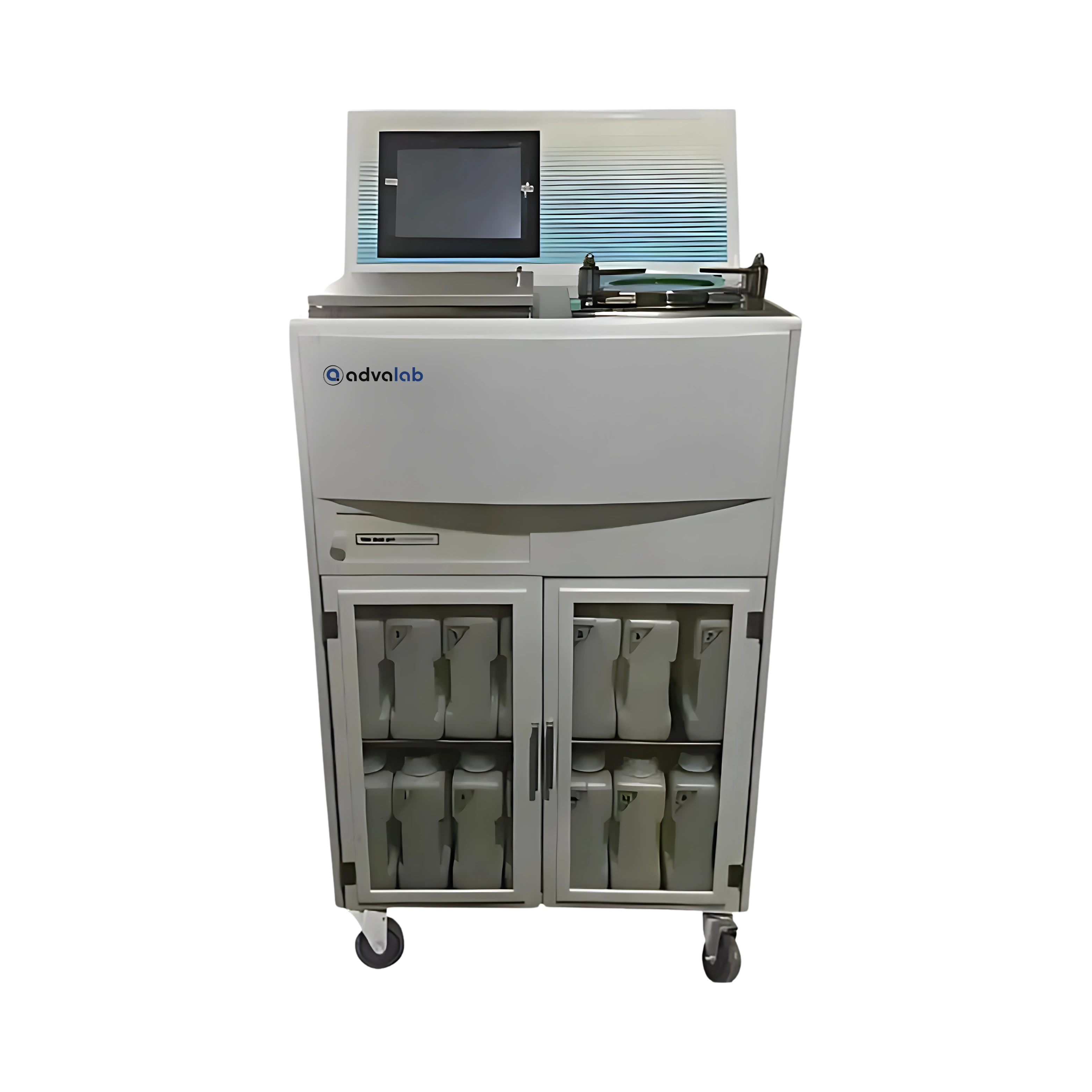
| Capacity | 300 (cassettes) |
| Number of Reagent Steps | 9 reagent steps |
| Number of Paraffin Wax Steps | 3 steps |
| Number of Programs | 10 programs |
| Time per Program Step | 0 to 99 hours, 59 minutes |
| Number of Baths | 3 |
| Volume per Bath | 4 liters |
| Temperature Accuracy | + 3°C |
| Paraffin Wax Temperature | 65°C |
| Melt Time | 3 hours |
| Operating Temperature Range | 15°C to 35°C |
| Relative Humidity | 10% to 80%, non-condensing |
| Time Between Cycles | 20 minutes |
| Main Fuses | 10 A |
| Number of Reagent Bottles | 10 |
| Cleaning Solution Bottles | 2 |
| Reagent Volume | 5.3 liters (per bottle) |
| Display | Large color Liquid Crystal Display (LCD) |
| Specimen Protection System | Multiple specimen protection system |
| Packaging Method | Wooden case |
| Filling Time | 5 minutes |
| Drain Time | 5 minutes |
| Impregnation Pressure | 35 kPa (g) |
| Drain Pressure | 35 kPa (g) |
| Recirculation | ON or OFF |
| Power Consumption | 1000 W |
| Power Supply | AC 220 V 60 Hz |
| Exterior Dimensions | 800 × 740 × 1460 mm |
| Gross Weight | 172 kg |
The Automatic Tissue Processor ADAT-506 is designed for clinical and research histopathology laboratories to automate tissue processing, improve specimen quality, and optimize workflow efficiency.
Tissue Basket | 1 pc |
Reagent Bottle | 17 pcs |
Fuse (10 A) | 2 pcs |
Power Line | 1 line |
1. What is the sample capacity of the Automatic Tissue Processor ADAT-506?
Automatic Tissue Processor ADAT-506 is capable of processing up to 300 tissue cassettes simultaneously. This large capacity suits laboratories with heavy workloads, enabling efficient batch processing. Handling multiple specimens in one cycle saves valuable time and boosts overall productivity. The system ensures uniform processing quality for every sample.
2. How many reagent steps does the Automatic Tissue Processor ADAT-506 support?
This Automatic Tissue Processor ADAT-506 features 9 customizable reagent cycles that can be tailored to different tissue types and protocols. Such flexibility allows optimal fixation, dehydration, and clearing of samples. By adjusting these steps, the unit ensures that tissue preservation is maximized for downstream analysis. It effectively adapts to varying laboratory requirements and sample characteristics.
3. Is paraffin embedding supported by the Automatic Tissue Processor ADAT-506?
Yes, it includes 3 dedicated paraffin wax steps for comprehensive infiltration of tissue samples. Precise control over paraffin temperature and timing helps prevent damage during embedding. This thorough process is critical for producing high-quality tissue sections for microscopy. These paraffin steps are seamlessly integrated into the automated workflow.
4. What kind of user interface does the Automatic Tissue Processor ADAT-506 offer?
The system is equipped with a large, vibrant LCD touchscreen for easy access and control. Its user-friendly design simplifies the creation and adjustment of processing programs. Operators can quickly navigate menus and monitor cycle status in real time. Built-in alerts help prevent errors and maintain smooth operation. This intuitive interface shortens the learning curve and reduces operator mistakes.
5. In what ways does the Automatic Tissue Processor ADAT-506 optimize laboratory workflow?
Automatic Tissue Processor ADAT-506 minimizes manual intervention and reduces the chance of human error. It frees lab personnel to focus on other important activities while samples are processed. The unit consistently delivers reproducible results across batches. Its ability to handle multiple samples at once significantly cuts down processing time. Overall, it enhances laboratory efficiency and throughput.
6. What are Automatic Tissue Processors?
Automatic Tissue Processors automate the preparation of tissue samples through chemical treatments and embedding. They handle dehydration, clearing, and paraffin infiltration efficiently. These instruments ensure consistent and reliable specimen processing. This automation improves overall workflow in the laboratory.
7. Where are Automatic Tissue Processors used?
Automatic Tissue Processors are found in histopathology labs, research centers, and diagnostic facilities. They process tissue specimens for detailed microscopic examination. Their use supports accurate diagnosis and medical research. These processors are essential tools in pathology workflows.

| Capacity | 2200 mL |
| Number of Tanks | 12 tanks (including 3 paraffin wax tanks at the end) |
| Temperature Setting | 0 to 99 °C |

| Capacity | 1500 mL |
| Number of Tanks | 12 tanks (including 3 paraffin wax tanks at the end) |
| Basket Capacity | 75 specimens |

| Capacity | 200 (cassettes) |
| Number of Reagent Steps | 9 reagent steps |
| Number of Paraffin Wax Steps | 3 steps |

| Capacity | 1000 mL |
| Number of Tanks | 12 tanks (including 3 paraffin wax tanks at the end) |
| Basket Capacity | 60 specimens |

| Glass Containers: | 9 units <br> capacity 2.3 L each |
| Wax Cups : | 3 units <br> capacity 1.8 L each |
| Temperature Control Range : | 60 to 99 °C |

| Glass Containers: | 9 units <br> capacity 1.2 L each |
| Wax Cups : | 3 units <br> capacity 1 L each |
| Temperature Control Range : | 60 to 99 °C |

| Capacity: | 2 L |
| Number of Reagent Containers : | 144 |
| Processing Time : | 0 to 99 hours per container |