
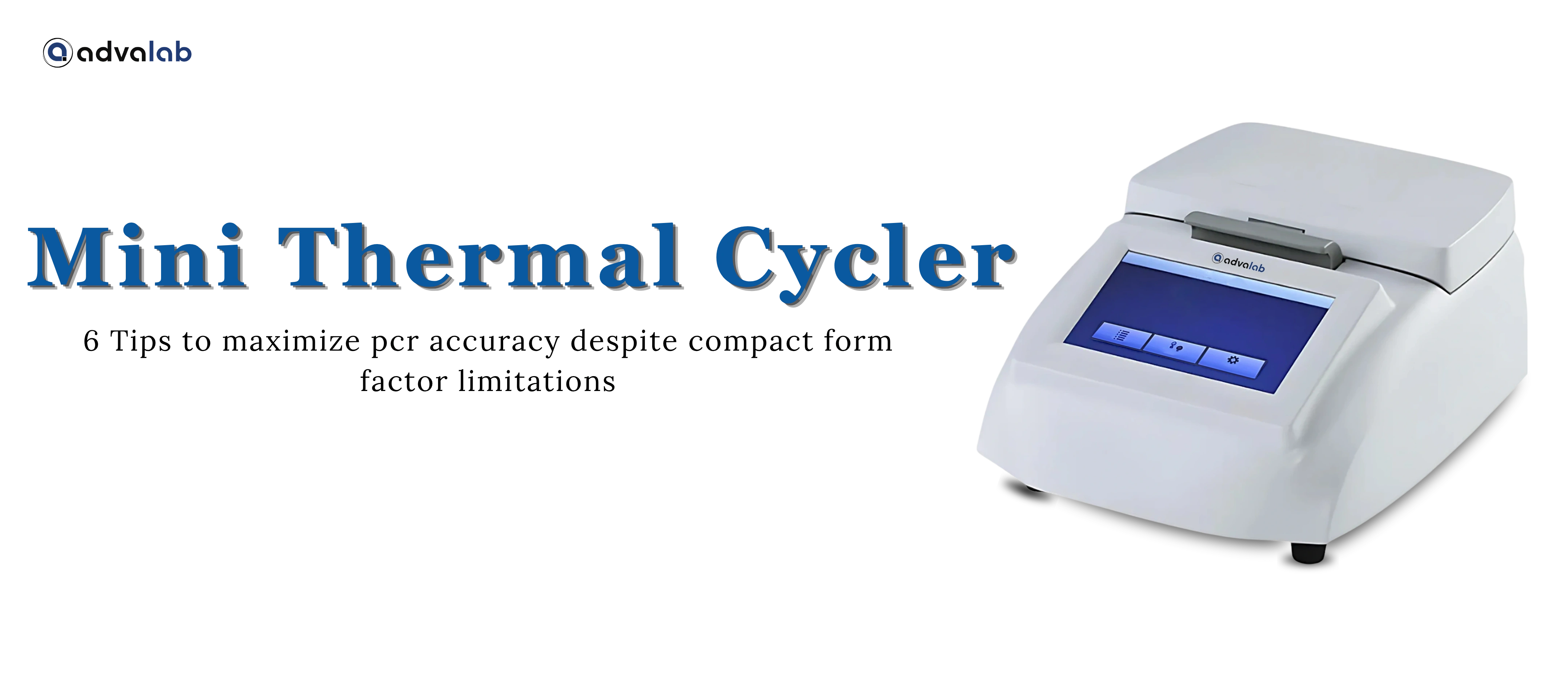
Polymerase chain reaction remains one of the most consequential amplification techniques in molecular biology, underpinning applications across genomics, clinical diagnostics, pharmaceutical research, biotechnology, and forensic analysis. A Mini Thermal Cycler extends PCR capability to settings where bench space, budget allocation, or throughput requirements favour a compact instrument over a full-capacity system.
The Advalab range of compact PCR instruments addresses the growing demand for space-efficient molecular amplification across educational laboratories, small research facilities, mobile testing environments, and low-throughput clinical workflows. However, the physical constraints of a compact form factor — smaller aluminum thermal blocks, reduced thermal mass, and simplified lid designs — create specific operational challenges that do not arise to the same degree in larger benchtop systems.
This article outlines six practical, technically grounded tips that laboratory operators can apply to maximize PCR accuracy when working with compact thermocycler systems. Each tip addresses a distinct aspect of the amplification workflow, from consumable selection through environmental control to calibration verification.
The Thermal Cycler meaning in molecular biology refers to a laboratory instrument that automates the sequential temperature transitions required for PCR amplification: high-temperature denaturation of double-stranded DNA, lower-temperature primer annealing, and intermediate-temperature polymerase extension. A mini pcr thermal cycler applies these same thermal cycling principles within a reduced physical footprint, typically supporting between 16 and 48 reaction wells rather than the 96-well capacity of standard benchtop systems.
Understanding the Thermal Cycler labelled diagram helps operators appreciate how each component contributes to amplification accuracy. The core architecture of a compact PCR system consists of:
The Peltier element drives both heating and cooling; the microprocessor modulates current direction and magnitude to achieve the programmed temperature transitions at the specified ramp rates.
The Peltier thermoelectric module is central to the thermal cycler function in compact instruments. Unlike resistive heating elements that can only add heat, a Peltier device switches current direction to alternate between heating and active cooling — enabling the rapid temperature transitions that characterize PCR. In compact systems, the reduced mass of the aluminum block allows faster ramp rates but also makes the system more susceptible to ambient temperature influence and block-to-block temperature non-uniformity when the instrument ages.
The Advalab ADMTC-501 supports 32 × 0.2 mL reaction tubes, operates across a temperature control range of 4 °C to 100 °C, and achieves a heating rate of 4 °C/s and a cooling rate of 2 °C/s. These parameters define both the throughput capability and the precision requirements that the following tips are designed to maintain.
The sealed thermal cycling chamber confines reaction tubes within a precisely controlled thermal environment. Chamber insulation quality affects temperature uniformity across the block surface.
USB connectivity enables protocol upload, firmware updates, and run data export. The ADMTC-501 stores up to 1000 PCR programs for workflow standardization across multiple users.
The Thermal Cycler function in laboratory settings depends on the instrument maintaining programmed temperatures within a defined tolerance throughout each phase of the PCR cycle. In a full-capacity 96-well system, the large aluminum block provides substantial thermal mass that buffers against ambient fluctuations and loading disturbances. A compact thermal block — serving 32 or fewer wells — has proportionally less thermal mass, making the temperature at each well position more sensitive to:
The consequences of temperature inaccuracy in PCR are well-documented. Annealing temperature errors of even 1–2 °C alter primer binding specificity — too high and primers fail to annex the template; too low and non-specific binding produces spurious amplicons. Extension temperature deviations affect DNA polymerase processivity, reducing yield or producing truncated products. Denaturation failures at insufficient temperatures leave double-stranded regions that block polymerase progression.
94–98 °C — separates double-stranded DNA into single strands. Incomplete denaturation blocks polymerase progression
50–65 °C — primers bind to target sequence. ±2 °C deviation alters specificity and introduces non-specific products
68–72 °C — polymerase synthesizes new strand. Rate and fidelity depend on accurate temperature maintenance
Consumable quality is a frequently underestimated variable in compact PCR accuracy. The thermal interface between the reaction tube wall and the aluminum block surface determines how rapidly and uniformly the sample reaches the programmed temperature at each cycle phase.
Thin-wall PCR tubes are manufactured specifically to minimize the thermal resistance at this interface. Thick-wall or general-purpose microcentrifuge tubes can introduce a temperature lag of 1–3 °C between the block surface and the sample, effectively shifting the true annealing and extension temperatures experienced by the reaction mixture away from the programmed set point. In a compact system where the block temperature is already more sensitive to external variables, this additional offset compounds the inaccuracy.
Eight-tube strip formats, compatible with the ADMTC-501 thermal block layout, provide consistent tube-to-block contact across all well positions simultaneously. Single tubes inserted into partially populated blocks may experience different thermal behaviour at edge versus central positions due to the reduced lateral heat conduction from neighbouring occupied wells.
Sample evaporation during PCR cycling concentrates the reaction mixture, altering reagent stoichiometry and increasing salt concentrations in a manner that inhibits DNA polymerase and reduces amplification yield. In compact systems with smaller reaction volumes — commonly 10–25 µL — even minor evaporation represents a proportionally larger compositional change than in 50 µL reactions.
The heated lid is the primary engineering control against evaporation in modern PCR instruments. By maintaining the lid surface above the reaction temperature — typically 10–15 °C above the highest cycling temperature — the heated lid prevents condensation on the tube cap inner surface. Without this temperature differential, water vapour generated during high-temperature denaturation condenses on the cooler cap surface, progressively depleting the reaction volume.
The Advalab ADMTC-501 features an adjustable heated lid with a temperature range from RT+5 °C to 110 °C. Setting the lid temperature to at least 5 °C above the denaturation temperature (typically 99–105 °C for protocols with 94–98 °C denaturation) ensures that no temperature gradient exists between the reaction vapour and the cap surface during the hottest phase of the cycle.
When the heated lid temperature exceeds the reaction temperature, vapour cannot condense on the cap surface — sample volume remains stable across all cycles.
Compact PCR systems commonly use reaction volumes between 10 and 25 µL. At these scales, pipetting errors that would be negligible in 50 µL reactions become significant. A 0.5 µL pipetting error in a 10 µL reaction represents a 5% volumetric deviation — sufficient to alter primer-to-template ratios, polymerase concentration, and buffer ionic strength in ways that measurably affect amplification outcome.
Master mix preparation distributes any pipetting error uniformly across all reactions in a batch, rather than allowing it to compound independently in each tube. Preparing a single master mix containing all common reagents — buffer, dNTPs, polymerase, primers — and then aliquoting it into individual tubes reduces inter-tube variability substantially. Template DNA is added last to each individual tube to maintain the master mix as a stable, uncontaminated reagent stock.
A pcr thermal cycler controls temperature within its thermal block, but it cannot compensate for extreme ambient conditions that exceed the design envelope of the Peltier cooling system. Compact instruments are particularly susceptible because their smaller chassis provides less thermal buffering against the surrounding environment.
The Peltier module cools the block by transferring heat from the cold side (the block) to the hot side (the heat sink and fan exhaust). If the ambient temperature is elevated — due to proximity to other heat-generating equipment, restricted ventilation, or high room temperature — the Peltier must work against a reduced temperature differential, reducing its effective cooling capacity. This can manifest as slower cooling ramp rates, higher minimum achievable temperatures, and increased overshoot at the annealing step.
Temperature accuracy is the foundational performance parameter of any PCR instrument. The Peltier module efficiency, the PT100 or thermistor feedback sensor, and the PID control algorithm collectively determine how closely the block temperature matches the programmed set point at each phase of the cycling protocol. All three components experience performance drift over time.
The Advalab ADMTC-501 specifies temperature accuracy of ≤±0.25 °C and temperature uniformity of ≤±0.25 °C across the block surface. These figures represent the out-of-box performance under calibrated conditions. Without periodic verification, calibration drift — typically arising from Peltier aging, sensor oxidation, or block contamination — can silently shift actual well temperatures by 1–3 °C from the programmed values, producing subtle but cumulative effects on amplification specificity and yield.
Operator-to-operator variability is a significant but often unquantified source of PCR inconsistency in shared laboratory instruments. When different users load tubes differently, set lid temperatures differently, or apply different heated lid closing pressures, the resulting amplification outcomes differ in ways that cannot be attributed to biological variability or reagent lot changes — making troubleshooting substantially more difficult.
A documented standard operating procedure (SOP) for the compact PCR instrument eliminates ambiguity from each step of the amplification workflow. The SOP should specify not only the cycling parameters but the pre-run checklist, consumable specifications, reagent preparation protocol, and post-run procedures including data export and instrument cleaning. The ADMTC-501 supports storage of up to 1000 PCR programs, enabling SOPs to be embedded directly into the instrument as saved protocols accessible to all users.
The Thermal Cycler uses in a compact format extend across a broader set of deployment scenarios than full-capacity benchtop systems, precisely because of the attributes — small footprint, low power draw, and reduced weight — that also create the accuracy challenges addressed in the tips above. Understanding where compact PCR systems are most appropriately deployed helps laboratories match the instrument specification to the application requirement.
In field-based pathogen detection — such as plant disease surveillance, veterinary diagnostics, or outbreak investigation — a compact PCR system provides amplification capability at the point of sample collection, reducing the delay and sample integrity risks associated with transporting specimens to a central laboratory. In educational settings, the reduced well count of a compact system matches the throughput requirements of classroom-scale experiments without the operational complexity of a 96-well automated thermal cycler.
For laboratory personnel new to compact PCR systems, a structured approach to instrument operation reduces the probability of protocol errors. The following workflow applies to standard end-point PCR using the Advalab ADMTC-501 and is consistent with the guidance in the mini thermal cycler instrument manual.
Inspect the thermal block for debris, verify that the heated lid moves freely, and confirm that the instrument is within its specified ambient operating range. Power on and allow the system to complete its self-test sequence before loading.
Prepare master mix on ice, including all components except template. Aliquot master mix into tubes, add template individually to each tube, cap securely, and centrifuge briefly to consolidate the reaction at the tube bottom.
Place tubes into the thermal block wells, ensuring full seating. Set the heated lid temperature to at least 5 °C above the denaturation temperature. Close and latch the lid with uniform pressure across the contact surface.
Select or recall the relevant protocol from instrument memory. Verify denaturation, annealing, and extension temperatures, hold times, ramp rates, and cycle number. Confirm that the initial denaturation and final extension steps are included.
Start the cycling protocol. Monitor the display to confirm that the instrument is advancing through the programmed steps. Note any anomalous temperature readings or error messages during the run and document them in the run record.
After cycling completes (with samples held at 4 °C), retrieve tubes and proceed immediately to product analysis or store at −20 °C. Export run data via USB if the instrument is configured for data logging. Clean the block surface with a lint-free laboratory wipe.
The table below summarises the principal technical parameters for the Advalab mini thermal cycler ADMTC-501, with applicable compliance standards indicated for each parameter category.
| Parameter | Specification |
|---|---|
| Sample capacity | 32 × 0.2 mL tubes / 8-tube strips |
| Temperature control range | 4 °C to 100 °C |
| Temperature accuracy | ≤ ±0.25 °C |
| Temperature uniformity | ≤ ±0.25 °C (across block) |
| Heating rate | 4 °C/s (maximum) |
| Cooling rate | 2 °C/s (maximum) |
| Heated lid range | RT+5 °C to 110 °C (adjustable) |
| Program storage | Up to 1000 PCR programs |
| Display | Touchscreen interface |
| Connectivity | USB (data export, firmware update) |
| Power supply | 100–240 V AC, 50/60 Hz |
The Advalab Mini Thermal Cycler ADMTC-501 is classified within the Molecular Biology Instruments product category on the Advalab home page. Navigating through the category hierarchy provides access to the full specification comparison, model documentation, and accessory compatibility data for the ADMTC series.
Covers all nucleic acid amplification, gel electrophoresis, nucleic acid quantification, and related molecular workflow instruments in the Advalab portfolio.
Includes standard 96-well thermocyclers, gradient PCR systems, real-time PCR instruments, and mini thermal cycler configurations.
32-well compact PCR system with adjustable heated lid, touchscreen interface, and USB data connectivity. View the product page for full accessory and kit options.
View full specifications, model comparisons, and accessory configurations for the ADMTC-501 and the broader Advalab compact PCR instrument range.
Contact Us