
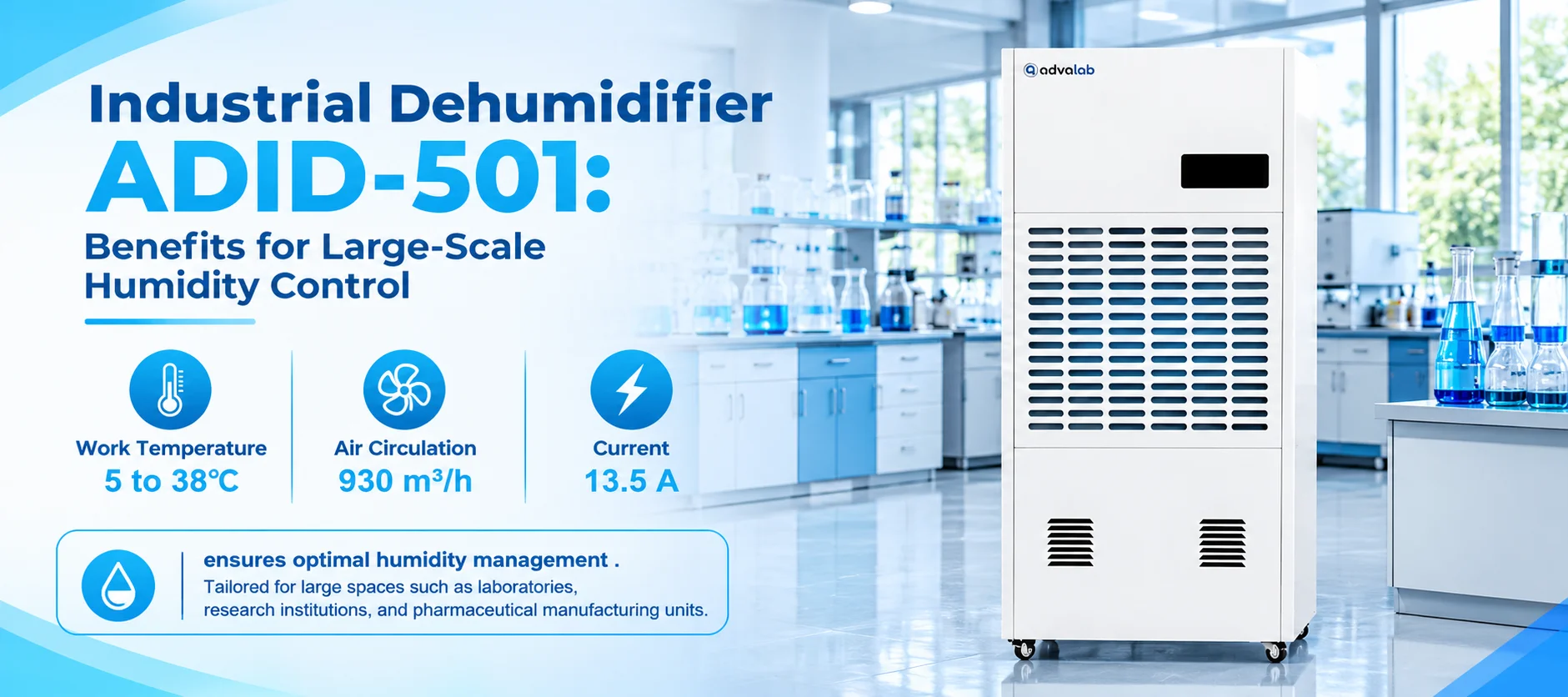
An Industrial Dehumidifier is a high-capacity machine that draws moist air through the unit, removes water vapor, and returns drier air to a large space. Unlike a household model, an industrial dehumidifier machine is rated in liters per day, moves hundreds of cubic meters of air each hour, and is made for long running periods.
The dehumidifier industry groups these machines by capacity, working temperature range, and airflow. That grouping explains why one room can suit a single model while another needs a larger unit or more than one.
Water vapor travels wherever air travels. It enters through rain-soaked walls, below-grade floors, open dock doors, and process areas, then settles on surfaces cooler than the surrounding air or soaks directly into materials that absorb moisture. Industrial dehumidification lowers the vapor content of the air itself, so damage is prevented at the source instead of repaired afterward.
The working principle rests on one physical fact: cooler air holds less water vapor. In a refrigerant-based unit, the cycle runs in five stages, shown below.
A fan draws room air into the unit.
A cold coil drops the air below its dew point.
Vapor turns to liquid and leaves through a drain.
A warm coil lifts the drier air back up in temperature.
Drier air re-enters the room and the cycle repeats.
A desiccant unit follows a different route. It passes air through a moisture-absorbing material that is then dried with heat, which suits very low temperatures and very low humidity targets. The desiccant dehumidifier range lists units rated from -20 °C to 50 °C for that purpose.
The ADID-501 listing does not name its technology, but a liters-per-day rating with a 5 to 38 °C working range is typical of refrigerant-based units, so confirm the technology with the supplier when the application is temperature-sensitive. The unit uses a centrifugal turbo fan rated at 930 m³/h, and that rating sets how often the room air passes through the machine.
The table lists the published values on the ADID-501 product page and explains how each one affects selection.
| Parameter | ADID-501 listing | Why it matters |
|---|---|---|
| Dehumidifying capacity | 192 L/D | Daily water removal; the main sizing figure |
| Working temperature | 5 to 38 °C | Sets the range where the unit can run without frosting or overheating |
| Air circulation | 930 m³/h | Controls how often room air is treated |
| Power consumption | 3200 W at 13.5 A | Informs circuit and supply planning |
| Fan | Centrifugal turbo fan | Moves air steadily with lower noise |
| Control | Touchscreen with real-time humidity and temperature monitoring | Allows setpoint changes and live checks |
| Dimensions (L × W × H) | 615 × 470 × 1500 mm | Determines floor space and door clearance |
| Weight | 88 kg | Affects handling and floor loading |
Capacity ratings change with test conditions. Some models in the same range state their rating at 30 °C and 80% relative humidity, while the ADID-501 listing gives 192 L/D without conditions. Ask for the test conditions before comparing capacity figures across models or brands.
The ADID-501 listing names basements, warehouses, high-rise office spaces, laboratories, research institutions, and pharmaceutical manufacturing units. Each setting changes how the unit should be placed and run.
An industrial dehumidifier for warehouse use works against a large open volume and frequent door openings. Place it centrally, keep dock doors closed while it runs, and leave aisles between pallets so air can circulate.
Moisture in below-grade rooms is continuous, so an industrial dehumidifier for basement areas runs for long periods. A fixed drainage path matters, and winter temperatures should stay above the listed 5 °C minimum.
Balances, optical instruments, and hygroscopic reagents respond to humidity swings more than to a single high reading. Aim for a stable band, and keep storage rooms separate from open work areas where possible.
Moisture-sensitive materials carry humidity limits set by the product and the facility procedures. Confirm those limits first, then check that the unit can hold them.
A dehumidifier for industry also serves equipment rooms, archives, and stockrooms, where condensation threatens electronics and structures long before it becomes visible.
Correct placement and setup decide whether an industrial dehumidifier reaches its rated performance. A typical routine follows these steps.
The listing does not publish an operating procedure, so the supplier manual remains the source for warm-up, drainage, and maintenance details. Operation below 5 °C or above 38 °C falls outside the listed working range.
Selection starts with the space and the humidity target, not the catalog. Units differ by technology and capacity across the full dehumidifier range, so shortlist two or three options and then compare ratings on equal test conditions.
| Requirement | Consider |
|---|---|
| Large basement or warehouse | High liters-per-day capacity and airflow suited to the room volume |
| Humidity-sensitive laboratory or storage room | Touchscreen control with live humidity and temperature display |
| Temperature near or below 5 °C | A desiccant unit rather than a refrigerant-based unit |
| Limited floor space | Footprint and weight of the cabinet |
| Unattended running | A confirmed drainage method |
Values divide the listed airflow by room volume. They show how often the air reaches the unit, not how much moisture is removed; the moisture load of the space still has to be matched to the capacity rating.
The industrial range lists five models with the same 5 to 38 °C working temperature. Capacity and airflow follow different paths: the ADID-503 lists 2300 m³/h of airflow at 240 L/D, while the ADID-504 lists 1350 m³/h at 300 L/D. Airflow suits wide, open halls, and capacity suits spaces with a heavier moisture load.
The ADID-501 sits within a category that spans three ranges: industrial dehumidifiers, commercial dehumidifiers, and desiccant dehumidifiers. Industrial and commercial units are rated in liters per day, with the commercial range listing 58 to 168 L/day. Desiccant units are rated in kilograms per hour at 20 °C and 60% relative humidity and work from -20 °C to 50 °C.
When evaluating options in this category, teams usually compare capacity, airflow, working temperature range, control type, drainage method, power draw, and footprint. The full set of models is listed on the dehumidifiers category page, and further laboratory equipment is available on the Advalab
An industrial dehumidifier earns its place when moisture damages stock, equipment, or structures faster than spot measures can repair them. The ADID-501 pairs 192 L/D capacity, 930 m³/h airflow, and touchscreen humidity and temperature control for basements, warehouses, laboratories, and similar large spaces. Matching capacity, airflow, and test conditions to the room turns a specification list into a sound selection.
Hazel Daniels
Specialty: Healthcare Technology & Laboratory Equipment
Writing Style: Professional, informative, and reader-friendly
Bio: Hazel Daniels specializes in writing about healthcare technology, laboratory equipment, and scientific applications. She presents technical information in simple language, highlighting practical uses and industry developments.
www.linkedin.com/in/hazel-daniels-4a108b444