
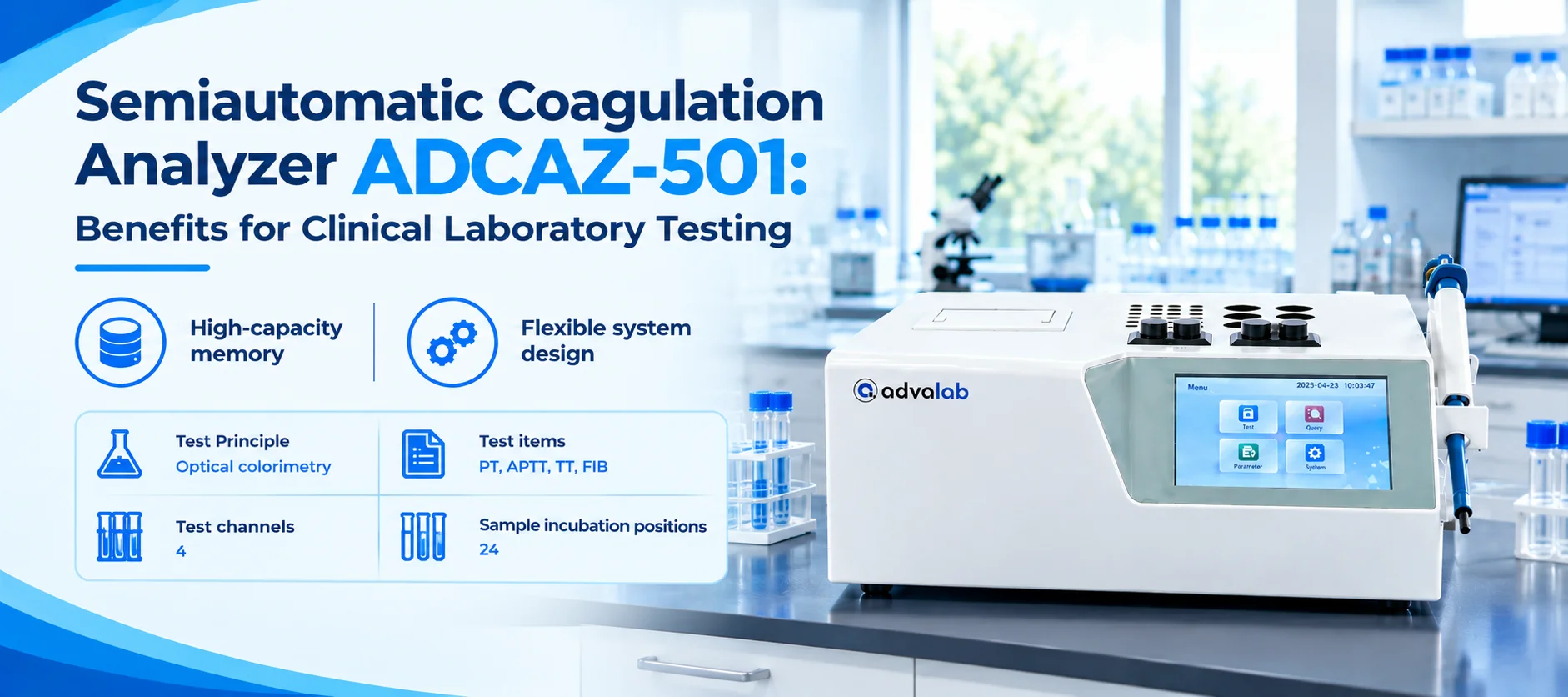
Consistent clot times start with an instrument that watches the sample instead of the clock. This article explains how a semi-automatic coagulation analyzer works and what to check before choosing one.
A patient on anticoagulant therapy may need urgent coagulation testing before the morning ward round. Manual tilt-tube timing rely on the technician's eye, repeat runs waste reagent, and sending plasma to a central laboratory can delay results by hours. Small and mid-sized laboratories face the same trade-off: a fully automated analyzer may exceed their daily testing volume, while manual methods can lack consistency.
A semi automated coagulometer closes that gap by timing clot formation optically while the technician controls sample and reagent handling. The listing for the ADCAZ-501 publishes its test items, channels, volumes, temperature, memory and interfaces, so a team can judge the fit before ordering.
A semi-automatic coagulation analyzer suits a laboratory only when those figures match its test menu and daily volume. This article explains how the instrument works, what it offers, how a typical run goes and which mistakes to avoid, and then the next step: confirm the open points with the supplier and review the full specifications.
Semi automatic coagulation analyzer how it works comes down to three steps. A reagent added to warmed plasma triggers clotting, the instrument watches the sample for the optical change that marks the clot, and the analyzer records the time taken as the result. The technician handles the pipetting, and the instrument handles the timing.
The semi automated coagulation analyzer principle used in the ADCAZ-501 is optical colorimetry at four hundred seventy nanometers. Light passes through the cuvette, a detector follows the change in optical density as fibrin forms, and the analyzer converts the time to that change into a clot time. People who search for the semi auto analyser principle want this same answer.
Inconsistent clot times usually begin at a few points:
A semi automatic blood coagulation analyzer addresses these points with optical timing, controlled incubation and stored results.
Each benefit below ties to a specification or feature published for the ADCAZ-501.
The listing gives four test channels, so different parameters can run side by side.
The listed test items cover the core clotting panel.
The sample volume is twenty to forty microliters.
The minimum reagent dosage is twenty microliters, which the listing ties to lower reagent consumption.
Detection and incubation hold thirty-seven degrees Celsius, within plus or minus one degree.
Twenty-four sample incubation positions and six reagent incubation positions are listed.
Detection takes twenty to forty seconds and can be set from twenty to ninety-nine seconds.
The unit stores two hundred thousand results.
An RS232 and LIS interface and a built-in thermal printer cover digital and paper records.
The body measures three hundred ninety by two hundred fifty by one hundred thirty-five millimeters and draws seventy volt-amperes.
Infographic: the four test items and the channel count from the ADCAZ-501 listing.
The listing describes the ADCAZ-501 for assessing blood clotting ability, to aid diagnosis and to monitor anticoagulant therapy. Its FAQ names these settings for semi automatic coagulation analyzer laboratory work:
Follow the ADCAZ-501 operator manual for exact setup, calibration, quality control and cleaning. A typical workflow for a semi automatic coagulation analyzer lab looks like this:
Match these published figures against your own test menu and volume before shortlisting any semi automatic coagulation analyzer equipment:
Infographic: sample, reagent and incubation figures published for the ADCAZ-501.
| Point | Manual tilt-tube | Optical semi-automatic |
|---|---|---|
| Clot detection | Judged by eye | Detector follows optical density |
| Temperature | rely on the heating block used | Thirty-seven degrees Celsius, within one degree |
| Records | Written down by hand | Stored, printed or sent to the LIS |
| Reagent use | Repeats waste reagent | Minimum dosage of twenty microliters |
The coagulation analyzers category at Advalab covers laboratory instruments for assessing blood clot formation, with optical colorimetry, a simple interface, data management for traceability and a compact design for hospitals, diagnostic centers and clinical laboratories. The range includes the semi-automatic coagulation analyzer format, and the ADCAZ-502 sits beside the ADCAZ-501 with the same optical colorimetry on four channels at four hundred seventy nanometers.
When laboratories compare options in this category, they typically weigh the detection method, sample requirement, build quality, interface, data management and footprint. To review the full range, explore the coagulation analyzers range, or see the wider laboratory equipment catalog on the Advalab home page.
The Semi-Automatic Coagulation Analyzer ADCAZ-501 combines four test channels, a PT, APTT, TT and fibrinogen menu, thirty-seven degree incubation, a large result memory and LIS connectivity in a compact bench unit. Teams that look for a semi auto coagulation analyzer are usually small and mid-sized clinical laboratories, diagnostic centers and teaching institutions that need consistent clot times without full automation.
Hazel Daniels
Specialty: Healthcare Technology & Laboratory Equipment
Writing Style: Professional, informative, and reader-friendly
Bio: Hazel Daniels specializes in writing about healthcare technology, laboratory equipment, and scientific applications. She presents technical information in simple language, highlighting practical uses and industry developments.
Review the published test items, volumes, temperature, memory and interface details for this semi-automatic coagulation analyzer and compare them against your own test menu.
Explore Semi-Automatic Coagulation Analyzer ADCAZ-501