
Chemical work releases vapors, fine particles and odors that do not stay where they start. Mixing acids, heating solvents and weighing powders all put something into the air, and a room without directed airflow lets it spread.
The question is how to capture those fumes at the source and send them out of the room. A ducted unit does that with a blower and an external duct, and the Advalab ADDFH-506 publishes its air volume, wind speed, opening, materials, noise and size, so a team can judge the fit before ordering.
A Ducted Fume Hood suits a laboratory only when those figures match the work done inside it and the building that carries the exhaust. This article explains the working principle, ten published benefits, typical uses, a sample routine and the mistakes to avoid, and then the next step: confirm the open points with the supplier and review the full listing.
People who ask how does a fume hood work usually want the short version. A blower pulls room air in through the front opening, across the work surface and out through a duct. Because more air leaves the chamber than a still room would supply, the pressure inside stays lower than the room, and air keeps moving inward instead of out toward the user. The listing describes a high-efficiency airflow system that maintains negative pressure.
The unit sends that air to the outside through ductwork, which separates it from a recirculating type. A laboratory fume hood of this kind depends on the full path, meaning the hood, the blower and the fume hood ductwork, so the duct run needs as much planning as the cabinet. The listing names an optional four-meter PVC duct and an optional active carbon filter, and the product notes describe adjustable baffles and airflow regulators for steering air.
Illustrative side view, not to scale: the general path of air through a ducted fume hood. Part names follow the listing and its notes.
Open-bench chemical work causes problems that are easy to overlook:
A chemical exhaust hood with stated airflow, lining and surface materials addresses these points, provided the published numbers match the work.
Each benefit below ties to a specification or feature published for the ADDFH-506.
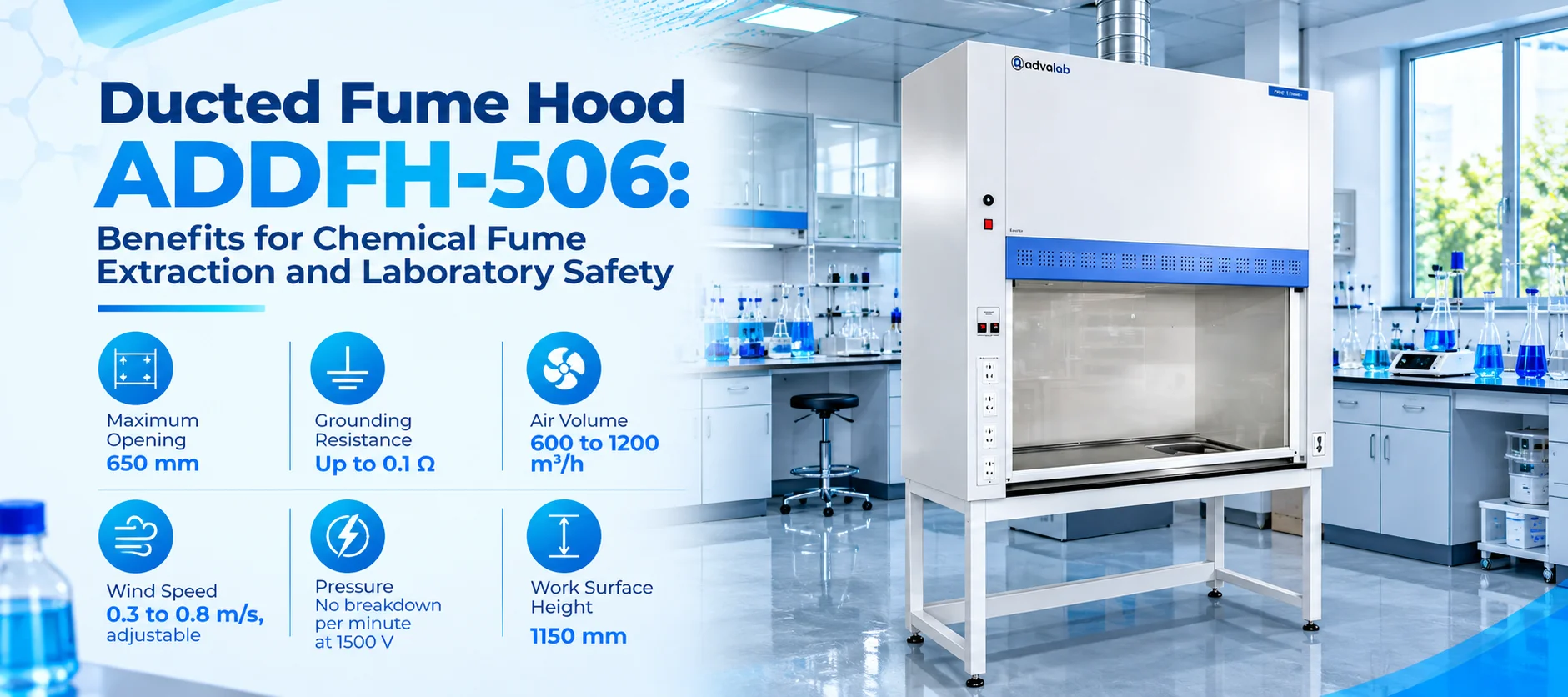
The listing gives an air volume of six hundred to twelve hundred cubic meters per hour.
Wind speed is adjustable from zero point three to zero point eight meters per second.
A high-efficiency airflow system maintains negative pressure inside the chamber.
LED lighting gives the work area clear visibility.
The inner body is five millimeters thick, compact, and resistant to acid and alkali.
The main body is one millimeter cold-rolled steel with an epoxy powder coating.
The work station is a twelve point seven millimeter black physicochemical board.
The inside measures twelve hundred fifty by six hundred thirty by eleven hundred fifty millimeters, with a maximum opening of six hundred fifty millimeters.
Grounding resistance is up to zero point one ohm, and the unit shows no breakdown per minute at fifteen hundred volts.
Noise is listed as up to sixty-two decibels A-weighted, and vibration as up to five micrometers RMS.
Infographic: airflow, opening, noise, electrical and size figures from the ADDFH-506 listing.
The Advalab listing says the unit is used in chemical research, industrial testing and forensic science to extract hazardous fumes, and its applications note names biotechnology, forensic laboratories and academic settings. The product notes add pharmaceutical laboratories, industrial R&D centers, environmental testing facilities and petrochemical work.
Teams that compare a ducted fume hood lab setup with a recirculating unit weigh the chemicals used, the building’s exhaust route and how much space the room offers. A lab hood exhaust path to the outside suits vapors that a filter alone may not capture.
The listing does not publish an operating procedure, so follow the supplier manual and your own safety rules for exact steps. People who look up how to use fume hood equipment will find that a routine usually follows a short sequence:
Match these published figures against your own work and building before shortlisting a hood:
| Model | External size (L × W × H) | Internal size (L × W × H) | Air volume |
|---|---|---|---|
| ADDFH-503 | One thousand two hundred by six hundred fifty by one thousand nine hundred millimeters | One thousand by five hundred thirty by seven hundred fifty millimeters | One thousand eight hundred fifty cubic meters per hour |
| ADDFH-505 | One thousand two hundred by eight hundred by two thousand three hundred fifty millimeters | Nine hundred fifty by six hundred thirty by one thousand one hundred fifty millimeters | One thousand eight hundred fifty cubic meters per hour |
| ADDFH-506 | One thousand five hundred by eight hundred by two thousand three hundred fifty millimeters | One thousand two hundred fifty by six hundred thirty by one thousand one hundred fifty millimeters | Six hundred to one thousand two hundred cubic meters per hour |
| ADDFH-513 | One thousand five hundred by eight hundred fifty by two thousand three hundred fifty millimeters | One thousand two hundred sixty by six hundred eighty by one thousand one hundred fifty millimeters | Not listed on the summary card |
| ADDFH-515 | One thousand forty by eight hundred by two thousand two hundred millimeters | Seven hundred ninety by six hundred seventy by one thousand fifty millimeters | Not listed on the summary card |
The ADDFH-506 has the longest inside space after the ADDFH-513 among these models, while the ADDFH-503 and ADDFH-505 list a higher air volume. Air volume is not the only measure, since the opening and the wind speed decide how well a hood captures fumes, so ask the supplier to compare them at your intended sash height.
Infographic: ducted fume hood models from the published listings. Air volume is shown only where the listing states it.
The Ducted Fume Hood ADDFH-506 pairs an air volume of six hundred to twelve hundred cubic meters per hour and an adjustable wind speed with a coated steel body, an acid and alkali resistant interior and LED lighting. It suits chemical research, industrial testing, forensic and biotechnology work where fumes must leave the building through ductwork.
Hazel Daniels
Specialty: Healthcare Technology & Laboratory Equipment
Writing Style: Professional, informative, and reader-friendly
Bio: Hazel Daniels specializes in writing about healthcare technology, laboratory equipment, and scientific applications. She presents technical information in simple language, highlighting practical uses and industry developments.
Review the published airflow, size, material, noise and accessory details for this ducted fume hood and compare them against your own work and building.
Explore Ducted Fume Hood ADDFH-506