
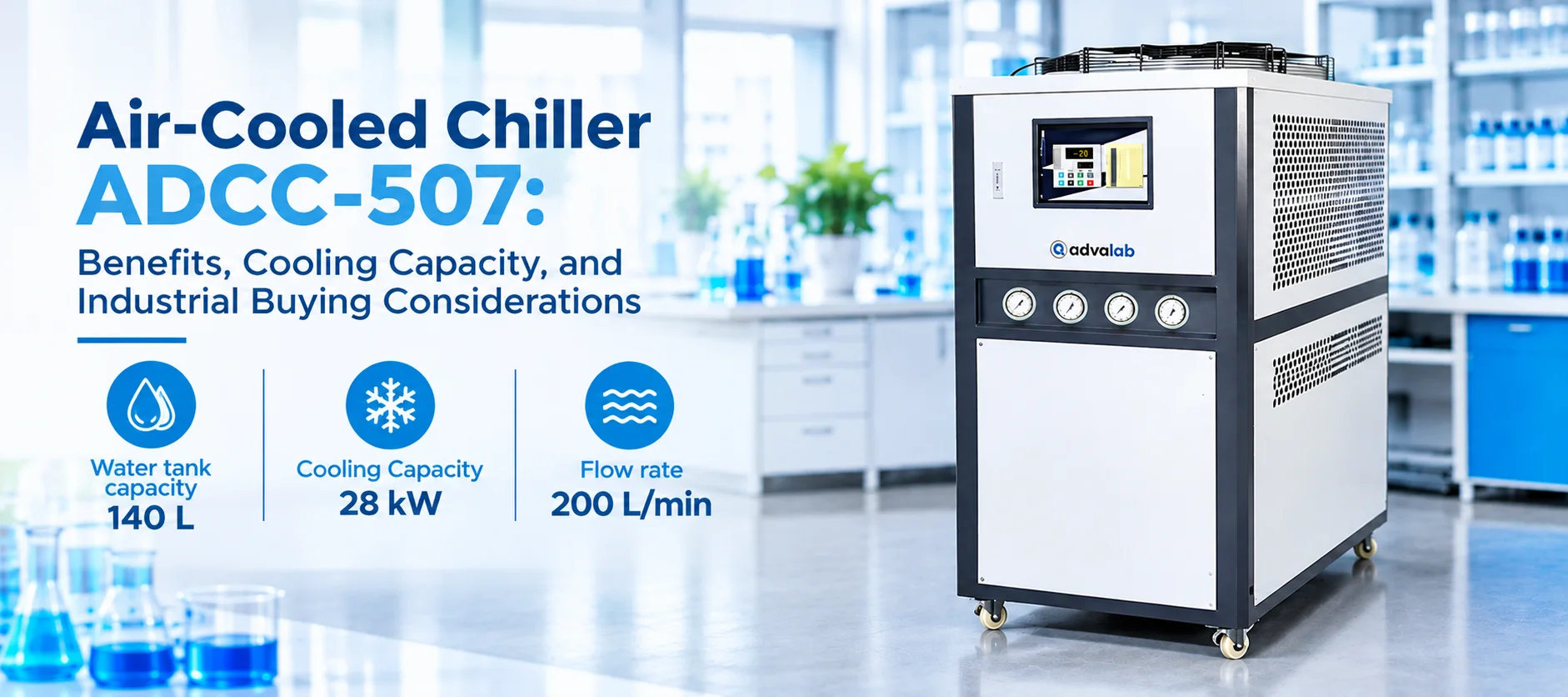
An Air Cooled Chiller is a refrigeration machine that cools a circulating water loop and sends the removed heat into the surrounding air through a fan and a finned condenser coil. It needs no cooling tower and no separate water supply for heat rejection, which is why it is chosen where water is limited.
Terms such as air cooled industrial chiller, air chiller, air chiller system, and air cooled chiller system describe the same equipment. The names portable air chiller and room chillers are used loosely. At 380 kg gross, the ADCC-507 is a floor-standing unit rather than a portable one, and it cools a process water loop rather than room air.
The Air Cooled Chiller working principle is heat transfer in two loops. A water loop carries heat away from the process, and a refrigerant loop moves that heat out of the water and into the air. Air Cooled Chiller how it works questions come down to one point: where the heat goes at the end. The diagram follows one full circuit.
Refrigerant absorbs heat from the returning process water.
A 7.5 kW motor raises refrigerant pressure and temperature.
Fans blow ambient air across the coil to release the heat.
Pressure and temperature drop before the next pass.
Chilled water leaves the 140 L tank and the pump returns it to the process.
The ADCC-507 listing names a 7.5 kW compressor motor, a 1.5 kW circulating water pump, and a capillary tube refrigerant control system. A capillary tube is a fixed restriction, which keeps the refrigerant path simple and low in maintenance.
The choice between the two types is mostly a site question, not a performance contest. The graphic sets out what each type asks of the installation.
These points are general technical knowledge, not a claim about specific Advalab models.
The table lists values published on the ADCC-507 product page and explains how each one affects planning.
| Parameter | ADCC-507 listing | Why it matters |
|---|---|---|
| Cooling capacity | 28 kW | Indicates how much heat the unit can remove; the main sizing figure |
| Flow rate | 200 L/min | Sets how much heat the water loop can carry at a given temperature rise |
| Water tank capacity | 140 L | Provides coolant reserve and buffers temperature swings |
| Circulating water pump | 1.5 kW | Drives the water loop through the process and its piping |
| Compressor motor | 7.5 kW | Reflects the refrigeration stage behind the capacity |
| Refrigerant | R22 (or R134a / R407c) | Affects servicing and local rules on refrigerant use |
| Voltage / base | 3N, 380 V, 50 Hz | Defines the electrical supply the site must provide |
| Dimensions (L × W × H) | 1500 × 750 × 1500 mm | Determines floor space and airflow clearance |
| Packaging dimensions (L × W × H) | 1620 × 850 × 1660 mm | Determines doorway and delivery access |
| Gross weight | 380 kg | Affects handling and floor loading |
The listing describes onboard alarms and real-time monitoring of compressor performance, water flow, and refrigerant pressure, with visual and audible warnings for faults such as low flow or compressor overload.
The ADCC-507 listing and FAQ name plastic molding, laser cutting, HVAC systems, laboratory processes, and the food, pharmaceutical, and manufacturing industries. Air cooled chiller use differs in each, mainly in what is being kept cool.
Mold temperature sets cycle time and part quality, so steady chilled water shortens cooling stages and keeps parts consistent.
Laser sources produce concentrated heat and stop when they overheat, so a chiller with enough capacity and flow keeps cutting uninterrupted.
Chilled water feeds air handling and process cooling circuits where a central cooling plant is not available.
Reactors, jacketed vessels, and process equipment need a steady coolant temperature, with limits set by the product and facility.
Cooling capacity alone does not describe what a chiller does to the process water. The heat removed equals the flow times the temperature change times the specific heat of water, so for a fixed capacity, lower flow means a larger temperature drop across the unit. The graphic shows this at the full 28 kW listed for the ADCC-507.
Calculated for water at full listed capacity. Real systems vary with coolant type, line losses, and ambient conditions.
At its listed 200 L/min, the ADCC-507 changes the water temperature by about 2 °C at full load, a small and stable difference. A process that needs a larger temperature drop, or one that has less flow available, changes this balance. Laboratories and plants weighing options across the full laboratory chiller range should compare capacity and flow together.
An air-cooled industrial chiller is easy to install, but it still needs a plan for four things.
The listing gives 3N, 380 V, 50 Hz. A site on a different supply needs a different configuration, so confirm voltage options before ordering.
The condenser needs free airflow. Leave open space around the unit, and keep the exhaust air from returning to the intake.
At 380 kg gross and 1500 × 750 × 1500 mm, the unit needs a solid, level floor and a delivery route that fits the 1620 × 850 × 1660 mm package.
The listing names R22, with R134a or R407c as configurable options. R22 is being phased out in many regions, so local rules and servicing availability matter.
The listing does not publish an installation procedure, so the supplier manual remains the source for commissioning and maintenance details.
The air cooled chiller range lists models from 2.8 kW up to the 28 kW of the ADCC-507, and the table shows how tank size and flow rise along with capacity.
| Model | Cooling capacity | Tank | Flow rate |
|---|---|---|---|
| ADCC-501 | 2.8 kW | 40 L | 40 L/min |
| ADCC-502 | 5.6 kW | 40 L | 40 L/min |
| ADCC-503 | 8.4 kW | 60 L | 100 L/min |
| ADCC-504 | 14 kW | 60 L | 100 L/min |
| ADCC-505 | 16.8 kW | 70 L | 100 L/min |
| ADCC-506 | 22.4 kW | 120 L | 150 L/min |
| ADCC-507 | 28 kW | 140 L | 200 L/min |
Capacity and flow do not always rise together. The ADCC-503 and ADCC-504 list the same 100 L/min flow, but the ADCC-504 lists 14 kW against 8.4 kW, so it changes the water temperature by a larger amount at that flow. A further model, ADCC-508, lists a smaller 1.2 to 2 kW capacity with R134a or R410A refrigerant.
The ADCC-507 belongs to a category with four ranges: air cooled chillers, water chillers, low temperature circulating chillers, and laser chillers. Listed temperature ranges reach -45 °C in the low temperature range, and the laser range lists 5 °C to 30 °C.
When comparing options in this category, teams usually weigh cooling capacity, temperature range, flow rate, tank volume, cooling method, refrigerant, control accuracy, footprint, and power supply. The full set of models is listed on the laboratory chillers page, and further laboratory equipment is available from the Advalab home page.
An air cooled chiller earns its place when a process needs steady chilled water and the site has no cooling tower or spare water supply. The ADCC-507 pairs 28 kW of capacity, 200 L/min flow, a 140 L tank, and onboard alarms. Matching heat load, flow, ambient conditions, power supply, and refrigerant to the site turns a specification list into a sound selection.
Hazel Daniels
Specialty: Healthcare Technology & Laboratory Equipment
Writing Style: Professional, informative, and reader-friendly
Bio: Hazel Daniels specializes in writing about healthcare technology, laboratory equipment, and scientific applications. She presents technical information in simple language, highlighting practical uses and industry developments.