
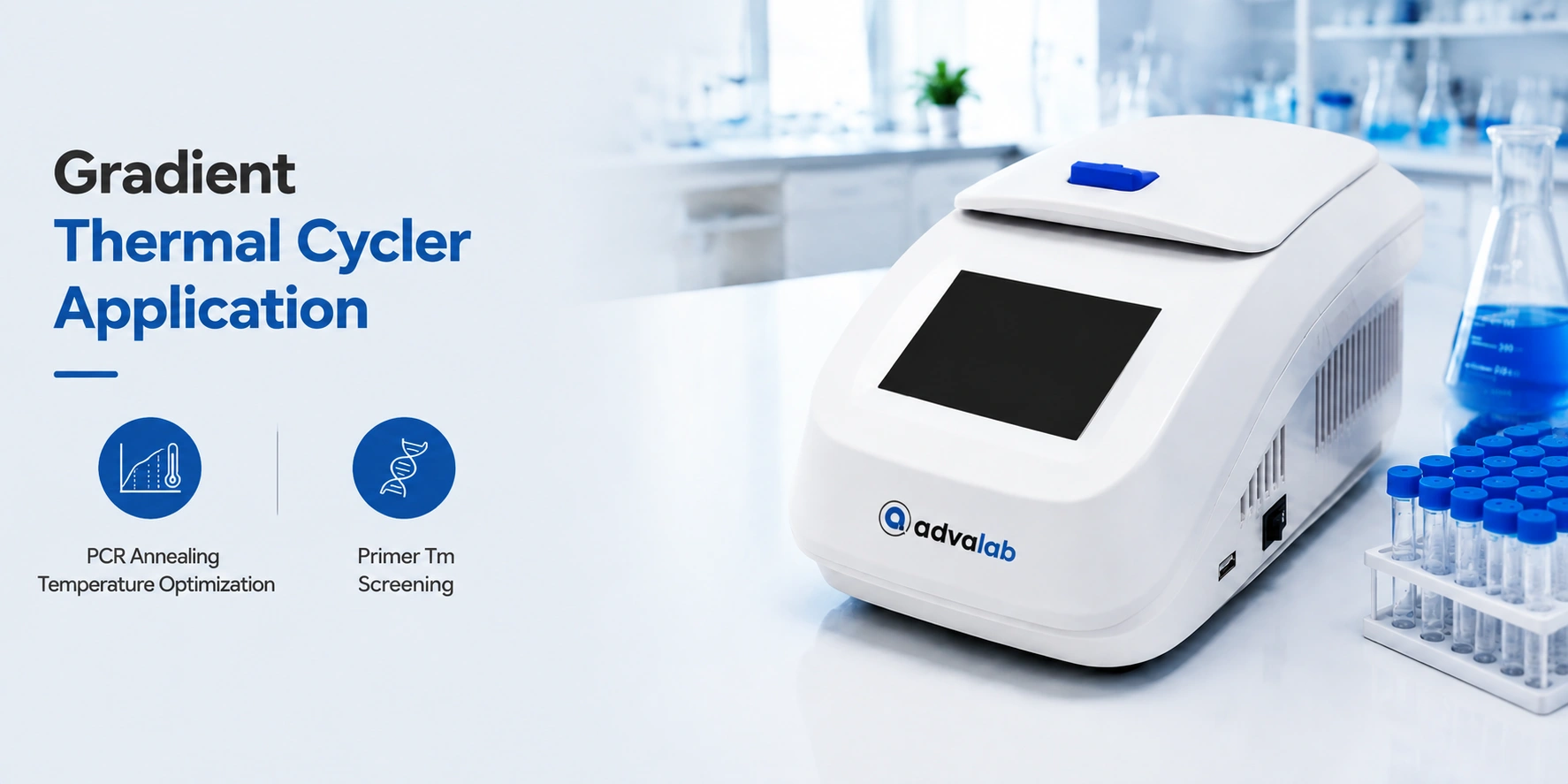
A working overview for laboratory, hospital, and research centre teams on where a Gradient Thermal Cycler fits into assay development, from finding a working annealing temperature to screening several primer pairs at once.
A Gradient Thermal Cycler runs a different annealing temperature across separate rows or columns of its block within a single cycling run, rather than holding one temperature for the whole plate. That capability turns a task that would otherwise take several separate runs, testing a range of annealing temperatures one at a time, into a single afternoon's work. Teams comparing gradient range and block layout across models often start from the gradient thermal cycler line on the gradient thermal cycler page before choosing a unit suited to typical assay development needs.
A gradient pcr machine achieves its temperature spread using independently controlled heating zones across the block, commonly arranged so each row sits at a slightly different annealing temperature while denaturation and extension stages stay uniform across the whole plate. The heated lid, held at a separate, typically higher lid temperature, presses down evenly across all rows regardless of the gradient beneath, so condensation control is not affected by which annealing temperature a given row is running. A gradient pcr cycler reports the actual temperature achieved at each row, letting the operator match a band of results directly back to the temperature that produced it once the run is complete.
Block layout: independent heating zones per row, uniform lid pressure and temperature across the full plate.
A gradient thermal cycler pcr machine supports several tasks in assay development where testing a range of conditions in one run saves considerable time.
Running one gradient identifies the temperature band that gives the cleanest, most specific amplification for a new primer pair.
Screening several candidate primer pairs against a spread of temperatures narrows down which pair performs reliably before committing to a routine protocol.
Multiplex reactions with several primer sets often need a shared annealing temperature that works across all targets, which a gradient run helps identify.
Demonstrating how annealing temperature affects specificity gives students a direct, visual result from a single plate rather than an abstract explanation.
Getting a usable result from a gradient screening run comes down to a short setup sequence before cycling starts.
Category spans gradient range, block capacity, ramp speed, and control interface.
Gradient thermal cyclers sit within a wider group of amplification and detection equipment, alongside fixed-temperature thermal cyclers and real-time PCR systems built for related molecular biology work. Buyers comparing options in this category typically weigh gradient range, block capacity, ramp speed, and control interface detail against the assay development work planned for the instrument. The full gradient thermal cycler lineup outlines configurations for bench and shared-lab use, and sits alongside the broader laboratory equipment range on advalab's main website, where related molecular biology hardware can also be reviewed.
| Factor | Gradient Thermal Cycler | Single-Temperature Thermal Cycler |
|---|---|---|
| Annealing temperature | Several temperatures tested across rows in one run | One fixed annealing temperature per run |
| Primer optimization | Optimal temperature found in a single plate | Needs several separate runs to cover the same temperature range |
| Routine testing | Suited to assay development and troubleshooting new primers | Suited to running an already-optimized protocol repeatedly |
| Data handling | Per-row temperature logging needed to track which band matches which result | Single temperature applies to the whole plate, simpler to log |
Log the centre temperature and gradient span for each screening run alongside the primer pair being tested.
Place negative controls in a row near the centre of the gradient where temperature accuracy is typically highest.
Verify gradient accuracy periodically using a calibrated probe across several rows rather than relying on the display alone.
Keep screening run records searchable by primer pair, so a previously identified optimal temperature does not need re-testing.
Confirm consumable compatibility across the full plate footprint, since some gradient blocks have tighter well spacing tolerances.
Train new staff on reading per-row temperature output correctly, so a result is not mismatched to the wrong condition.