
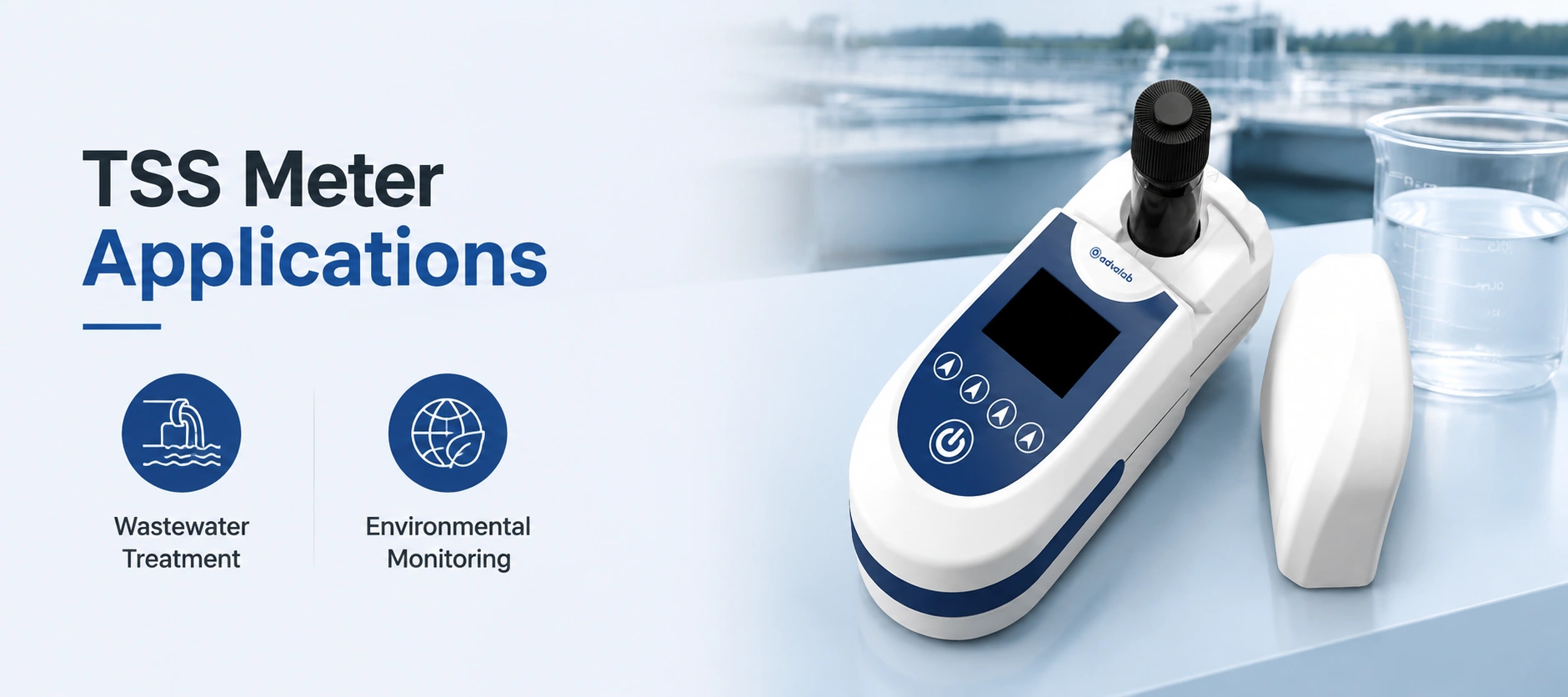
A working overview for laboratory, hospital, and research centre teams on how a TSS Meter reads suspended particle concentration in water samples, and where that reading fits into wastewater and field monitoring work.
A TSS Meter gives a numeric reading of total suspended solids in a water sample without the filtration and drying steps a gravimetric lab method requires. That speed is why a portable tss meter has become common on treatment plant floors and in the field, where a technician needs a usable number in seconds rather than hours. Teams comparing handheld options for site work often start from the tss meter line on the Tss Meter page before deciding between a pocket-style unit and a bench instrument for a fixed testing station.
Most current designs work as a tss turbidity meter at their core, shining light through or into a sample and reading how much of it scatters off suspended particles rather than passing straight through. Denser or more numerous particles scatter more light, and the detector converts that scattered signal into a suspended solids value, usually shown directly in milligrams per litre on a digital tss meter display. Because the reading depends on particle size, shape, and colour as well as concentration, a unit is generally calibrated against a known sample type before results are treated as an accurate tss measurement instrument for a specific water source.
This optical approach is what makes a suspended solids meter fast enough for repeated spot checks across a treatment process, compared with a gravimetric method that needs filtering, oven drying, and weighing before a number is available.
Light path: source beam, particle scattering, detector signal, converted TSS reading.
A tss meter wastewater application is the most common starting point, but the same optical principle supports several other water quality tasks with different sampling needs.
Spot readings across influent, aeration, and effluent stages track how well a treatment process is removing suspended particles.
Field readings from rivers, lakes, and stormwater outflows flag sediment loading events that a lab sample taken later might miss.
Discharge checks confirm suspended solids levels sit within the range a facility is expected to report before water leaves the site.
A tss meter portable enough for a shoulder bag lets survey teams log readings at several sites in a single trip without lab access.
Getting a usable reading from a tss handheld meter comes down to a short sequence, though the details shift slightly between probe-style and cuvette-style designs.
Category spans optical range, probe format, logging capacity, and calibration needs.
A TSS meter sits within a wider group of water quality instruments, alongside turbidity meters, dissolved oxygen meters, and pH probes that a field or plant team often carries together. Buyers comparing options in this category typically weigh measurement range, probe or cuvette format, data logging capacity, and how often calibration is needed between samples. The full TSS meter lineup outlines configurations for bench and field use, and sits alongside the broader laboratory equipment range on advalab's main website, where related water testing hardware can also be reviewed.
| Factor | Digital TSS Meter | Gravimetric Lab Method |
|---|---|---|
| Result timing | Reading available within seconds of sampling | Requires filtering and oven drying before a result is ready |
| Field use | Battery-powered handheld units work directly at the sample site | Sample generally needs transport back to a lab bench |
| Repeat sampling | Supports frequent spot checks across a treatment process or site survey | Better suited to periodic reference measurements rather than frequent checks |
| Calibration needs | Optical reading depends on calibration against a known reference sample | Weight-based result does not depend on an optical calibration step |
Log calibration dates alongside field readings so a drifting sensor can be traced back before results are questioned.
Rinse the probe or cuvette between samples from different sites to avoid carrying residue into the next reading.
Keep a spare calibration sample on hand for labs running the meter across several sampling trips in a week.
Take readings at more than one depth in larger water bodies, since suspended solids concentration is not always even throughout a column of water.
Note water temperature alongside a reading, since temperature can influence particle behaviour in some sample types.
Train field staff on gentle sample mixing, since vigorous shaking can introduce air bubbles that distort the optical reading.