
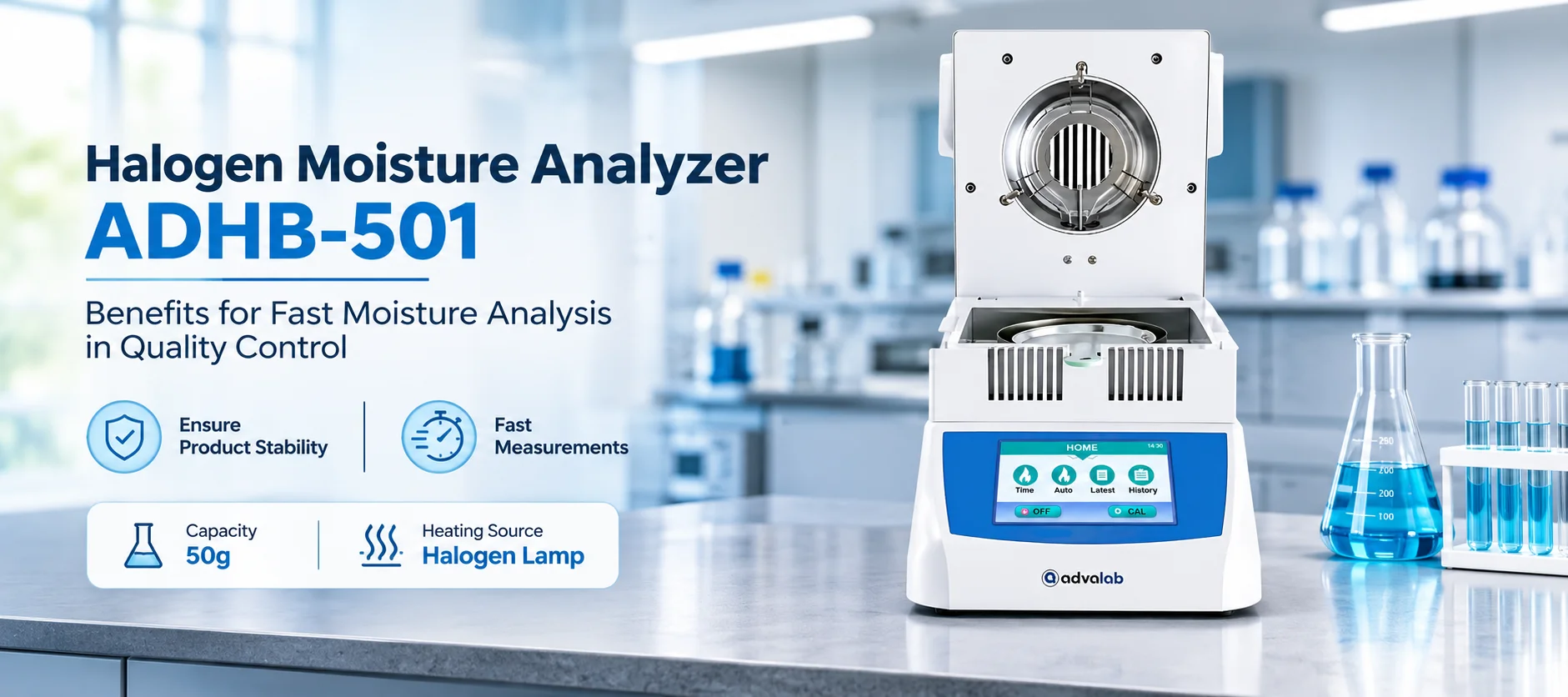
A powder batch waits for an oven test that takes hours, and by the time the result arrives, the lot has moved on to packing. A dried sample sits on a separate balance and takes moisture back up before it is weighed. A sample heated too hard scorches before the water has fully left it. Quality teams meet these problems whenever moisture decides whether a batch passes. The Halogen Moisture Analyzer ADHB-501 lists a halogen lamp, 0.005 g readability, 0.02% moisture readability, and 0.2% repeatability, which raises a practical question: what do those figures mean for fast moisture checks in quality control?
A Halogen Moisture Analyzer is a laboratory instrument that dries a small sample with halogen heat while an integrated balance records the weight loss, then reports the lost weight as moisture content. Heating and weighing happen in one place, so the sample never leaves the balance between steps.
Terms such as moisture balance analyzer, laboratory moisture analyzer, moisture testing equipment, and moisture testing machine all describe this instrument class. What separates one model from another is capacity, readability, heating control, and the data it can pass on to records.
A Halogen Moisture Analyzer works on the loss-on-drying principle. The sample is weighed, heated until its water has left, and weighed again, and the difference becomes the result. Moisture content equals the weight lost divided by the starting weight, expressed as a percentage. The cycle runs in five stages.
A thin, even sample is placed on the pan.
The balance records the starting weight.
The halogen lamp warms the sample quickly.
Weight loss is logged until it levels off.
Moisture content appears on the display.
Halogen heating is fast because the lamp delivers radiant heat directly to the sample surface instead of warming a large oven chamber. The ADHB-501 FAQ describes adjustable heating temperatures and times, and the halogen range description mentions automated end point detection that halts drying once the sample stabilizes, so confirm that function for this model.
Halogen drying is one of three common ways to determine moisture. Each answers a different need, and choosing the right one matters before choosing the instrument.
Many samples at once, but a test usually runs for hours.
One small sample, often finished in minutes, with the weight loss tracked live.
Measures water itself, suited to trace levels that drying cannot show.
Times and suitability are general laboratory knowledge, not claims about the ADHB-501.
Drying methods measure all material that leaves the sample as it heats, including volatile compounds other than water. Karl Fischer titration measures water specifically, so it is the usual choice where that distinction matters.
The table lists values published on the ADHB-501 product page and explains how each one affects testing.
| Parameter | ADHB-501 listing | Why it matters |
|---|---|---|
| Capacity | 50 g | Sets the maximum sample and pan weight the balance accepts |
| Heating source | Halogen lamp | Provides fast radiant heating of the sample surface |
| Readability | 0.005 g | Smallest weight change the balance can show |
| Moisture readability | 0.02% | Smallest moisture change the display can show |
| Repeatability | 0.2% | Shows how closely repeat tests of one sample agree |
| Pan diameter | 100 mm | Limits how widely a sample can be spread for even drying |
| Interface | RS232 | Sends results to a computer or printer for records |
Moisture readability is tied to the balance and the sample. A balance that shows 0.005 g can detect a weight change of that size, and the same change is a larger share of a small sample than of a large one. Dividing the balance readability by the sample mass gives the smallest moisture change that can be shown.
Calculated as balance readability divided by sample mass. The listed 0.02% moisture readability matches a sample of about 25 g, if the instrument defines it this way. Confirm the definition with the supplier.
The ADHB-501 listing and FAQ name food processing, pharmaceuticals, and environmental testing, and the halogen range description adds plastics. Each setting uses moisture results differently.
Moisture in grains, flours, powders, and snacks affects texture, shelf life, and batch consistency, so fast checks on incoming material and finished product keep lots moving.
Powders and granules carry moisture limits set by the product and the facility, which makes repeatable readings more useful than a single fast one.
Soils, sludges, and similar materials are dried to a stable weight, with moisture reported as the weight lost.
Polymer resin and chemical powders are checked for moisture before processing, since excess water affects quality.
A moisture testing machine gives repeatable results only when the sample routine is repeatable. A typical sequence follows these steps.
Selection starts with the material and the moisture level to be measured, not with the capacity figure. Analyzers differ in capacity, readability, and heating control across the full moisture analyzer range, so define the sample and the limit first.
| Requirement | Consider |
|---|---|
| Low-moisture materials | A larger permitted sample and fine readability |
| Small or limited samples | Balance readability and moisture readability |
| Heat-sensitive materials | Adjustable temperature and heating profile |
| Records for each batch | RS232 or other data output |
| Thin, even spreading of powders | Pan diameter and chamber design |
| Verification against a reference method | Repeatability and an oven or titration cross-check |
The halogen moisture analyzer range lists models that all use a halogen lamp as the heating source. The table shows how capacity and readability vary among five of them.
| Model | Capacity | Readability | Moisture readability |
|---|---|---|---|
| ADHB-501 | 50 g | 0.005 g | 0.02% |
| ADHB-504 | 100 g | 0.005 g | Not listed |
| ADHB-508 | 100 g | 0.005 g | Not listed |
| ADHB-510 | 100 g | 0.001 g | Not listed |
| ADHB-512 | 120 g | 0.001 g | 0.01% |
Capacity and readability do not rise together. The ADHB-504 and ADHB-508 list a larger capacity than the ADHB-501 with the same 0.005 g readability, while the ADHB-510 and ADHB-512 list a finer 0.001 g readability. Ask for moisture readability and repeatability on each model before comparing, since not all listings give them.
The ADHB-501 belongs to a category built around rapid determination of water content, with temperature control and stable heating, used in pharmaceutical, food, and quality control laboratories. The range currently listed under it is the halogen moisture analyzers range.
When comparing options in this category, teams usually weigh capacity, readability, moisture readability, repeatability, heating source and temperature range, pan size, data interface, and footprint. The full set of models is listed on the moisture analyzers page, and further laboratory equipment is available from the Advalab home page.
A halogen moisture analyzer earns its place when waiting hours for an oven result slows decisions on batches, incoming materials, or process changes. The ADHB-501 pairs halogen heating with 0.005 g readability, 0.2% repeatability, and RS232 output. Matching sample mass, heating control, and record keeping to the material turns a specification list into a sound selection.
Hazel Daniels
Specialty: Healthcare Technology & Laboratory Equipment
Writing Style: Professional, informative, and reader-friendly
Bio: Hazel Daniels specializes in writing about healthcare technology, laboratory equipment, and scientific applications. She presents technical information in simple language, highlighting practical uses and industry developments.