
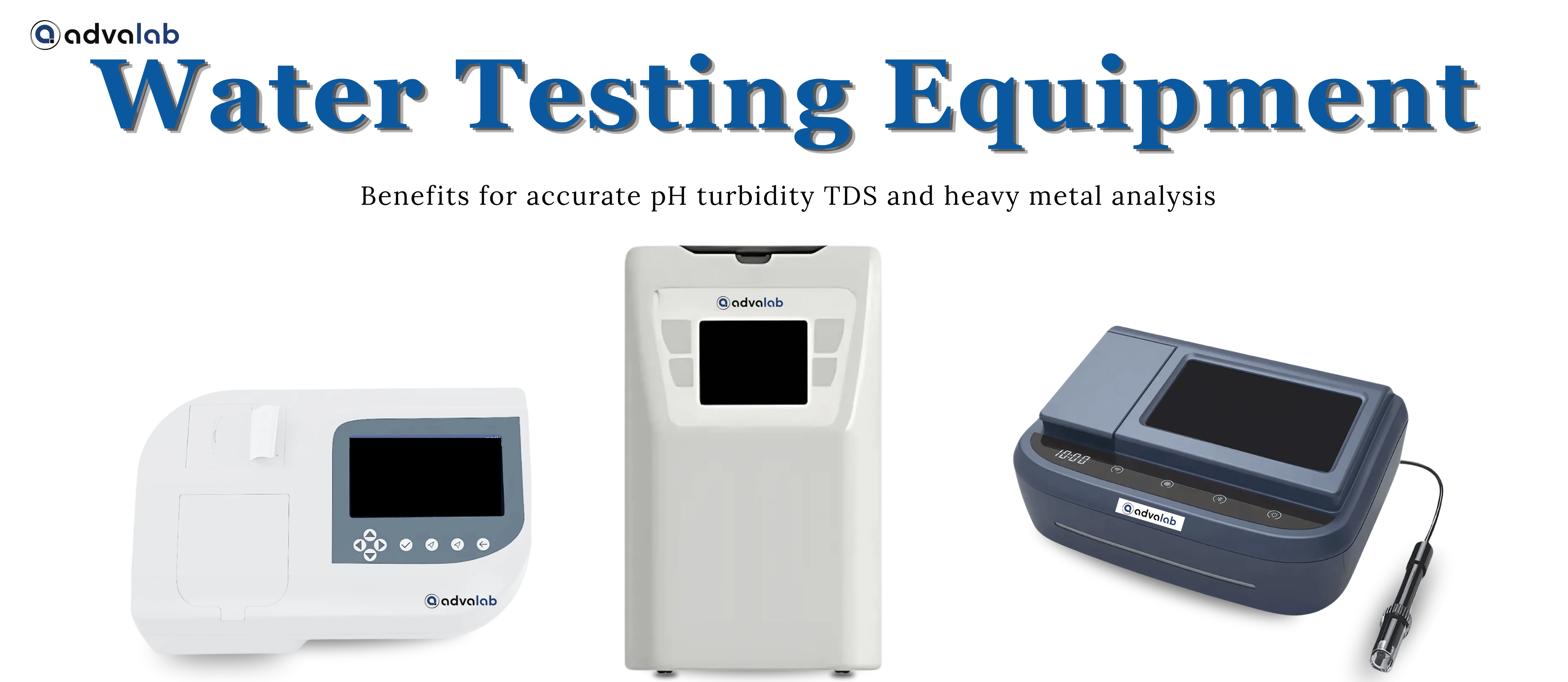
Water quality monitoring plays a major role in environmental analysis, wastewater treatment, industrial process control, municipal water management, food production, pharmaceutical workflows, and research laboratories. Modern water quality testing equipment helps laboratories evaluate physical, chemical, and biological water parameters with improved measurement consistency and workflow efficiency. These systems support analysis of pH, turbidity, total dissolved solids (TDS), dissolved oxygen, conductivity, salinity, and heavy metal contamination across multiple testing environments.
Environmental laboratories increasingly rely on digital water analysis equipment to support regulatory, contamination monitoring, treatment verification, and process validation. Compared to manual testing methods, automated water testing instruments improve analytical reproducibility while reducing operator variability during routine monitoring procedures.
Whether using a portable water testing machine, advanced water analysis equipment, or a field-ready water testing device, modern systems support efficient sample analysis for environmental monitoring and industrial laboratory workflows. This article explains the major benefits of water testing systems, laboratory applications, operating principles, and user practices for maintaining accurate analytical performance.
What Is Water Testing Equipment?
Water Testing Equipment refers to laboratory and field instruments used to measure water quality parameters for environmental, industrial, pharmaceutical, agricultural, and municipal applications. These instruments evaluate water composition, contamination levels, and physicochemical properties through electrochemical sensing, optical measurement, spectroscopic detection, and titration-based analysis techniques.
A modern water analysis machine helps laboratories evaluate water composition and contamination levels efficiently, combining multiple measurement modalities within a single analytical platform. Selection of appropriate instrumentation depends on the target parameters, detection limits required, sample throughput, and field or laboratory deployment conditions.
Why Water Quality Testing Matters
Water quality directly influences public health outcomes, industrial processing performance, wastewater treatment efficiency, environmental protection, and pharmaceutical production standards. Inadequate monitoring of water parameters can result in regulatory, contamination incidents, process failures, and adverse ecological impacts.
Public Health Protection
Monitoring microbial loads, chemical contaminants, and trace metals prevents health risks from contaminated water supplies.
Industrial Process Control
Consistent water quality parameters ensure stable manufacturing processes and product quality in industrial facilities.
Wastewater Treatment
Continuous monitoring of treatment efficiency supports discharge and environmental protection requirements.
Environmental Protection
Regular surface and groundwater monitoring identifies contamination sources and supports remediation programs.
Accurate monitoring helps laboratories identify chemical contamination, suspended solids, heavy metal presence, oxygen depletion, pH imbalance, and conductivity variation across water bodies and process streams. A properly calibrated water testing device supports consistent analytical monitoring across environmental workflows.
1. Accurate pH Analysis for Water Monitoring
pH measurement remains one of the most fundamental aspects of water quality analysis. The hydrogen ion concentration in water determines chemical reactivity, biological treatability, corrosion potential, and ecological suitability for aquatic organisms. Deviations from target pH ranges can compromise treatment effectiveness, accelerate infrastructure degradation, and trigger regulatory.
A water pH testing kit or digital pH meter helps laboratories monitor drinking water quality, industrial discharge streams, wastewater treatment processes, environmental water samples, and laboratory process water. Most modern systems employ glass electrode sensors with temperature compensation circuitry to reduce measurement drift across varying sample conditions.
Improper pH levels affect chemical reaction rates, biological treatment system performance, corrosion rates in metallic infrastructure, and aquatic ecosystem health. For drinking water applications, regulatory agencies specify pH acceptance ranges that require routine verification through calibrated instrumentation.
- Calibrate pH electrodes before each analytical session using fresh two- or three-point buffer standards
- Rinse probes with deionised water between samples to prevent cross-contamination
- Store combination electrodes in storage solution rather than deionised water to preserve junction health
- Allow temperature equilibration between sample and electrode before measurement
- Replace cracked or sluggishly responding electrodes promptly to maintain measurement integrity
2. Turbidity Testing Supports Suspended Particle Analysis
Turbidity measurement evaluates water clarity by quantifying the scattering of light by suspended particles including sediment, algae, organic matter, and colloidal materials. High turbidity values indicate elevated concentrations of suspended matter that may harbor pathogens, absorb disinfectants, and interfere with UV-based treatment processes.
Modern water testing instruments measure turbidity using nephelometric methods that detect scattered light at defined angles, typically 90° from the incident beam. Results are expressed in Nephelometric Turbidity Units (NTU) and compared against regulatory benchmarks for drinking water, surface water, and wastewater discharge standards.
High turbidity levels may indicate organic contamination, poor filtration performance, industrial process discharge, or conditions favorable for microbial growth. Digital turbidity analyzers improve analytical precision during routine environmental monitoring by minimising operator-dependent variability compared to visual assessment methods.
3. TDS Measurement Improves Water Quality Assessment
Total dissolved solids (TDS) analysis determines the concentration of dissolved inorganic and organic materials within a water sample. TDS reflects the cumulative contribution of dissolved salts, minerals, metals, and other ionic species that cannot be removed through standard filtration at 0.45 µm pore size.
A digital water testing machine commonly measures conductivity, TDS concentration, salinity, and dissolved ionic content using conductimetric sensing methods. Conductivity is measured in µS/cm or mS/cm, and TDS is derived through a conversion factor appropriate to the ionic composition of the sample matrix.
Industrial Water Systems
TDS monitoring supports cooling tower management, boiler feed water control, and process water quality.
Wastewater Treatment
Tracking dissolved solids through treatment stages verifies removal efficiency and discharge.
Aquaculture
Maintaining appropriate salinity and TDS ranges supports aquatic organism health and growth rates.
High-Purity Water
Pharmaceutical and semiconductor facilities verify ultrapure water specifications through TDS and conductivity measurements.
Environmental Studies
Baseline TDS monitoring supports hydrological assessments and contamination source identification studies.
- Verify conductivity cell constants through certified standard solutions before analytical sessions
- Use clean, dedicated sample containers to prevent ionic contamination between measurements
- Measure samples at stable temperatures or apply automatic temperature compensation (ATC)
- Select appropriate TDS conversion factors for the specific ionic profile of the sample matrix
- Maintain calibration records systematically to support traceability and audit requirements
4. Heavy Metal Analysis Supports Environmental Safety
Heavy metal contamination monitoring remains critically important for environmental and industrial laboratories responsible for assessing drinking water safety, industrial effluent quality, and ecological impact. Unlike organic contaminants, heavy metals do not degrade over time and accumulate within biological tissues and sediments, posing long-term environmental and health risks.
Advanced water analysis equipment designed for trace metal detection employs atomic absorption spectroscopy (AAS), inductively coupled plasma optical emission spectrometry (ICP-OES), anodic stripping voltammetry (ASV), and colorimetric test kit methods to detect and quantify metal concentrations across a wide dynamic range.
Heavy metal analysis supports regulatory verification, industrial discharge monitoring programmes, environmental remediation studies, and drinking water safety assessments. Accurate trace metal detection at sub-ppb levels requires careful sample preservation, appropriate acidification, and matrix-matched calibration to avoid measurement bias.
5. Dissolved Oxygen Monitoring Supports Aquatic Analysis
A dissolved oxygen kit helps laboratories evaluate oxygen concentration in water samples, which serves as a primary indicator of water health in both natural aquatic environments and engineered biological treatment systems. Oxygen availability in water governs aerobic biological activity, decomposition rates, and the survival of aquatic organisms.
Dissolved oxygen testing is widely used in wastewater treatment to verify aeration efficiency, in aquaculture to maintain oxygen concentrations supporting fish health, and in surface water monitoring to assess eutrophication and organic pollution impacts on aquatic ecosystems. Analytical methods include polarographic membrane electrodes, optical luminescence-based sensors, and Winkler titration for reference measurements.
Low oxygen levels may indicate organic pollution loading, elevated biological activity, poor aeration in treatment systems, or water stagnation. Continuous dissolved oxygen monitoring in biological reactors supports aeration energy optimisation and treatment process stability.
- Calibrate dissolved oxygen probes using water-saturated air or zero-oxygen reference solutions before testing
- Avoid trapping air bubbles at the sensor membrane during sample measurement
- Measure samples immediately after collection to minimise atmospheric re-equilibration effects
- Inspect optical sensor caps or polarographic membranes regularly for fouling and degradation
- Replace electrolyte fluid and membrane assemblies according to the manufacturer's maintenance schedule
6. Portable Testing Improves Field Monitoring Flexibility
Portable water testing instruments extend analytical capability to field environments, enabling on-site measurements without transporting large sample volumes to fixed laboratory facilities. Field-portable systems are particularly valuable when sample stability is a concern, when large geographic areas require monitoring, or when real-time data collection is needed to support operational decisions.
Portable water testing devices support river and lake monitoring surveys, groundwater quality assessment, wastewater field inspection, industrial site environmental verification, and agricultural irrigation water analysis. Advances in sensor miniaturisation, battery technology, and wireless data transmission have significantly improved the analytical performance of portable water testing machines compared to earlier generations.
Faster Field Analysis
On-site measurement eliminates sample transport delays and reduces the risk of parameter change during transit.
Multi-Location Coverage
Portable systems enable simultaneous multi-point monitoring across extended water bodies and networks.
Wireless Data Logging
Bluetooth and cellular-connected field meters transmit measurement data directly to laboratory information management systems.
Extended Battery Operation
Modern portable instruments sustain multi-day field campaigns on rechargeable battery systems.
7. Multiparameter Analysis Streamlines Laboratory Workflows
Modern water quality testing equipment often integrates multiple analytical functions within a single platform, reducing the number of discrete instruments required and simplifying data management processes. Multiparameter water analyzers measure pH, conductivity, TDS, salinity, dissolved oxygen, and temperature simultaneously from a single sample, significantly improving laboratory throughput.
Integrated systems help laboratories reduce total testing time per sample, improve workflow organisation, simplify result documentation, and increase analytical throughput during peak monitoring periods. Multiparameter instruments are particularly advantageous in high-volume environmental monitoring programmes where numerous samples require analysis across multiple parameters within defined turnaround timeframes.
A single multiparameter water analysis machine can replace up to five standalone instruments, reducing bench space requirements, calibration time, and maintenance complexity while improving data consistency across parameters measured from the same sample aliquot.
Water Sampler Equipment and Proper Sample Collection
Accurate water quality analysis fundamentally depends on collecting representative samples that authentically reflect the composition of the water body or process stream under investigation. Water sampler equipment encompasses depth-integrated samplers, automatic composite samplers, grab samplers, and isokinetic sampling devices designed for specific sampling objectives.
Sample collection errors — including contamination from sampling equipment, sample preservation failures, and non-representative grab points — introduce systematic bias that cannot be corrected through instrument calibration or analytical corrections. Consequently, water sampler equipment selection and sampling protocol design require the same attention as instrument selection.
- Pre-clean sampling containers with sample water before final collection to equilibrate container surfaces
- Avoid direct hand contact with sample container interiors and caps during collection
- Label containers immediately after collection including location, time, depth, and collector identification
- Maintain cold chain (2–8°C) for samples requiring biological preservation during transport
- Follow validated sampling procedures and document any deviations that may affect result interpretation
Water Treatment Test Kit Applications
A water treatment test kit helps operators monitor treatment process efficiency at various stages of water processing, from raw water intake through final treated water discharge. These kits provide rapid colorimetric or titrimetric measurements of residual chlorine, total hardness, alkalinity, iron, manganese, and other parameters relevant to treatment process control.
Treatment facilities use test kit measurements to guide chemical dosing decisions, verify filtration performance, confirm disinfection residuals, and assess treated water quality specifications. The rapid turnaround of kit-based analysis supports real-time process adjustments, complementing laboratory instrument analysis for comprehensive treatment monitoring.
Equipment Selection Considerations and Common Mistakes
Selecting appropriate water quality testing equipment requires systematic evaluation of analytical requirements, operational environment, regulatory needs, and long-term maintenance considerations. Laboratories frequently encounter challenges when instrument specifications are not matched to actual measurement requirements, leading to under-performing or over-specified acquisitions.
Explore the full range of water quality testing equipment categories to identify instrumentation aligned with your analytical objectives. For instrument models and configurations, visit the water testing equipment models page.
Common Mistake: Ignoring Detection Limits
Selecting instruments without verifying detection limits against regulatory thresholds leads to measurements that cannot confirm at required concentrations.
Common Mistake: Overlooking Matrix Effects
Instruments calibrated with distilled water may exhibit significant measurement bias when applied to complex environmental matrices with high ionic strength or colour.
Common Mistake: Neglecting Calibration Frequency
Infrequent calibration allows electrode drift to accumulate, introducing systematic errors that compound over multiple measurement sessions.
Common Mistake: Inadequate Training
Insufficient operator training results in inconsistent technique, improper calibration procedures, and misinterpretation of instrument error flags.
When evaluating water testing instruments, laboratories should systematically assess measurement range and resolution, calibration point requirements, sensor compatibility with the sample matrix, detection limits relative to regulatory thresholds, data management and connectivity features, and ongoing maintenance requirements.
Technical Specification Reference Table
| Parameter | Measurement Technique | Typical Range | Resolution |
|---|---|---|---|
| pH | Glass Electrode / Potentiometric | 0.00 – 14.00 pH | 0.01 pH |
| Turbidity | Nephelometric (90° Scatter) | 0 – 4000 NTU | 0.01 NTU |
| TDS / Conductivity | Conductimetric (4-Electrode) | 0 – 200 mS/cm | 0.001 µS/cm |
| Dissolved Oxygen | Optical Luminescence / Polarographic | 0 – 20 mg/L | 0.01 mg/L |
| Heavy Metals (Trace) | AAS / ICP-OES / ASV | 0.1 µg/L – 10 mg/L | 0.01 µg/L |
| Salinity | Conductimetric / Refractometric | 0 – 70 ppt | 0.01 ppt |
| Temperature | Thermistor / Pt100 RTD | -10 – 110°C | 0.1°C |
| ORP / Redox | Platinum Electrode / Potentiometric | -2000 to +2000 mV | 0.1 mV |
Product Category Overview
Water quality testing instruments span a broad range of analytical categories, from single-parameter benchtop meters to fully integrated automated sampling and analysis systems. The Advalab catalogue encompasses laboratory and field instrumentation across the complete water analysis workflow.
Sub-categories relevant to this product area include: electrochemical water analyzers, optical turbidity measurement systems, trace heavy metal detection instruments, dissolved oxygen and BOD analyzers, portable multiparameter field meters, and automated water sampling equipment. For detailed model comparisons, visit the water testing equipment catalogue.
Preventive Maintenance and Operational Practices
Long-term analytical performance of water quality testing equipment depends on systematic preventive maintenance, calibration discipline, and adherence to validated operating procedures. Inadequate maintenance leads to gradual measurement drift, sensor fouling, and eventual instrument failure that disrupts laboratory operations.
Preventive Maintenance Schedule
| Component | Maintenance Action | Frequency |
|---|---|---|
| pH Electrode | Clean, condition, and calibrate; inspect for cracks | Before each session |
| Conductivity Cell | Rinse with deionised water; verify cell constant | Weekly or as per use |
| Turbidity Cuvettes | Clean optical surfaces; check for scratches | After each use |
| DO Membrane / Cap | Inspect for fouling; replace electrolyte and membrane | Monthly or as scheduled |
| Reference Standards | Check expiry; prepare fresh calibration solutions | Per calibration session |
| Cable and Connectors | Inspect for corrosion, damage, and secure fit | Monthly |
- Use certified reference standards traceable to national or international measurement standards (NIST, PTB)
- Avoid cross-contamination by rinsing sensors thoroughly between sample measurements
- Maintain stable sample temperatures during measurement or apply automatic temperature compensation
- Follow manufacturer operating guidelines for warm-up times and sensor conditioning procedures
- Document all maintenance activities, calibration data, and corrective actions in a laboratory logbook
Comprehensive maintenance records support laboratory quality management system requirements, external audit readiness, and long-term instrument performance trend analysis.
Water Testing Equipment Applications Across Industries
Modern water analysis machines support testing across diverse industry sectors. Environmental laboratories rely on these instruments for surface water and groundwater quality characterisation, sediment elutriate testing, and regulatory verification. Pharmaceutical facilities apply water analysis equipment to verify purified water and water for injection (WFI) quality against pharmacopoeial specifications.
Food and beverage manufacturers monitor process water quality to protect product safety and regulatory standing. Municipal water utilities operate continuous monitoring networks to verify treatment efficacy and distribution system water quality. Industrial manufacturing sites apply water analysis instruments to process water management, cooling tower monitoring, and effluent verification.
For product information and water testing instruments suited to your sector, explore the water testing equipment category at Advalab.
Frequently Asked Questions
Explore Advalab Water Testing Equipment
For complete product specifications, instrument configurations, and laboratory water analysis systems, visit the Advalab product catalogue.
View Equipment Catalogue Contact Us