
Wastewater does not hold still. Solids load rises with flow, weather and plant load, and a team that tests only now and then misses the swings. A bench instrument with a narrow range adds repeat dilutions, and separate tools for solids and cloudiness add more handling.
The question is how to read thin and thick samples with one compact instrument. The Advalab ADTSS-502 lists a total suspended solids range up to fifty thousand milligrams per liter, a separate turbidity range, a zero drift limit and its size and weight, so a team can judge the fit before ordering.
A TSS Meter suits a laboratory or plant team only when those figures match its samples and working conditions. This article explains what the readings mean, ten published advantages, typical uses, a sample routine and the mistakes to avoid, and then the next step: confirm the open points with the supplier and review the full listing.
Total suspended solids describe the particles that stay in water instead of dissolving in it. A total suspended solids meter reports that load in milligrams per liter, and the figure informs decisions in treatment, discharge checks and process control. Turbidity describes how cloudy the same water looks and is reported in NTU. The two readings are related, but they are not the same, so a suspended solids meter that reports both gives a fuller picture of one sample.
The ADTSS-502 listing states that the unit detects and monitors total suspended solids and turbidity over a range of 0.1 to 50,000 milligrams per litre for solids and 0.1 to 50 NTU for turbidity.
Illustrative flow, not to scale: one sample, one meter, two readings, each with its own listed range.
Results become hard to use for a few common reasons:
A meter with a stated range, drift limit and upkeep profile lets a team plan around these problems, provided the published numbers match its samples.
Each advantage below ties to a specification or feature published for the ADTSS-502.
The meter detects both total suspended solids and turbidity.
Solids are measured from zero point one to fifty thousand milligrams per liter.
Turbidity is measured from zero point one to fifty NTU.
Zero drift is listed as within plus or minus zero point three percent of full scale over thirty minutes.
Repeatability is listed as below one percent for both solids and turbidity.
The durable diaphragm works without electrolyte, so upkeep stays minimal.
The backlit display supports use in dim labs and plant rooms.
Stored results support quick analysis and reporting, though the capacity is not stated.
The unit measures two hundred twenty by ninety-six by forty-four millimeters and weighs four hundred sixty grams net.
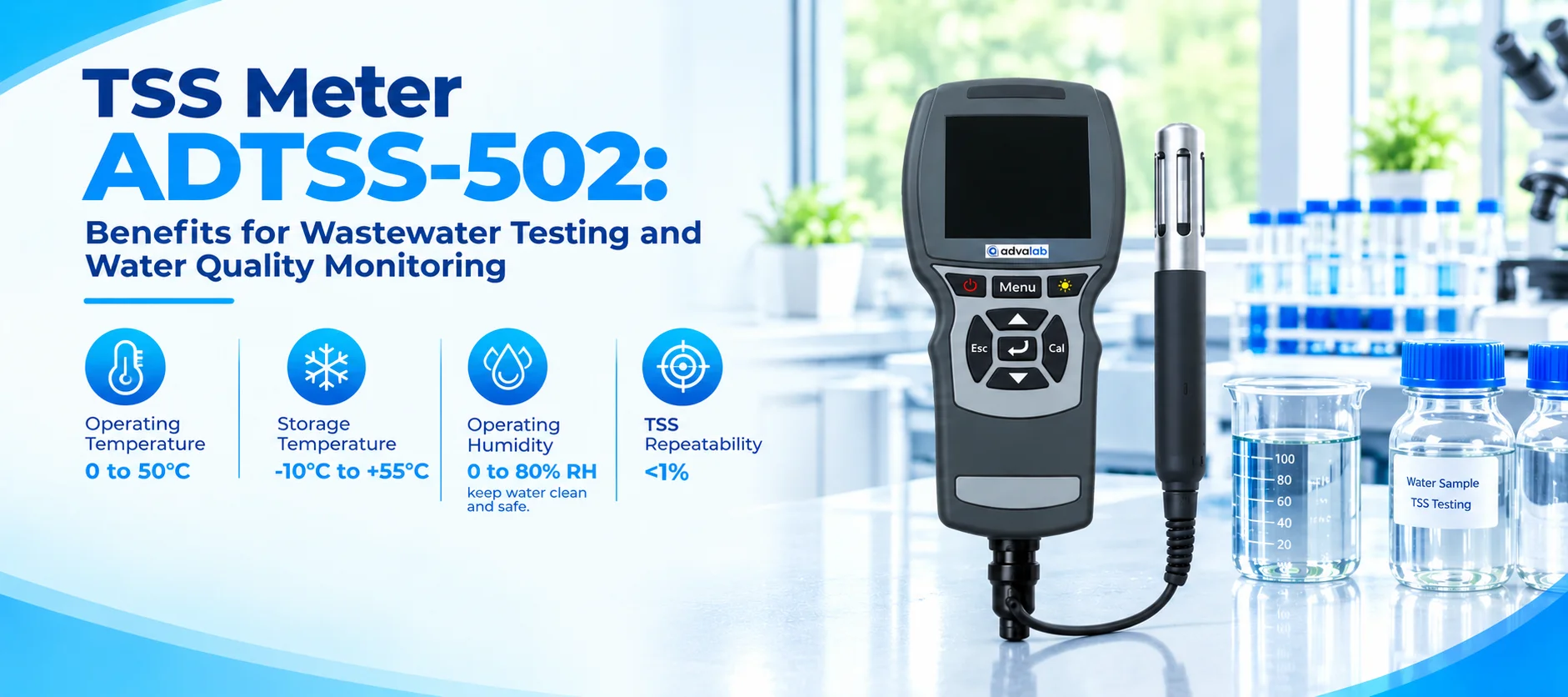
The operating range is zero to fifty degrees Celsius at up to eighty percent relative humidity.
The listing ties solids accuracy to the homogeneity of activated sludge and gives turbidity accuracy as two values joined by “or”, so confirm with the supplier which applies at your sample level.
Infographic: measuring, stability and operating figures from the ADTSS-502 listing.
The Advalab listing states that the unit detects and monitors total suspended solids and turbidity in water samples, and it names these industries:
Teams that look for a portable TSS meter or a portable total suspended solids meter should check three facts: size, weight and operating conditions. The ADTSS-502 listing gives two hundred twenty by ninety-six by forty-four millimeters, four hundred sixty grams net and five kilograms gross with packing, and zero to fifty degrees Celsius at up to 80% relative humidity, with storage from minus ten to fifty-five degrees Celsius.
The unit is compact and light, which suits work near tanks and sample points. The listing does not describe it as handheld or name a power source, so ask how it is powered before planning field use.
The listing does not publish an operating procedure, so follow the supplier manual for exact steps. People who ask how to use TSS Meter equipment will find that a routine usually follows a short sequence:
Many users search for a digital TSS Meter or a TSS Meter digital model because they want a clear numeric readout. The listing describes a backlit display and an operating keyboard but not the screen layout. People also ask how to check unit in digital meter readouts: read the unit label next to the value before you record it, milligrams per liter for solids and NTU for turbidity, and confirm the setting in the manual if the unit differs.
Match these published figures against your own samples and sites before shortlisting a TSS meter portable enough for field work:
Infographic: size, weight, storage and calibration details published for the ADTSS-502.
| Model | TSS range | Turbidity range | Solids accuracy |
|---|---|---|---|
| ADTSS-501 | Zero to one thousand milligrams per liter | Zero to one thousand NTU | Plus or minus zero point three milligrams per liter or eight percent |
| ADTSS-502 | Zero point one to fifty thousand milligrams per liter | Zero point one to fifty NTU | Plus or minus five percent of full scale, relying on activated sludge homogeneity |
The ADTSS-502 reaches much higher solids loads, while the ADTSS-501 covers a far wider turbidity range, so choose by your typical sample. For turbidity alone, the Turbidity Meter ADTM-501 lists its own range.
The water testing equipment category at Advalab covers twelve instrument types: the COD analyzer, multi parameter water quality analyzer, portable dissolved oxygen meter, portable water quality analyzer, turbidity meter, the TSS meter range, TDS meter, salinity tester, thermoreactor, pH tester, ORP meter and pH/ORP meter.
When laboratories compare options in this category, they typically weigh the parameter measured, measuring range, accuracy and repeatability, portability, upkeep and calibration method. To review all instrument types side by side, explore the full water testing equipment range, or see the wider laboratory equipment catalog on the Advalab home page.
The TSS Meter ADTSS-502 pairs a solids range up to fifty thousand milligrams per liter with a turbidity reading, a zero drift limit and a body of four hundred sixty grams. It suits wastewater, environmental and water quality teams that read thin and thick samples with one compact unit.
Hazel Daniels
Specialty: Healthcare Technology & Laboratory Equipment
Writing Style: Professional, informative, and reader-friendly
Bio: Hazel Daniels specializes in writing about healthcare technology, laboratory equipment, and scientific applications. She presents technical information in simple language, highlighting practical uses and industry developments.
Review the published ranges, drift, repeatability, conditions and size details for this TSS meter and compare them against your own samples and sites.
Explore TSS Meter ADTSS-502