
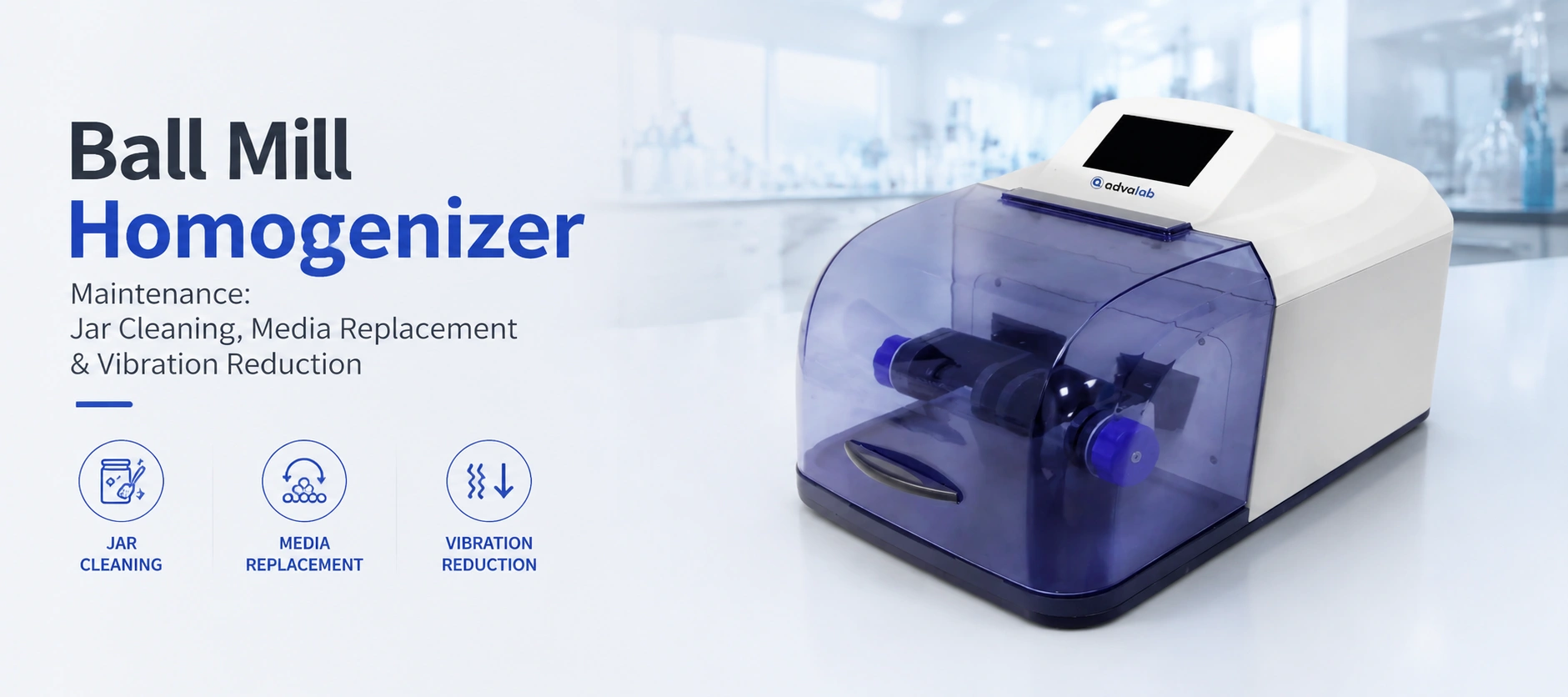
A practical maintenance guide for laboratory, hospital, and research teams running a Ball Mill Homogenizer for sample grinding, particle reduction, and tissue disruption work.
A Ball Mill Homogenizer processes samples by rotating a set of grinding jars filled with small beads, using rapid mechanical motion to break material down to a fine, uniform particle size. Because the jars, beads, and mounting hardware are all in constant motion during a run, the unit needs periodic attention to keep results consistent and to prevent avoidable wear. This guide covers jar cleaning, when to replace grinding media, and how to reduce vibration during operation, so labs running plant, animal, or mineral samples can keep output quality steady over time.
The working principle behind a Ball Mill Homogenizer is straightforward: a motor drives the jar holders through a rapid back-and-forth or rotational motion, and the grinding beads inside each jar collide repeatedly with the sample. These collisions apply shear and impact force that break down plant tissue, animal tissue, soil, or mineral samples into smaller particles. Speed settings on this class of laboratory Homogenizer typically run from roughly 180 rpm up to 2100 rpm, with short acceleration and deceleration windows of around two seconds so the jars reach working speed quickly without an abrupt jolt.
Grinding beads are available across a wide diameter range, often from about 0.1 mm up to 30 mm, and matching bead size to sample type and desired final particle size is part of getting consistent output. Smaller beads suit fine tissue disruption, while larger beads handle tougher or bulkier material.
Jar and bead motion diagram: sample loaded with beads, jar rotation, and impact grinding cycle.
Grinding jars are the part of a ball mill homogenizer that sees the most direct contact with sample material, and leftover residue between runs is one of the most common causes of cross-contamination in a shared lab setting. Both dry and wet grinding leave different types of residue behind, so a cleaning routine needs to account for whichever mode was in use.
Recommended jar cleaning steps after each run:
Labs running a tissue homogenizer workflow across multiple sample types benefit from keeping a dedicated jar set per sample category in the ball mill homogenizer lab area, which reduces cleaning time and lowers the risk of trace carryover between unrelated samples.
Grinding beads wear down gradually with repeated impact, and worn media is one of the more overlooked reasons a ball mill homogenizer stops producing the fine, uniform particle size it once did. Beads made from stainless steel hold up well over many cycles, but they are not permanent components.
Small pits or rough patches on bead surfaces reduce grinding efficiency and can introduce fine metal particles into the sample.
Beads gradually lose diameter through wear, which changes the impact force delivered to the sample over time.
Worn media often needs extra run time to reach the same final particle size, a useful early warning sign.
Metal fines shedding from worn beads can tint sensitive samples, a sign media should be checked and swapped.
When replacing media, matching the new bead diameter to the original sample protocol keeps particle size results comparable across a study. Mixing bead sizes or materials mid-project without documenting the change can make it difficult to explain shifts in output later.
Balanced jar loading across both positions reduces uneven vibration during high-speed cycles.
Because a ball mill homogenizer relies on rapid, repeated motion to process samples, vibration is a normal part of operation, but excessive or uneven vibration points to something that needs attention. Left unaddressed, it can loosen fittings, accelerate wear, and introduce inconsistency into results.
Running the double-position setup with matched jar weights on each side is one of the simplest habits that keeps a ball mill homogenizer machine steady across longer processing batches.
Several recurring mistakes show up when labs are choosing a ball mill homogenizer for a new workflow, often leading to maintenance headaches later:
Reviewing sample capacity, jar material, and bead diameter range against actual lab workflow before purchase avoids many of the jar, media, and vibration issues covered above.
A ball mill homogenizer sits within a wider laboratory homogenizer category that also includes bead mill and other mechanical disruption designs, each suited to different sample types and throughput needs. Buyers evaluating this category typically compare speed range, sample capacity, bead compatibility, and jar material against the kind of material they process most often. The full Ball Mill Homogenizer outlines the configurations available for different batch sizes and grinding requirements. Advalab, the manufacturer behind this range, lists its wider laboratory equipment catalog on its where related sample preparation equipment can also be reviewed.
| Factor | Ball Mill Homogenizer | Bead Mill Homogenizer |
|---|---|---|
| Grinding action | Jar rotation or oscillation with beads inside sealed tubes | High-frequency agitation of beads for rapid tissue disruption |
| Typical sample types | Plant and animal tissue, soil, minerals, dry or wet batches | Cell lysis, small tissue samples, microbial disruption |
| Batch handling | Suited to larger or multiple jars processed together | Suited to smaller tube counts run at higher frequency |
| Maintenance focus | Jar cleaning, media wear, and load balance across positions | Tube sealing and bead-tube compatibility checks |
Labs processing larger or tougher samples tend to lean toward a ball mill homogenizer for its jar capacity and bead diameter range, while smaller, high-throughput tissue work may fit better with a bead mill format. Reviewing the Ball Mill homogenizer Equipment options alongside other homogenizer formats helps match the grinding approach to actual sample volume and type rather than defaulting to one machine for all workflows.
Log bead condition and jar cleaning dates together, so wear patterns and cleaning gaps are easy to cross-reference later.
Match acceleration and deceleration settings to sample fragility, since delicate samples can benefit from gentler ramp-up.
Store spare beads by diameter and material in labeled containers to avoid mixing sizes accidentally during setup.
Keep the protective cover closed during operation, both for user safety and to reduce airborne dust from dry grinding.
Balance jar weight across both positions on each run, not only when vibration is already noticeable.
Review touch screen program settings periodically, since saved protocols can drift from current sample needs over time.