
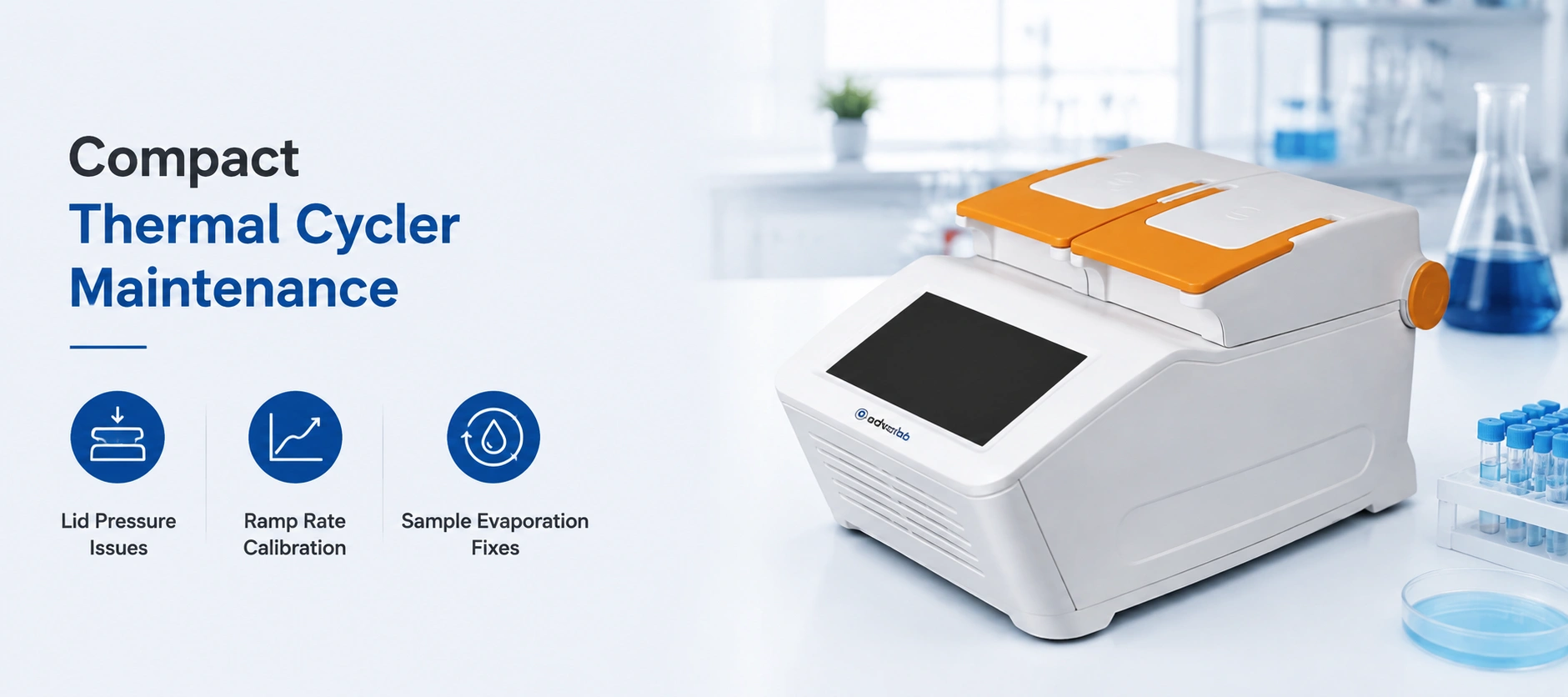
A working reference for laboratory, hospital, and research centre teams on reading lid and ramp-rate warning signs on a compact Thermal Cycler, before a PCR run finishes with a weak or inconsistent result.
Most amplification problems on a Thermal Cycler trace back to one of three areas: a heated lid that is not sealing samples under enough pressure, a block that no longer ramps between temperatures at its expected rate, or evaporation pulling liquid out of the reaction mix during long cycling runs. Each produces a distinct pattern in the results rather than a single generic failure, which makes it possible to narrow the cause down before assuming the block itself needs replacing. Labs sourcing a replacement lid assembly or block often start from the thermal cycler line on the Thermal Cyclers page to check which parts are available for a given compact model.
A thermocycler machine relies on two heated surfaces working in sync: the sample block, which cycles through denaturation, annealing, and extension temperatures, and the heated lid, which presses down on tube caps to stop condensation forming inside during high-temperature stages. A pcr instrument depends on consistent contact between tubes and the block for even heat transfer, and on the lid holding firm downward pressure for the full run. When either element falls short, a run can still complete and still produce a visibly wrong result, since the cycling program itself keeps running regardless of contact quality.
System path: heated lid pressure, block-tube contact, programmed ramp, temperature hold per cycle.
Condensation on tube caps, or reactions that concentrate unevenly toward the bottom of a tube, usually point back to lid pressure rather than the block underneath.
A spring or cam mechanism that has weakened over repeated use applies less downward force than the tube caps need, letting condensation form during high-temperature stages. This tends to appear gradually across many runs rather than all at once.
Consumables slightly taller or shorter than the lid was set for can leave some positions under-pressed even when the mechanism itself is functioning fully. Confirming tube compatibility against the unit's specification avoids this.
Adjustable-height lids left on a setting from a different tube format apply pressure inconsistently across a new plate or strip. Rechecking the height setting against the current consumable resolves this quickly.
Repeated heat cycling can slightly warp a lid surface over its working life, leaving corners of a plate under less pressure than the centre. A visibly uneven contact pattern across a plate points toward this cause.
Ramp rate, how quickly the block moves between temperatures, affects both total run time and how sharply defined an amplified product turns out to be. A few recurring causes explain most drift.
Checking for drift starts with running a verification cycle and timing how long the block takes to move between two known temperatures, then comparing that figure against the specification sheet for the model in use.
Reduced final reaction volume, or a visible ring of dried residue near the tube cap, points to evaporation pulling moisture out during cycling.
When a run finishes with a weak or inconsistent result, working through a short check narrows the cause down faster than adjusting the protocol by guesswork.
Category spans block capacity, ramp speed, gradient function, and control interface.
Thermal cyclers and pcr machines sit within a wider group of amplification and detection equipment, alongside real-time PCR systems that share similar lid and block maintenance needs. Buyers comparing replacement parts or a new compact unit typically weigh lid mechanism design, block material, and available diagnostic checks across the thermal cycler line, laid out in full on the Thermal Cycler category page. The wider molecular biology equipment range sits alongside it on advalab's main website, where related PCR and detection hardware can also be reviewed.
| Factor | Scheduled Ramp Rate Verification | Reactive Checks |
|---|---|---|
| Result confidence | Drift is caught before it affects amplification quality | Weak results may already have accumulated before drift is noticed |
| Run disruption | Verification happens on a planned gap between runs | A failed run discovered afterward forces a repeat with fresh samples |
| Fault isolation | Verification logs help separate lid, block, and evaporation causes quickly | Without a baseline, several causes can look similar after the fact |
| Consumable use | Fewer wasted reagents from runs affected by undetected drift | Repeated runs to confirm a fault add to reagent use over time |
Set a fixed interval for ramp rate verification rather than waiting for a weak result to prompt a check.
Confirm lid height setting any time a different tube or plate format is introduced to a workflow.
Wipe dust from around the fan intake and heat sink on a regular cleaning schedule, not only when ramp rate slows.
Keep a spare lid gasket on hand for labs running the cycler across long, continuous testing days.
Log which tube positions showed evaporation, since a pattern limited to plate edges often points to lid contact rather than a tube defect.
Train staff to check cap seating before loading a plate, since a partially open cap is easy to miss under time pressure.