
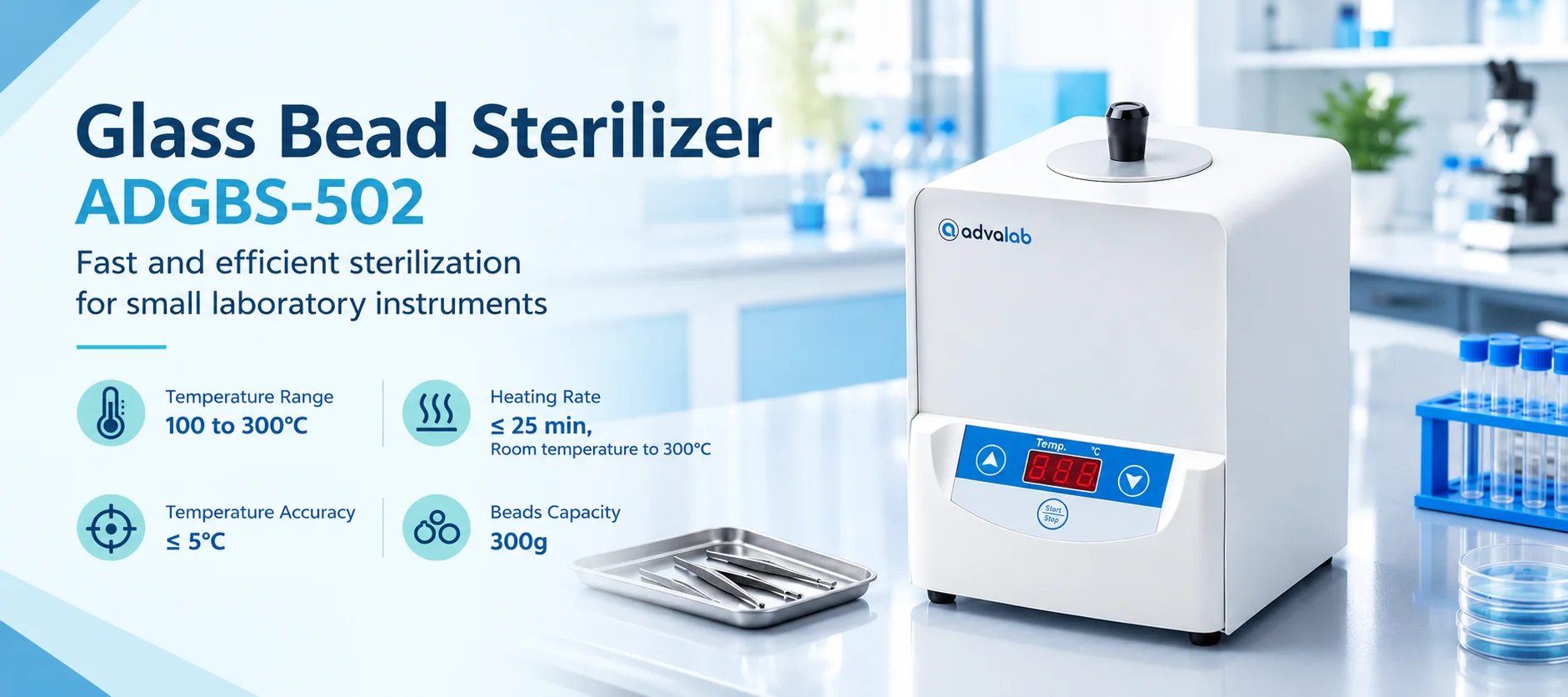
Small laboratory instruments often require repeated sterilization during daily bench work. Glass bead sterilizers use heated beads to support rapid treatment of compatible instrument tips. Before choosing a unit, consider its temperature range, accuracy, heating time, bead capacity, and instrument compatibility. These factors help determine whether the equipment suits your laboratory workflow.
A bench session rarely uses a tool once. Forceps, probes, and small glass utensils return to the work area again and again, and each return raises the same question: is this tool ready for the next sample? A slow answer interrupts the procedure, while a skipped step risks contamination.
The Advalab Glass Bead Sterilizer ADGBS-502 It works from 100 to 300 °C, holds 300 g of beads, and includes an automatic cooling system.
A glass bead sterilizer is used for fast sterilization of small metal and glass utensils in scientific research laboratories. Dry heat passes from hot beads to the surface of the tool, which leaves it free of bacteria, viruses, and other microorganisms without chemical disinfectants.
Suppliers list the equipment under several names, including bead sterilizer, hot bead sterilizer, glass sterilizer, and dry glass bead sterilizer. In research settings the unit also heats and processes small samples, so its common glass bead sterilizer uses reach beyond tool decontamination.
People who look up “glass bead sterilizer how it works” usually want the heat path first. A heating element warms a tank filled with sterilizer beads, and the packed glass spheres spread that heat evenly. A tool tip pushed into the tank touches hot surfaces from several sides at once, so the surface temperature rises quickly without water, steam, or pressure.
Because the heated mass is small, the glass bead sterilizer machine stays compact, and the listing describes its heating as precise and uniform across repeated cycles.
The ADGBS-502 operates from 100 to 300 °C with an accuracy of ≤ 5 °C. Higher bead temperatures shorten the exposure needed, and a typical exposure lasts 5 to 10 seconds. Larger or denser tools absorb heat more slowly and need a little longer.
Follow your laboratory's sterilization protocol for the set temperature and the exposure time, since those values rely on the tool and the procedure.
Fast turnaround of small metal and glass utensils between samples.
Compact bench-side readiness for small instruments.
A shared unit that serves several users during one session.
Heating and processing of small samples in scientific research.
Readers who search for “glass bead sterilizer how to use” usually want a short sequence. Follow the instruction manual for exact operation; the general routine has five steps.
The beads warm from room temperature to 300 °C in 25 minutes or less.
The tool tip enters a φ40 mm tank that is 140 mm deep and holds 300 g of beads.
Exposure usually lasts 5 to 10 seconds, and longer for larger or denser tools.
The tool leaves the tank while the handle stays outside the heat zone.
The automatic cooling system helps the unit return to a safe temperature.
Read the five steps in order, from heating to cooling.
The tiles summarize the published figures for this glass bead sterilizer, and the bars show where the ADGBS-502 differs from the ADGBS-501: a deeper tank and double the bead mass.
Tank depth
Beads capacity
The two models in each bar group share one scale.
The ADGBS-503 and ADGBS-504 share the temperature range and add a display accuracy of 1 °C.
Each route suits a different load, and the full range of sterilizers from Advalab shows how widely those loads vary. A bead tank resets small tools within seconds, while chamber-based routes handle batches.
| Route | Typical load | Heating approach |
|---|---|---|
| Glass bead sterilizer | Small metal and glass utensils | Dry heat at 100 to 300 °C, exposure in seconds |
| Hot air sterilizer | Glassware and instruments in racks | Chambers of 64 to 452 L at 5 to 300 °C |
| Electric heated sterilizer | Steam-based batch loads | 35 to 150 L chambers at 105 to 134 °C and 0.23 MPa |
| Horizontal sterilizer | Large batch loads | 150 to 280 L chambers at 40 to 134 °C, drying timer up to 99 min |
Advalab, a manufacturer of laboratory equipment based in the United States, groups heat-based sterilizers into several families: bead tanks, electric heated steam units, horizontal pressure and horizontal sterilizers, bacti-cinerators, and hot air units. The glass bead models are the smallest and quickest of these.
When options inside the family are evaluated, laboratories usually weigh the type and size of the load, the temperature range, the exposure or cycle time, the chamber or tank dimensions, the power supply, and the bench or floor space. The complete range of sterilizers makes it easy to review those points side by side.
Hazel Daniels
Specialty: Healthcare Technology & Laboratory Equipment
Writing Style: Professional, informative, and reader-friendly
Bio: Hazel Daniels specializes in writing about healthcare technology, laboratory equipment, and scientific applications. She presents technical information in simple language, highlighting practical uses and industry developments.