
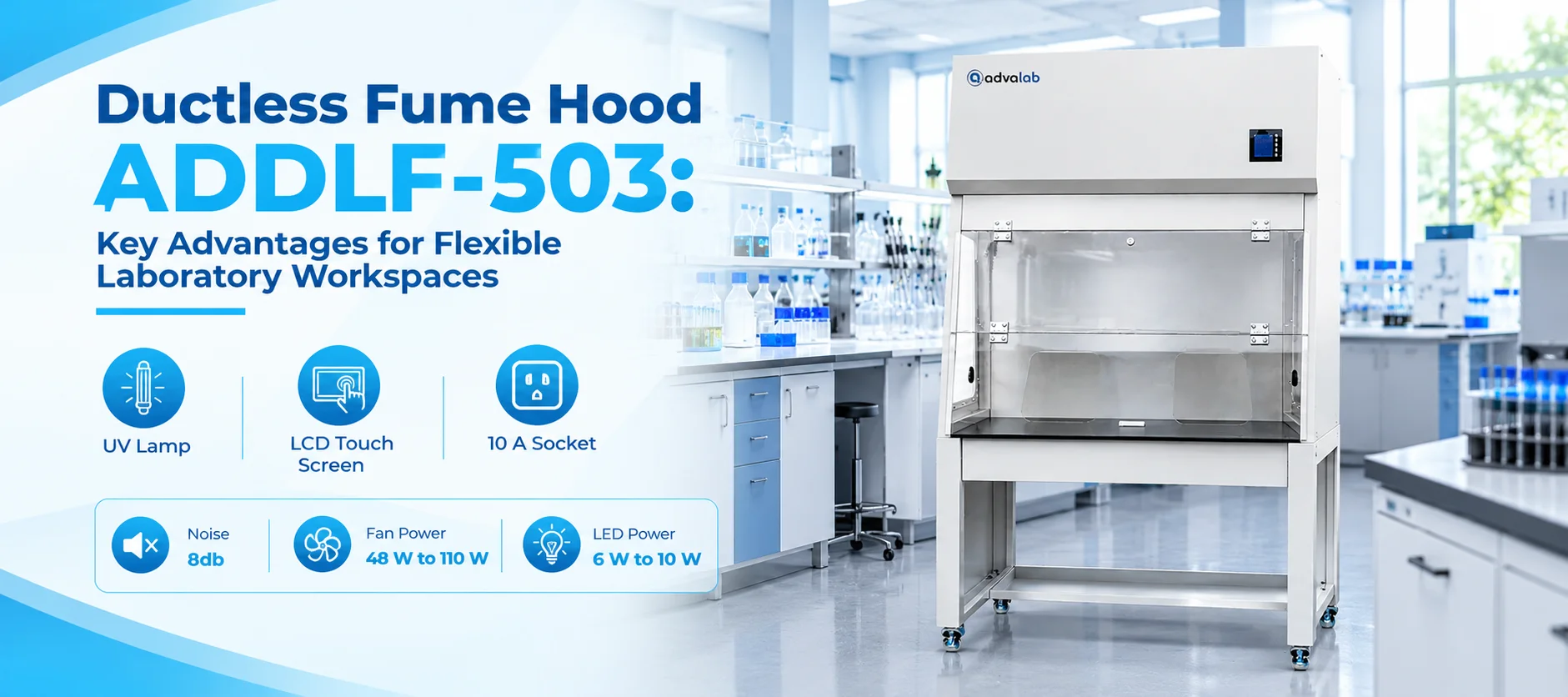
Chemical work needs controlled airflow, but many rooms cannot take a duct. A rented bay, a shared teaching lab or a space with no route to the roof leaves a ducted hood out of reach, and open-bench work leaves the fumes in the room.
One answer is a unit that cleans the air itself and returns it to the room. The Advalab ADDLF-503 does this with filters instead of a duct, and its listing publishes air treatment, power, materials, size and weight, so a team can judge the fit before ordering.
A Ductless Fume Hood suits a laboratory only when its filters match the chemicals in use. This article explains the working principle, ten published benefits, how the filters decide what is safe to handle, typical uses and the mistakes to avoid, and then the next step: confirm the open points with the supplier and review the full listing.
A Ductless Fume Hood how does it work question has a short answer. A fan draws air from the work area into the unit, the air passes through filters that hold back the contaminants, and the cleaned air returns to the room. The Advalab listing says the unit requires no external ducting and recirculates clean air back into the room, and the product notes describe a negative pressure airflow that pulls contaminants away from the operator.
The filtration rely on the chemicals. The listing states that the filtration system can be customized to the type of chemicals used, and the product notes name activated carbon for chemical vapors and optional HEPA filters for particles. That makes the filter choice the center of the whole design, because the room gets back only what the filters fail to capture.
Illustrative flow, not to scale: the general path of air through a recirculating hood. There is no duct to the outside.
Each benefit below ties to a specification or feature published for the ADDLF-503.
The listing says the unit requires no external ducting, so installation stays simple.
The unit filters two hundred twenty to twelve hundred cubic meters of air per hour.
Clean air returns to the room, so conditioned air stays indoors.
The filtration system can be matched to the type of chemicals used.
LED power of six to ten watts lights the work area.
Fan power is listed at forty-eight to one hundred ten watts.
The main body is one millimeter cold-rolled steel with an epoxy powder coating.
The work top is a twelve point seven millimeter solid physiochemical board, with ceramic or stainless steel as options.
A universal caster set is included, so the unit can be repositioned.
An LCD touch screen is listed among the included accessories.
Infographic: airflow, power, size and weight figures from the ADDLF-503 listing.
Ductless Fume Hood filters are the only barrier between the work area and the room, so they deserve more attention than any other part. The product notes describe activated carbon filters for chemical vapor adsorption and optional HEPA filters for particulate removal, selected to suit the chemicals used.
Filters hold a limited amount before they saturate. The notes give an average carbon filter life of about six to twelve months under regular conditions, and say it rely on the chemicals, their concentration and how often the hood is used. They also mention saturation indicators, but the listing does not tie those to this model, so ask the supplier how saturation is detected and how a team should log filter changes.
The notes are also direct about limits: some highly toxic chemicals need more specialized containment, and gases that the carbon cannot filter call for a ducted system. Review your chemical list against the filter options before any purchase.
The Advalab listing says the unit is used in laboratories, research and forensics to filter fumes without external ventilation, and its applications note names biotechnology, clinical laboratories and quality control. The product notes add educational institutions, pharmaceutical testing, and temporary or shared lab spaces.
Teams weighing ductless fume hood use against a ducted type should list the chemicals first, since that list decides whether filtration is enough. A ductless fume hood for lab work that handles a few known solvents in small volumes is a different case from one that sees many unknown reagents.
Match these published figures against your own chemicals and room before shortlisting a ductless fume hood for lab use:
| Model | External size (L × W × H) | Internal size (L × W × H) | Air treatment |
|---|---|---|---|
| ADDLF-502 | One thousand by six hundred fifty by one thousand nine hundred millimeters | Nine hundred twenty by six hundred twenty by seven hundred millimeters | Two hundred twenty to twelve hundred cubic meters per hour |
| ADDLF-503 | One thousand two hundred by six hundred fifty by one thousand nine hundred millimeters | One thousand one hundred twenty-five by six hundred twenty by seven hundred millimeters | Two hundred twenty to twelve hundred cubic meters per hour |
| ADDLF-505 | One thousand five hundred by six hundred fifty by one thousand nine hundred millimeters | One thousand four hundred twenty-five by six hundred twenty by seven hundred millimeters | Two hundred twenty to twelve hundred cubic meters per hour |
These three differ mainly in size. The ADDLF-501 lists its external and internal sizes in an order that looks swapped, so check its page directly. Other ductless models are described by filter modules and air pressure instead: the ADFD-504 lists three modules and seven hundred twenty pascals, the ADFD-506 lists four modules and nine hundred sixty pascals, and the ADFD-507 lists its filter size.
Infographic: ductless fume hood models with comparable listings. The size is the main difference between them.
The fume hoods category at Advalab covers several families: the ductless fume hood range, the ducted fume hood range, the ducted benchtop fume hood range, the PP spray fume hood range and the PP fume hood range. Ductless types pass air through filters and return it to the room, while ducted types send it outside through a duct.
When laboratories compare options in this category, they typically weigh working size, air volume, filter or duct requirements, interior and surface materials, noise, lighting and the accessories included. To review all families side by side, explore the full fume hoods range, or see the wider laboratory equipment catalog on the Advalab home page.
The Ductless Fume Hood ADDLF-503 pairs filtered recirculation and an air treatment range of two hundred twenty to twelve hundred cubic meters per hour with a coated steel body, a physiochemical worktop and universal casters. It suits laboratories that cannot add a duct and work with a known, filterable set of chemicals.
Hazel Daniels
Specialty: Healthcare Technology & Laboratory Equipment
Writing Style: Professional, informative, and reader-friendly
Bio: Hazel Daniels specializes in writing about healthcare technology, laboratory equipment, and scientific applications. She presents technical information in simple language, highlighting practical uses and industry developments.
Review the published airflow, power, material, size and accessory details for this ductless fume hood and compare them against your own chemicals and room.
Explore Ductless Fume Hood ADDLF-503