
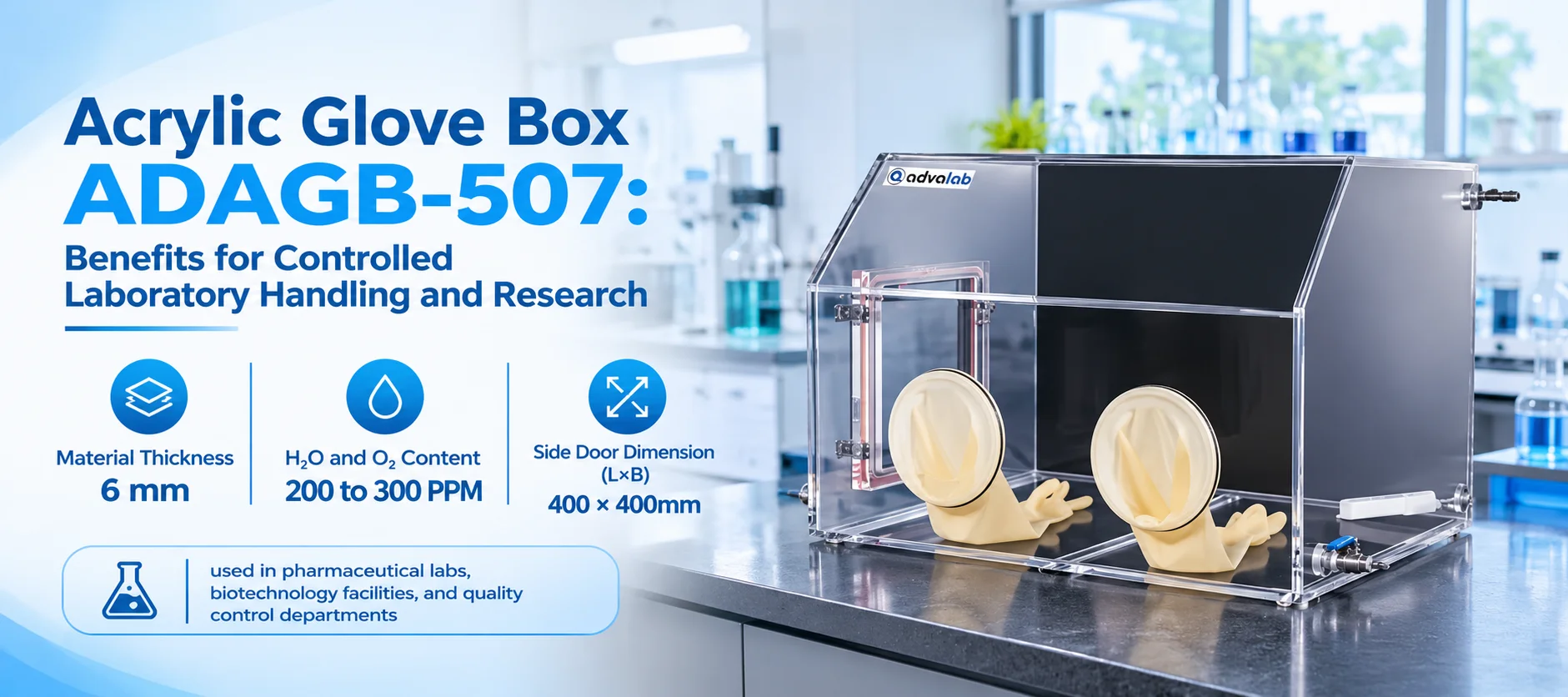
An Acrylic Glove Box is a sealed, transparent enclosure with built-in glove ports that lets an operator handle materials inside a controlled atmosphere without direct contact. Gas connections let the chamber be evacuated and purged, so moisture and oxygen levels inside can be held below those of room air while the work stays fully visible.
Terms such as laboratory glove box and ab glove box are used loosely for the same family of sealed handling enclosures. As glove box laboratory equipment, the acrylic type sits between an open bench and a stainless steel chamber with a gas purification system.
The Acrylic Glove Box working principle is displacement. Room air is removed from the sealed chamber, and a drier or inert gas takes its place, so the atmosphere around the sample changes while the operator works through the gloves. The cycle runs in five stages.
Materials and tools pass in through the door.
The door closes against its seal.
A vacuum line draws room air out through the valve.
Dry or inert gas refills the chamber.
The operator handles samples through the gloves.
Understanding how an Acrylic Glove Box works also means knowing where it leaks. Each opening of a door admits room air, so the chamber is normally purged again after loading. Searches for an Acrylic Glove Box holder usually point to the glove ports and sealing rings that hold each glove in the chamber wall, and those rings are where leak-tightness is won or lost.
Each listed feature of the ADAGB-507 handles one part of the cycle above. The graphic maps the components to their jobs.
1200 × 800 × 700 mm in 6 mm transparent acrylic for full visibility.
400 × 400 mm opening for loading and unloading.
Corrosion-resistant latex gloves with sealing rings.
304 stainless steel valve for vacuuming and gas purging.
Multi-hole sockets for instruments inside the chamber.
Reserved port for adding accessories later.
The table lists values published on the ADAGB-507 product page and explains how each one affects planning.
| Parameter | ADAGB-507 listing | Why it matters |
|---|---|---|
| Main chamber (L × B × H) | 1200 × 800 × 700 mm | Sets the largest apparatus and containers that fit |
| Material thickness | 6 mm | Affects the rigidity of the transparent walls |
| H₂O and O₂ content | 200 to 300 ppm | Reports the atmosphere level; compare it with the tolerance of the work |
| Side door (L × B) | 400 × 400 mm | Limits the size of items passed in and out |
| Ball valve | 304 stainless steel, with integrated nozzles for air or water entry | Connects vacuum and purge gas to the chamber |
| Power socket | Multi-hole power sockets | Supplies instruments used inside the chamber |
| Reserved interface | KF interface | Allows accessories to be connected later |
| Packing dimensions (L × B × H) | 1580 × 920 × 920 mm | Determines doorway and delivery access |
| Net weight | 56 kg | Affects bench or stand loading |
The listing does not state a vacuum level, a gas-flow rating, or the conditions behind the 200 to 300 ppm figure. Ask for all three before planning purge cycles. By arithmetic, the main chamber holds about 672 L, and flushing normally takes several chamber volumes of gas, so the gas supply should be sized accordingly.
The ADAGB-507 listing names pharmaceutical laboratories, biotechnology facilities, and quality control departments, and describes the unit as suited to research, testing, and experiments needing a low-moisture, oxygen-controlled environment. Acrylic glove box use falls into a few clear patterns.
Weighing hygroscopic powders, transferring air-sensitive reagents, and running short synthesis steps that tolerate hundreds of ppm of moisture and oxygen.
Protecting samples during testing and development, where room humidity would alter results or degrade material.
Preparing moisture-sensitive samples in a stable atmosphere so repeat tests start from the same conditions.
Keeping fine or hazardous material behind a physical barrier while the operator works through the gloves.
A consistent routine matters more than any single feature, because most atmosphere problems begin at loading or at a worn seal. A typical sequence follows.
The listing does not publish an operating procedure, so the supplier manual remains the source for purge sequences and gas connections. Some cleaning solvents craze or cloud acrylic, so confirm compatibility first. Inert gas can displace oxygen in a closed room, so keep the room ventilated.
Selection starts with how much moisture and oxygen the work can tolerate, not with chamber size. Units differ widely in this respect across the full glove box range, so match the atmosphere level first and the dimensions second.
| Requirement | Consider |
|---|---|
| Moisture-tolerant handling at hundreds of ppm | An acrylic glove box with a listed range such as 200 to 300 ppm |
| Work needing less than 1 ppm of H₂O and O₂ | A purification-type glove box with a circulating purifier |
| Frequent loading of items | A model with an antechamber, such as the ADAGB-513 |
| Large apparatus inside the chamber | Main chamber size and side door opening, checked against the apparatus |
| Instruments powered inside | Power sockets and a spare KF interface |
| Limited bench space | Overall size, packing size for access, and weight of the unit |
The scale is logarithmic, so each step down is a factor of ten or more, not a linear drop. The room-air figure is general knowledge for oxygen alone. The other two come from the listed H₂O and O₂ values on Advalab product pages.
The acrylic glove box range lists models by chamber size. The two largest share the same main chamber, and the difference is how items enter.
| Parameter | ADAGB-507 | ADAGB-513 |
|---|---|---|
| Main chamber (L × B × H) | 1200 × 800 × 700 mm | 1200 × 800 × 700 mm |
| Antechamber (L × B × H) | Not listed; side door 400 × 400 mm | 260 × 260 × 260 mm |
| H₂O and O₂ content | 200 to 300 ppm | 200 to 300 ppm |
Smaller chambers are listed for tighter bench space: ADAGB-502 at 700 × 450 × 550 mm, ADAGB-503 at 800 × 550 × 600 mm, and ADAGB-504 at 900 × 500 × 500 mm. All list the same 200 to 300 ppm range, so chamber size and loading method are what separate them.
The ADAGB-507 belongs to a category with three ranges: acrylic glove boxes, stainless steel glove boxes, and gas purification glove boxes. Stainless steel units list a vacuum degree of -0.1 MPa, and gas purification units list H₂O and O₂ levels below 1 ppm with nitrogen or argon as the working gas.
When comparing options in this category, teams usually weigh chamber size, wall material, atmosphere level, purification capability, antechamber, vacuum capability, ports and interfaces, and footprint. The full set of models is listed on the glove boxes category page, and further laboratory equipment is available from the Advalab home page.
An acrylic glove box earns its place when work needs a visible, sealed, low-moisture space but not the single-digit ppm levels of a purified system. The ADAGB-507 pairs a large 6 mm acrylic chamber, sealed gloves, a stainless steel ball valve, and a spare KF interface. Matching atmosphere level, loading method, and gas supply to the work turns a specification list into a sound selection.
Hazel Daniels
Specialty: Healthcare Technology & Laboratory Equipment
Writing Style: Professional, informative, and reader-friendly
Bio: Hazel Daniels specializes in writing about healthcare technology, laboratory equipment, and scientific applications. She presents technical information in simple language, highlighting practical uses and industry developments.
www.linkedin.com/in/hazel-daniels-4a108b444