
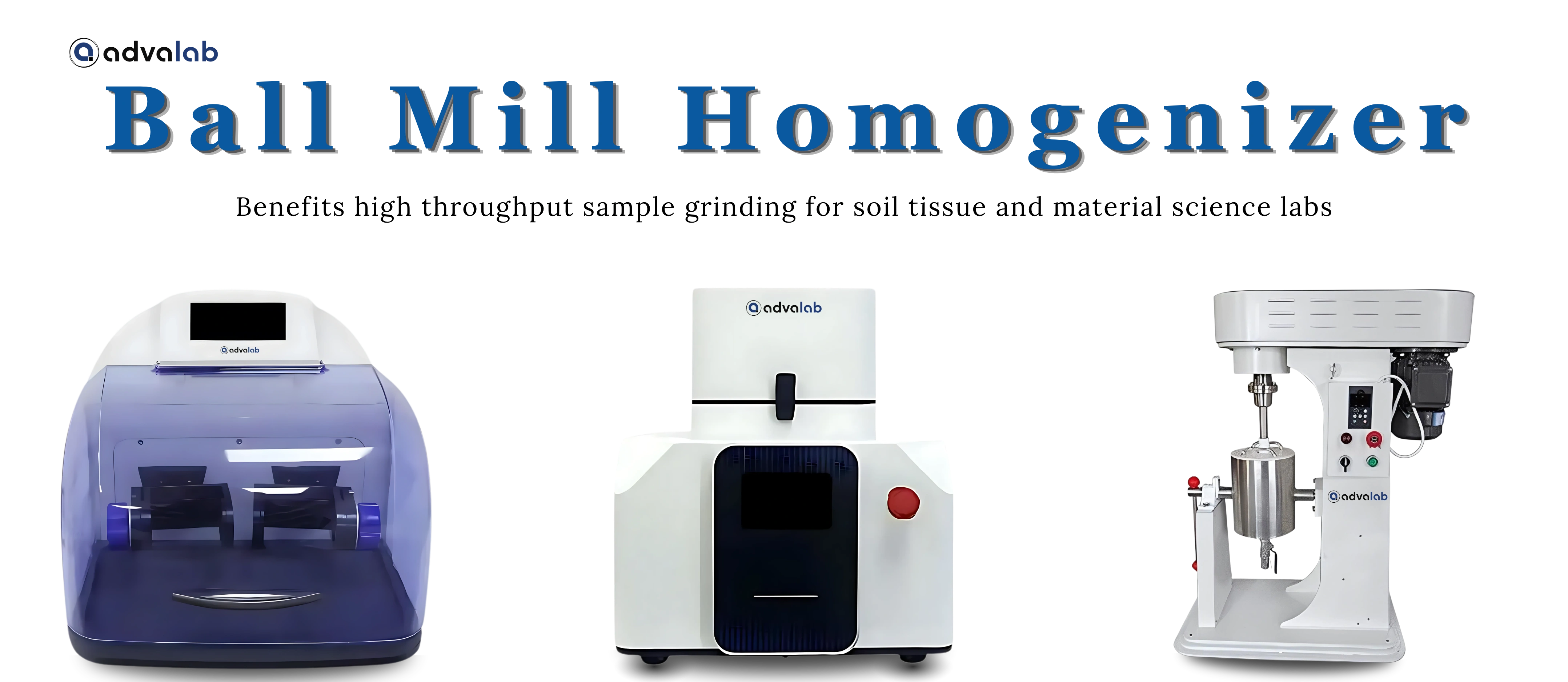
High-speed bead-milling systems with sealed chamber technology — delivering uniform particle reduction, precise homogenization, and cross-contamination prevention across pharmaceutical, chemical, materials science, and life science applications.
Ball Mill Homogenizers use steel or ceramic beads loaded into sealed jars to break down samples through high-speed, multidirectional shaking. As the jars oscillate or rotate at programmable speeds, the beads collide with sample material — generating intense shear, impact, and friction forces that rupture cell walls, reduce particle size, and create homogeneous suspensions or extracts within minutes.
The enclosed chamber design is fundamental to the system's versatility: samples are never exposed to ambient air during processing, preventing volatile compound evaporation, protecting oxygen-sensitive materials, and eliminating aerosol-based cross-contamination between samples. This makes the Ball Mill Homogenizer the preferred choice for nucleic acid extraction from tissue, fine particle production in pharmaceutical manufacturing, and mechanical alloying in materials research.
Adjustable speed (typically 100–3,000 rpm or equivalent oscillation frequency) and programmable cycle times allow operators to tailor the energy input to each sample type, preventing over-processing of sensitive biological materials while delivering sufficient force for hard mineral or polymer matrices. The compact footprint and intuitive interface of the Advalab ADBAM series make these instruments equally suited to benchtop research and QC laboratory environments.
Bead Mill Working Principle
High-speed oscillation drives beads against sample material — generating shear and impact forces within the sealed chamber.
Ball Mill Homogenizer — Operating Workflow
Each processing jar seals completely before operation. This prevents cross-contamination between samples, protects volatile compounds from evaporation, and eliminates aerosol exposure for the operator during high-energy processing cycles.
Programmable oscillation speed and cycle duration allow precise energy input control for diverse sample types — from soft mammalian tissue to hard mineral matrices — without over-processing sensitive biological materials.
Models accommodate multiple jars simultaneously, enabling parallel processing of different samples in a single run cycle and significantly increasing throughput for high-volume laboratory workflows.
Compatible with stainless-steel, zirconia, tungsten carbide, and borosilicate glass beads across a range of diameters (0.1–6.0 mm), providing flexibility across biological, chemical, and materials science sample types.
LCD or touchscreen control panel with clear parameter display, preset programme storage, and run status indicators. Designed for single-hand operation and accessible to first-time users without extended training.
Space-efficient cabinet dimensions allow installation in standard fume hoods, BSC cabinets, or restricted benchtop environments. Rubber-dampened base minimises vibration transmission to adjacent instruments.
Application Areas
Active pharmaceutical ingredient (API) particle size reduction, nano-suspension production, and co-grinding for solid dispersion formulation. The sealed environment prevents contamination of potent compounds during processing.
Mechanical cell lysis for difficult-to-lyse organisms (yeast, fungi, bacteria with thick cell walls), nucleic acid and protein extraction from tissue and plant material, and preparation of cell-free extracts for enzymatic assays.
Mechanical alloying, nano-material synthesis, polymer blending, catalyst preparation, and pigment dispersion. The high-energy milling environment achieves sub-micron particle reduction in hard inorganic matrices not achievable by rotor-stator methods.
Three models are available across the ADBAM series, each offering a distinct combination of capacity, speed range, and jar configuration to match specific laboratory throughput and sample volume requirements.
Suited for single-operator use, small-volume biological samples, and routine homogenisation tasks. Compatible with stainless steel and ceramic bead types.
Mid-range model with interval-mode programming for heat-sensitive samples. Handles four jars simultaneously for parallel processing workflows in pharmaceutical and life science labs.
High-throughput model with multi-step programmable cycles, eight-jar parallel capacity, and RS-232 connectivity. Designed for QC laboratories, materials research, and high-volume pharmaceutical workflows.
Full parameter comparison across all three Ball Mill Homogenizer models. Badges indicate the applicable standards for each parameter group.
Use the comparison table to identify the model that best matches your throughput requirements, sample volume range, and operational complexity.
| Feature / Capability | ADBAM-501 | ADBAM-502 ★ | ADBAM-503 |
|---|---|---|---|
| Max. speed | 2,500 rpm | 3,000 rpm | 3,000 rpm |
| Parallel jar slots | 2 | 4 | 8 |
| Max. sample volume | 40 mL | 80 mL | 160 mL |
| Interval (pulse) mode | |||
| Multi-step programme | |||
| Zirconia bead compat. | |||
| Tungsten carbide beads | |||
| Touchscreen display | |||
| RS-232 connectivity | |||
| Motor power | 150 W | 300 W | 500 W |
| Net weight | 8.5 kg | 14 kg | 22 kg |
| Recommended for | Small-volume routine lab work | Mid-throughput pharma & life science | High-volume QC & materials research |
★ ADBAM-502 highlighted as the most frequently selected model for general-purpose laboratory homogenisation workflows.
View complete model configurations, accessories, dimensional drawings, and compliance documentation for the Advalab Ball Mill Homogenizer range.