
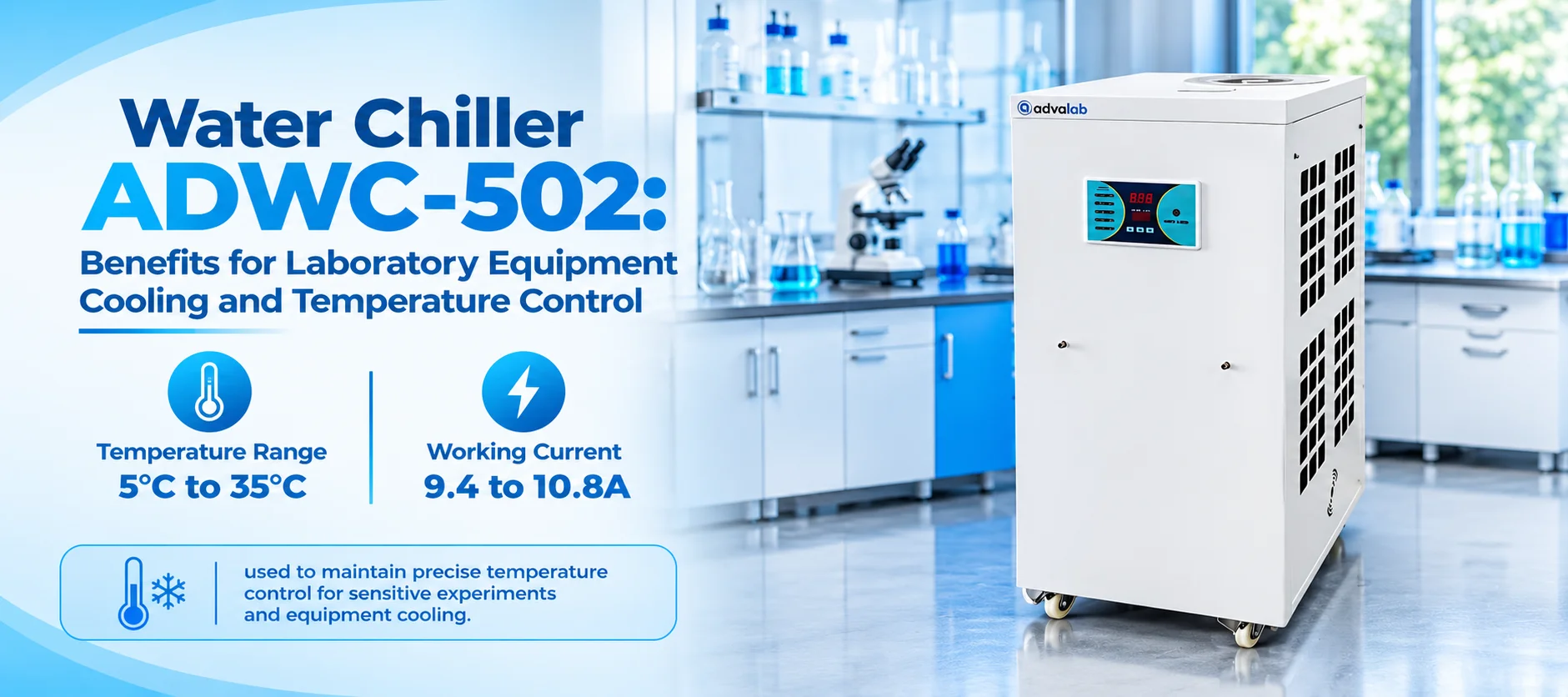
A Water Chiller is a refrigeration machine that cools a circulating water loop to a set temperature and pumps that water through the equipment that needs cooling. The water absorbs heat from the instrument, returns to the chiller, and leaves cold again, so the instrument stays at a steady operating temperature.
Terms such as industrial water cooler, Water Chiller machine, and Water Chiller system all describe this equipment. An industrial water chiller or industrial chiller usually implies a larger unit running for long periods, and the ADWC-502 is an upright cabinet of 550 × 505 × 972 mm that sits between bench-scale recirculating coolers and plant-scale equipment.
A Water Chiller works as two linked loops. The water loop carries heat away from the instrument, and the refrigeration loop moves that heat out of the water. The diagram follows one full circuit.
Circulating water absorbs heat from the instrument.
Warm water flows back to the chiller tank.
The evaporator passes the heat to the refrigerant.
Compressor and condenser move the heat out of the refrigerant.
Cooled water is pumped back to the instrument at the setpoint.
Step 4 is where chillers differ. A water cooled chiller rejects condenser heat into a water supply, while an air-cooled unit sends it into room air, and that choice sets site needs: a water connection and drain in one case, ventilation clearance in the other. The ADWC-502 FAQ describes a water-cooled method but the specification table does not name the condenser type, so confirm it with the supplier before planning the installation.
The ADWC-502 listing describes use for cooling sensitive laboratory instruments and for heat produced during high-energy pulses, with chromatography, spectroscopy, and medical device cooling named as examples. It also lists industrial and commercial applications.
Systems that need steady column and detector temperature.
Instruments whose sources and optics warm during use.
Equipment cooled to stay within safe operating limits.
Heat produced during high-energy pulses.
Process equipment that runs for long periods.
The table lists values published on the ADWC-502 product page and explains how each one affects planning.
| Parameter | ADWC-502 listing | Why it matters |
|---|---|---|
| Temperature range | 5 °C to 35 °C | Sets the lowest and highest water temperature the unit can supply |
| Refrigeration capacity | 5.48 kW | Indicates how much heat the unit can remove; the main sizing figure |
| Compressor power | 2 HP | Reflects the refrigeration stage that supports the capacity |
| Water tank volume | 24 L | Provides coolant reserve and buffers temperature swings |
| Flow meter | 2.0 L/min (as listed) | Indicates water flow; confirm whether it is pump flow or meter range |
| Working current | 9.4 to 10.8 A | Informs circuit and supply planning |
| Dimensions (L × B × H) | 550 × 505 × 972 mm | Determines floor space and doorway clearance |
| Weight | 80 kg net; 90 kg gross | Affects handling and floor loading |
| Packaging dimensions | 570 × 520 × 1000 mm | Determines delivery access |
Corrosion-resistant piping and heat exchangers, a closed-loop water cooling circuit, and a user interface described as intuitive.
A Water Chiller lab installation is only as sound as its connections, so setup deserves the same care as the instrument being cooled. A typical sequence follows.
Selection starts with the heat the instrument produces, not with the catalog. Chillers differ in capacity, temperature range, and flow across the full laboratory chiller range, so settle the heat load first and match the unit to it.
| Requirement | Consider |
|---|---|
| Instrument with a stated heat load in kW | Refrigeration capacity above that load, with margin for room temperature |
| Instrument that specifies a flow rate | Pump flow at the loop's pressure drop, not only chiller capacity |
| Setpoint below about 5 °C | A low temperature circulating chiller rather than a general-purpose water chiller |
| Room with no water supply or drain | Confirmation of the condenser type before installation |
| Several instruments on one loop | Combined heat load and a tank volume that buffers swings |
| Tight floor space | Footprint, height, and weight of the cabinet |
Capacity and flow work together. The heat carried away equals the water flow times the temperature rise times the specific heat of water, so a chiller with ample capacity still fails if the flow is too low. The graphic shows the flow needed to carry a given load at a 5 °C rise.
Calculated for water with a 5 °C temperature rise. Real needs vary with coolant type and line losses. The ADWC-502 lists 2.0 L/min under the label flow meter, so ask what that figure represents.
The water chiller range lists models that share the same 5 °C to 35 °C temperature range and step up in capacity.
| Parameter | ADWC-502 | ADWC-503 | ADWC-504 |
|---|---|---|---|
| Temperature range | 5 °C to 35 °C | 5 °C to 35 °C | 5 °C to 35 °C |
| Refrigeration capacity | 5.48 kW | 8.5 kW | 15 kW (listed as kW/h) |
| Water flow | 2.0 L/min (flow meter) | Not listed | 100 L/min |
Two further models list a different format: ADWC-510 is described as an integrated air cooling system and ADWC-511 as an integrated water cooling system, both with cooling capacity of at least 1.2 kW and a pressure of 0.08 to 0.17 MPa. The listings use different parameters across models, so compare capacity, flow, and cooling method side by side on each product page.
The ADWC-502 belongs to a category with four ranges: water chillers, low temperature circulating chillers, air cooled chillers, and laser chillers. Listed temperature ranges reach -45 °C in the low temperature range, listed capacities reach 28 kW in the air cooled range, and the laser range lists 5 °C to 30 °C.
When comparing options in this category, teams usually weigh temperature range, cooling capacity, flow rate, tank volume, cooling method, control accuracy, footprint, and power draw. The full set of models is listed on the laboratory chillers page, and further laboratory equipment is available from the Advalab home page.
A water chiller earns its place when instrument heat, not the instrument itself, limits how long and how steadily an experiment can run. The ADWC-502 pairs 5.48 kW of capacity, a 2 HP compressor, a 24 L tank, and a closed-loop circuit for laboratory and commercial cooling. Matching heat load, flow, condenser type, and site conditions to the equipment turns a specification list into a sound selection.
Hazel Daniels
Specialty: Healthcare Technology & Laboratory Equipment
Writing Style: Professional, informative, and reader-friendly
Bio: Hazel Daniels specializes in writing about healthcare technology, laboratory equipment, and scientific applications. She presents technical information in simple language, highlighting practical uses and industry developments.