
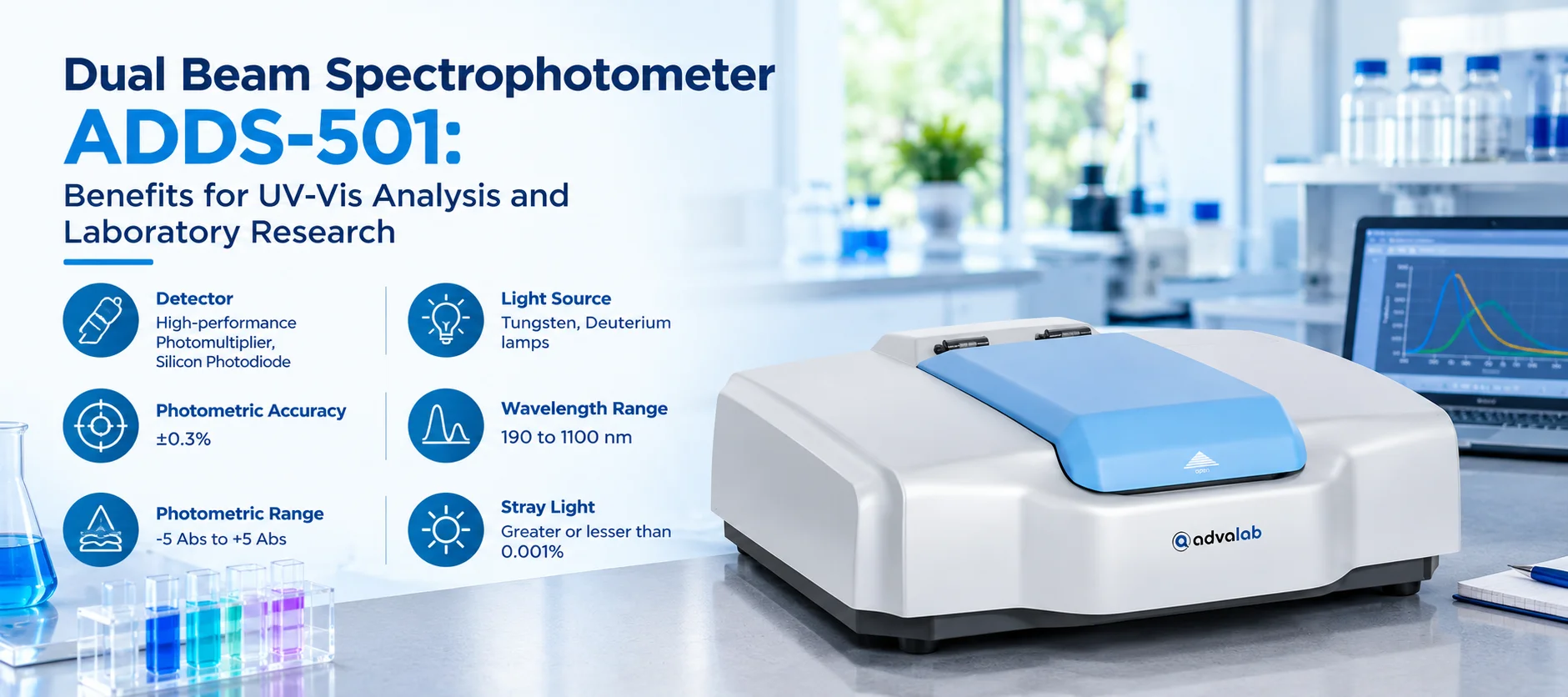
A lamp ages, its output wobbles, and a reading that looked steady at the start of a run creeps by the end. A laboratory that measures nucleic acids, proteins or blood samples cannot always tell whether a change came from the sample or from the instrument. Repeat runs follow, and confidence in the data drops.
A dual beam spectrophotometer addresses that problem by measuring the sample and a reference together. The Advalab ADDS-501 publishes its wavelength range, bandwidth options, accuracy, stability, detectors and lamps, so a team can judge the fit before ordering.
A Dual Beam Spectrophotometer suits a laboratory only when its published figures match the methods it must run. This article explains the working principle, published benefits, typical uses, a sample routine and the mistakes to avoid, and then the next step: confirm the open points with the supplier and review the full listing.
People who ask about the Dual Beam Spectrophotometer working principle want a short answer. A Dual Beam Spectrophotometer splits the light into two beams. One beam passes through the sample, the other through a reference, and the detector compares them in real time. The same logic applies to any dual beam spectrometer, and the Advalab product notes say this arrangement compensates for variations in light intensity, and that a reference cuvette corrects for background noise.
Knowing the Dual Beam Spectrophotometer principle helps staff read results with care, and the Double Beam Spectrophotometer working steps are easy to follow in the Double Beam Spectrophotometer diagram below. A single beam instrument measures the reference first and the sample later, so any lamp drift between the two readings appears as error. A double beam design takes both measurements at once. The listing names tungsten and deuterium lamps and two detectors, a photomultiplier and a silicon photodiode, across the ultraviolet and visible range. To see how related instruments compare, browse the spectrophotometers range.
Illustrative flow, not to scale: the general optical path of a double beam instrument, as described in the ADDS-501 product notes.
Without a reference path, results shift for a few predictable reasons:
A dual beam spectrophotometer with a reference beam, two lamps and a stated stability addresses these points, provided the published numbers match the method.
Each benefit below ties to a specification or feature published for the ADDS-501.
The range runs from one hundred ninety to eleven hundred nanometers, across ultraviolet and visible light.
Tungsten and deuterium lamps provide a full range of light output.
A photomultiplier and a silicon photodiode detect light across the spectrum.
Spectral bandwidth can be changed for flexible resolution.
Wavelength accuracy is plus or minus zero point three nanometer, and photometric accuracy is plus or minus zero point three percent.
The photometric range runs from minus five to plus five absorbance.
Stability is listed as two ten-thousandths of an absorbance unit per hour at five hundred nanometers.
Software supports operation and data processing.
Infographic: wavelength, accuracy, stability and weight figures from the ADDS-501 listing.
The Advalab listing says the ADDS-501 is widely used in research and laboratory settings for measuring DNA, RNA and protein extraction, and for analyzing blood and other biological samples. The product notes add that a double beam spectrophotometer can analyze liquids and some transparent solids, which suits chemistry, biology and environmental science. A double beam spectrophotometer used for routine analysis typically serves these cases:
Teams that look up dual beam spectrophotometer uses, or compare dual beam spectrophotometer applications with double beam spectrophotometer applications, often start from ultraviolet and visible spectrophotometry, which measures how a sample absorbs light across a wavelength range. A uv light spectrophotometer of this type covers both bands in one instrument, and a dual beam spectrophotometer adds the reference path.
The listing does not publish an operating procedure, so follow the supplier manual for exact steps. People who ask how to use double beam spectrophotometer models usually find a routine like this one:
Match these published figures against your methods before shortlisting a dual beam spectrophotometer for dual beam spectroscopy work:
| Model | Wavelength range | Spectral bandwidth | Other listed detail |
|---|---|---|---|
| ADDS-501 | One hundred ninety to eleven hundred nanometers | Zero point five, one, two and five nanometers | Tungsten and deuterium lamps, two detector types |
| ADDS-514 | One hundred ninety to eleven hundred nanometers | One nanometer | Double beam, grating of twelve hundred lines per millimeter |
| ADDS-520 | One hundred ninety to eleven hundred nanometers | Not listed here | Seven-inch color screen, grating of twelve hundred lines per millimeter |
| ADDS-524 | One hundred ninety to eleven hundred nanometers | Two nanometers | Double beam, grating of twelve hundred lines per millimeter |
| ADDS-529 | One hundred ninety to eleven hundred nanometers | Zero point five, one, two, four and five nanometers | Double beam, grating of twelve hundred lines per millimeter |
All five list the same wavelength range, so the choice comes down to bandwidth options, display and other features. Confirm the remaining details with the supplier.
Infographic: wavelength ranges from the published listings. Ultraviolet coverage separates UV-Vis models from visible-only models.
The spectrophotometers category at Advalab covers several families: the dual beam spectrophotometer range, split beam, single beam UV-Vis, visible, digital and fluorescence spectrophotometer instruments. Each one measures light in a different way, so the choice between a dual beam spectrophotometer and another family should follow the method.
When laboratories compare options in this category, they typically weigh the wavelength range, bandwidth, optical design, accuracy, stability, detectors and software. To review all families side by side, explore the full spectrophotometers range, or see the wider laboratory equipment catalog on the Advalab.
The Dual Beam Spectrophotometer ADDS-501 pairs a range of one hundred ninety to eleven hundred nanometers with two lamps, two detector types and accuracy of plus or minus zero point three nanometer. It suits research and clinical laboratories that measure nucleic acids, proteins and biological samples.
The listing also marks limits. This dual beam spectrophotometer page gives a bandwidth description that differs from its table, an unclear stray light figure and no software details, so plans that rely on those points call for confirmation with the supplier.
Review the published wavelength, accuracy, stability and accessory details for this dual beam spectrophotometer and compare them against your own methods.
Explore Dual Beam Spectrophotometer ADDS-501