
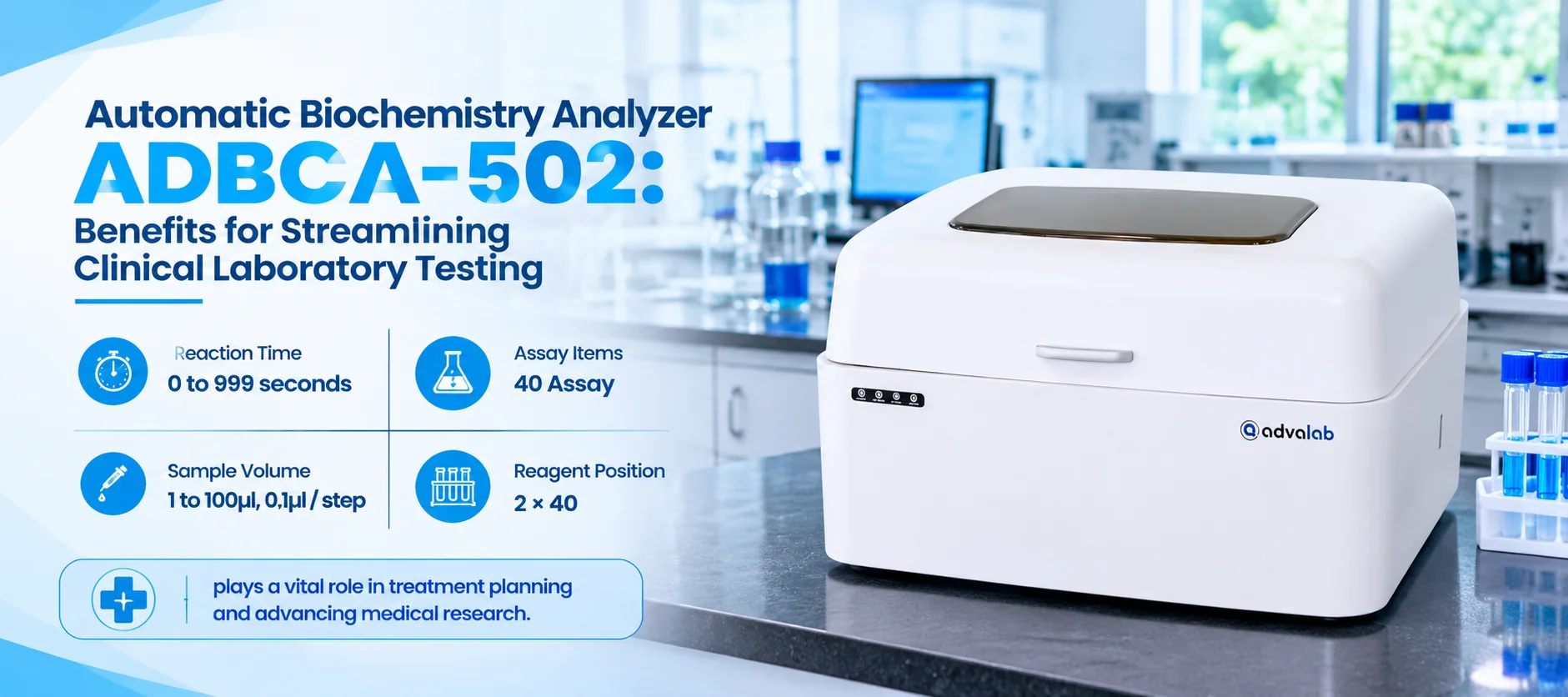
An urgent request arrives while a batch is still running. A repeat test is needed, but the sample left in the tube is too small. A calibration drifts, and the whole run has to be redone. Manual pipetting and cuvette washing add steps where small errors creep in. Clinical laboratories meet these problems all the time, and an automated analyzer addresses them by moving sampling, mixing, measurement, and washing into one controlled sequence. The Automatic Biochemistry Analyzer ADBCA-502 lists 40 assay items, random access operation, and a sample range of 1 to 100 µl, which raises a practical question: what does that mean for clinical testing, and what should be confirmed before choosing one?
An Automatic Biochemistry Analyzer is a laboratory instrument that measures chemical substances in biological samples, such as blood, urine, and serum, by mixing each sample with reagents and reading the resulting reaction with a photometer. Automation handles sampling, mixing, timing, measurement, and washing, so results follow from a fixed sequence rather than from manual steps.
Search terms such as fully automatic biochemistry analyzer, fully automatic biochemistry analyzer machine, auto biochemistry analyzer machine, automated biochemistry analyser, auto analyser machine, biochemistry fully automatic machine, and even fully biochemistry analyzer all point to this class of instrument. What separates one from another is menu size, throughput, sample volume, and the quality of calibration and control.
The Automatic Biochemistry Analyzer principle is photometry. A sample reacts with a reagent to produce a color or turbidity change, a light beam passes through the reaction, and the amount of light absorbed reveals the concentration of the target substance. The sequence repeats for each test.
A probe adds sample and reagent to a reaction cuvette.
The mixture reacts for a programmed time.
Light passes through the cuvette and absorbance is read.
Absorbance is converted to concentration using the calibration.
The cuvette is washed and ready for the next test.
Absorbance relates to concentration through the Beer-Lambert relationship, which holds over a limited range. That is why calibration, dilution, and retest functions matter: a sample outside the linear range needs to be diluted and run again.
The listing names four reaction methods, each suited to a different kind of test. The typical uses below are general laboratory knowledge, not claims about specific ADBCA-502 reagent kits.
| Method | What is measured | Typical use |
|---|---|---|
| End point | Absorbance once the reaction has run to completion | Substances that give a stable color, such as total protein |
| Kinetic | Rate of absorbance change over time | Enzyme activity measurements |
| Fixed time | Absorbance change between two set time points | Reactions with a short, consistent timing window |
| Immunoturbidimetric | Turbidity from antigen-antibody complexes | Specific proteins such as C-reactive protein |
One- and two-reagent methods are supported, with reagent and serum blank settings, so the same instrument can run both simple and multi-step assays.
Each listed feature of the ADBCA-502 serves one stage of the test cycle. The graphic maps the main parts to their jobs.
Liquid level and collision sensors with a Teflon coating.
2 × 40 positions for up to 40 assay items.
8-channel automatic washing of reaction cuvettes.
Halogen lamp covering 340 nm to 810 nm.
Linear, non-linear, multi-point, and K factor modes.
Levey-Jennings program at three levels.
The table lists values published on the ADBCA-502 product page and explains how each one affects planning.
| Parameter | ADBCA-502 listing | Why it matters |
|---|---|---|
| Sample volume | 1 to 100 µl, 0.1 µl per step | Covers small samples and fine volume adjustment |
| Reagent positions | 2 × 40 | Sets how many reagents can sit on board at once |
| Reagent volume R1 and R2 | 1 to 400 µl, 1 µl per step | Allows methods with different reagent ratios |
| Wavelength | 340 nm to 810 nm | Determines which colorimetric and turbidimetric methods can be read |
| Throughput, 1 reagent | 300 tests/hour | Indicates the ceiling for single-reagent work |
| Throughput, 2 reagents | 200 tests/hour | Indicates the ceiling for two-reagent work |
| Reaction time | 0 to 999 seconds | Limits how long a single reaction can be monitored |
| Assay items | 40 | Sets the size of the test menu |
| Operation | Random access | Allows tests to be run in any order |
| Light source | Halogen lamp | Provides the light for photometric readings |
| Absorbance readout | 0.0001 A; accuracy ±0.0003 A (0 to 2.5 A) | Describes the smallest reading step and its closeness |
| Repeatability | CV ≤ 2% | Shows how closely repeat readings of one sample agree |
| Dimensions (L × B × H) | 850 × 720 × 530 mm | Determines bench space |
| Weight | 90 kg | Affects bench loading |
The ADBCA-502 listing describes fully automatic analysis of blood, urine, and serum, with built-in quality control and sample dilution and retest when a result falls out of range or a sample is insufficient. Random access operation lets tests be run in the order requests arrive rather than in fixed batches. The graphic shows what the listed throughput means for workload planning.
Calculated from the specification table at 300 and 200 tests per hour. The figures assume continuous running and exclude loading, calibration, quality control, and retests.
Questions about how to use biochemistry analyzer equipment come down to the order of operations, because quality control comes before patient samples. A typical routine follows these steps.
Selection starts with the test menu and the daily workload, not with the headline throughput. Analyzers differ in format, menu, and sample handling across the full biochemistry analyzer range, so define the menu and volume first.
| Requirement | Consider |
|---|---|
| High daily test volume | Listed throughput, reagent positions, and the time lost to calibration and retests |
| Broad test menu | Assay items and the number of reagent positions |
| Small or limited samples | Minimum sample volume and volume step |
| Immunoturbidimetric tests alongside chemistry | Listed methods and the wavelength range |
| Confidence in results | Repeatability, calibration modes, and the quality control program |
| Single quick tests at the point of care | A dry chemistry analyzer rather than a batch instrument |
| Limited bench space | Footprint and weight of the instrument |
Within the automatic analyzer range, ADBCA-501 lists 2 × 36 reagent positions, while ADBCA-502 and ADBCA-503 each list 2 × 40. All three list the same 1 to 100 µl sample range, so reagent capacity and the product page details are where they separate.
A different format may suit some laboratories better. The table compares the ADBCA-502 with the Dry Biochemistry Analyzer ADDBA-501.
| Parameter | ADBCA-502 | ADDBA-501 |
|---|---|---|
| Format | Automatic photometric analyzer | Dry chemistry analyzer |
| Sample volume | 1 to 100 µl | 45 µl |
| Sample types (as listed) | Blood, urine, serum | Serum, whole blood, plasma |
| Speed (as listed) | 200 to 300 tests/hour | Detection in 3 minutes or less |
The ADBCA-502 belongs to a category with two listed ranges: automatic biochemistry analyzers and dry biochemistry analyzers. The category description highlights reagent temperature regulation, liquid level detection, and multi-test capability across blood, serum, plasma, and urine samples.
When comparing options in this category, teams usually weigh throughput, menu size, sample volume, calibration and quality control, reagent handling, connectivity, and footprint. The full set of models is listed on the biochemistry analyzers page, and further laboratory equipment is available from the Advalab home page.
An automatic biochemistry analyzer earns its place when manual steps, repeat runs, and slow turnaround limit what a clinical laboratory can report. The ADBCA-502 pairs 40 assay items, random access operation, four listed methods, and built-in quality control. Matching menu, throughput, sample volume, and reagent handling to the laboratory turns a specification list into a sound selection.
Hazel Daniels
Specialty: Healthcare Technology & Laboratory Equipment
Writing Style: Professional, informative, and reader-friendly
Bio: Hazel Daniels specializes in writing about healthcare technology, laboratory equipment, and scientific applications. She presents technical information in simple language, highlighting practical uses and industry developments.