
Small metal and glass tools return to the bench many times in a working day. Here is how dry-heat bead sterilization works, where it fits, and what to check before choosing a unit.
Forceps, probes, and small glass utensils are handled again and again during a single procedure. Waiting for a full steam cycle between uses is rarely practical, and a chemical wipe may not suit each tool. Point-of-use dry heat answers a narrower question: how can a small tool be made ready again within seconds?
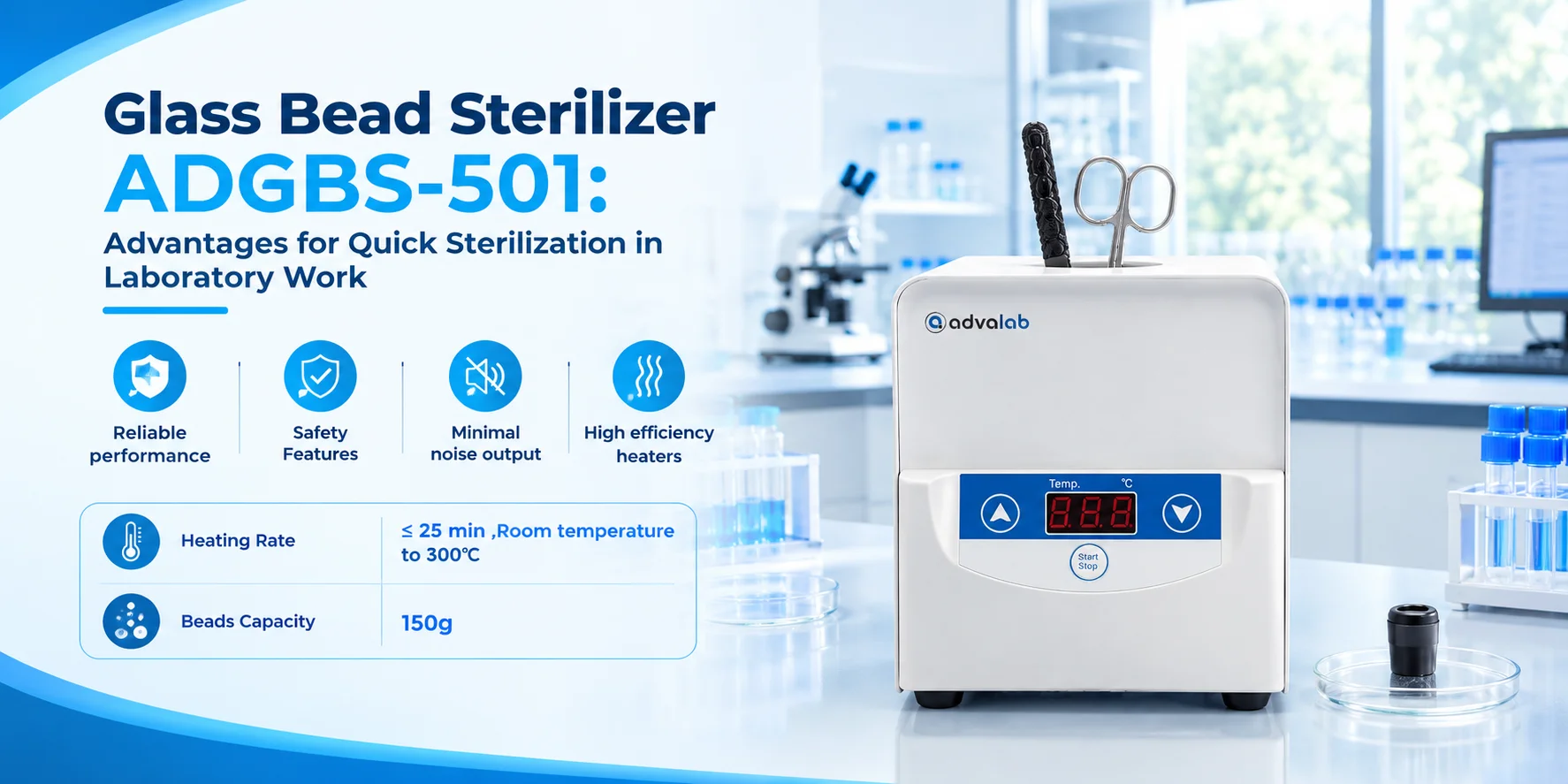
The Advalab Glass Bead Sterilizer ADGBS-501 is a Glass Bead Sterilizer built for this niche. It uses a compact tank of heated beads, handles small metal and glass utensils, and operates from 100 to 300 °C.
A Glass Bead Sterilizer is used for sterilizing small metal and glass utensils through direct contact with very hot glass beads, which pass dry heat to the surface of the tool. Suppliers list the same equipment as a bead sterilizer, a hot bead sterilizer, a glass sterilizer, or a dry glass bead sterilizer, and the sterilizer beads inside the tank carry out the heat transfer.
In scientific research laboratories, a glass bead sterilizer machine such as the ADGBS-501 is applied to experimental tools that need rapid decontamination between samples.
People who look up “Glass Bead Sterilizer how it works” usually want the heat path first. A heating element warms a tank filled with beads. Heat spreads through the packed glass spheres, so a tool tip pushed into the tank touches hot surfaces from several sides at once. Dry heat then raises the surface temperature of the tool until bacteria, spores, and other microorganisms are destroyed.
In the ADGBS-501 the tank measures φ40 mm × 80 mm and holds 150 g of beads. That small heated mass keeps the footprint compact, at 135 × 150 × 160 mm, and no water, steam, or pressure is involved.
The ADGBS-501 offers a range of 100 to 300 °C with an accuracy of ≤ 5 °C, and it needs up to 25 minutes to climb from room temperature to 300 °C. Higher bead temperatures shorten the exposure needed, and a typical exposure lasts about 5 to 10 seconds. Larger or denser tools absorb more heat and need slightly longer.
A cold tool briefly lowers the local bead temperature, so allow the unit to settle before relying on the next insertion. Always follow your laboratory's own sterilization protocol for the set temperature and the time.
Common Glass Bead Sterilizer uses cluster around four settings, each with its own reason for wanting a short turnaround.
Rapid decontamination of experimental tools between samples.
Small metal instruments that must return to the tray quickly.
Shared tools that pass between users during one working session.
Bench-side readiness where a full steam cycle would interrupt the procedure.
Readers who search for “glass bead sterilizer how to use” usually want a short sequence. Follow the instruction manual for exact operation; the general routine has five steps, and each one has a clear purpose.
Wipe visible residue from the tool first.
Load the beads and bring the tank to the chosen temperature.
Lower the working end into the beads.
Keep it there for the exposure time set by your protocol.
Lift the tool out and let it cool before use.
Heat-sensitive items such as plastic or rubber can melt or degrade, so they stay out of the tank.
Figures on a specification sheet describe how a unit behaves at the bench. The table lists the values published for the ADGBS-501.
| Parameter | ADGBS-501 |
|---|---|
| Temperature range | 100 to 300 °C |
| Temperature accuracy | ≤ 5 °C |
| Heating rate | ≤ 25 min, room temperature to 300 °C |
| Beads capacity | 150 g |
| Power consumption | 120 W |
| Tank dimension | φ40 mm × 80 mm |
| Dimensions (W × D × H) | 135 × 150 × 160 mm |
Related models share the same working range. The ADGBS-502 lists matching temperature specifications, while the ADGBS-503 and ADGBS-504 list a display accuracy of 1 °C.
Each method suits a different load, and the full range of sterilizers from Advalab shows how widely those loads vary. A bead tank handles quick turnaround of small tools, while chamber-based methods handle batches.
| Method | Typical load | Heating approach |
|---|---|---|
| Glass bead sterilizer | Small metal and glass utensils | Dry heat at 100 to 300 °C, exposure in seconds |
| Hot air sterilizer | Racks of glassware and instruments | Chamber volumes of 64 to 452 L at 5 to 300 °C |
| Electric heated steam sterilizer | Steam-based batch loads | 35 to 150 L chambers at 105 to 134 °C and 0.23 MPa |
| Bacti-cinerator sterilizer | Small items placed in a heated zone | Central temperature of about 800 to 825 °C |
Advalab, a manufacturer of laboratory equipment based in the United States, groups heat-based sterilizers into several families: bead tanks, electric heated steam units, horizontal pressure and horizontal sterilizers, bacti-cinerators, and hot air units. The glass bead models form the smallest and quickest of these.
When options inside the category are evaluated, teams usually weigh the type and size of the load, the temperature range, the exposure or cycle time, the chamber or tank dimensions, the power supply, and the floor or bench space available. The complete range of sterilizers makes it possible to review those points side by side.
Hazel Daniels
Specialty: Healthcare Technology & Laboratory Equipment
Writing Style: Professional, informative, and reader-friendly
Bio: Hazel Daniels specializes in writing about healthcare technology, laboratory equipment, and scientific applications. She presents technical information in simple language, highlighting practical uses and industry developments.