
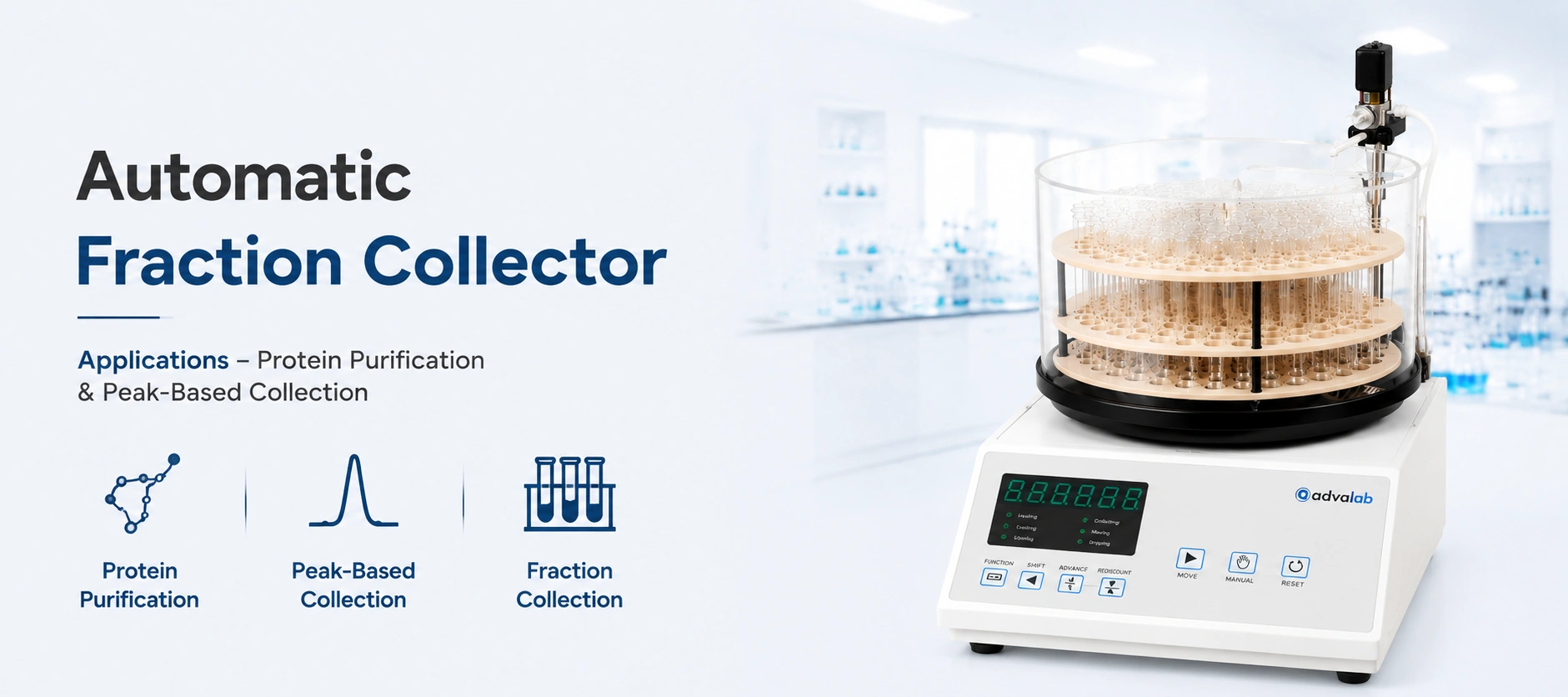
A working overview for laboratory, hospital, and research centre teams on how an Automatic Fraction Collector separates and gathers eluate during chromatography runs, and where peak-based collection fits into protein purification work.
An Automatic Fraction Collector sits at the outlet end of a chromatography system, directing evaluate into individual tubes or wells as it exits the column. Rather than a technician manually swapping collection vessels at fixed intervals, the unit tracks either elapsed time, dispensed volume, or a detector signal, then moves its collection arm to the next position on cue. Many labs choosing equipment for peptide, protein, or nucleic acid separation review the automatic fraction collector line on the Automatic Fraction Collectors page before settling on a configuration suited to their column diameter and flow rate.
At its core, the unit pairs a moving collection arm or rotating rack with a control module that decides when to switch tubes. Three triggering methods are common across current designs. Time-based collection moves to the next tube after a set interval, useful for runs with a predictable flow rate. Volume-based collection counts dispensed liquid through a drop sensor or pump reading, switching tubes once a target amount is reached. Peak-based collection reads a signal from an inline UV, conductivity, or fluorescence detector and only diverts flow into a fresh tube when that signal crosses a threshold, which keeps the collected fractions concentrated around actual elution peaks rather than spread across mostly empty runoff.
Peak-based collection is the method most closely associated with protein purification, since it lets the fraction collector concentrate effort on the narrow window where a target protein is actually eluting, leaving flat baseline sections uncollected or merged into waste.
Signal path: column outlet, inline detector, threshold comparison, arm repositioning, tube fill.
Beyond a single workflow, an automatic fraction collector machine supports several recurring laboratory tasks, each with different demands on tube capacity and trigger sensitivity.
Peak-triggered collection isolates target protein fractions from a size-exclusion or ion-exchange column run.
Detector-linked switching narrows tube changes to the portion of a run where a compound is actually eluting.
Fixed-interval collection suits methods where flow rate stays steady and elution timing is already known.
Smaller tube formats and finer volume increments support DNA and RNA fraction separation from gel or column output.
Setup steps vary by model, but most automatic fraction collector use cases follow a similar sequence before a chromatography run begins.
Category spans rack size, detector compatibility, tube format, and control interface.
Automatic fraction collectors sit within a wider group of liquid chromatography accessories, alongside detectors, pumps, and column hardware that work together during a purification run. Buyers comparing options in this category typically weigh rack capacity, supported tube and plate formats, trigger modes available, and how the unit communicates with an existing detector or pump. The full Automatic Fraction Collector lineup outlines configurations for different bench sizes and run volumes, and sits alongside the broader laboratory equipment range on advalab's main website, where related chromatography and purification hardware can also be reviewed.
| Factor | Automatic Fraction Collector | Manual Collection |
|---|---|---|
| Tube switching | Handled by the control module on a time, volume, or peak-based trigger | Technician swaps tubes by hand at observed intervals |
| Peak targeting | Detector-linked collection narrows fractions to actual elocution peaks | Depends on the technician watching the trace and reacting in time |
| Run length suitability | Suited to long or overnight runs left unattended | Limited to runs that can be actively supervised throughout |
| Run-to-run consistency | Trigger settings repeat the same switching pattern each run | Timing varies with attention and reaction speed between runs |
Label rack positions alongside the run log so a fraction number can be traced back to its collection tube later.
Recheck the peak threshold after changing sample concentration, since a setting tuned for one run may collect too early or too late on the next.
Keep a spare set of tubing and tube racks on hand for labs running back-to-back purification sessions.
Rinse the collection arm and outlet line between runs handling different sample types to limit carryover.
Review detector baseline drift periodically, since a shifting baseline can throw off peak-based tube switching over time.
Train new staff on both time-based and peak-based setup, so either mode can be selected correctly for a given method.