
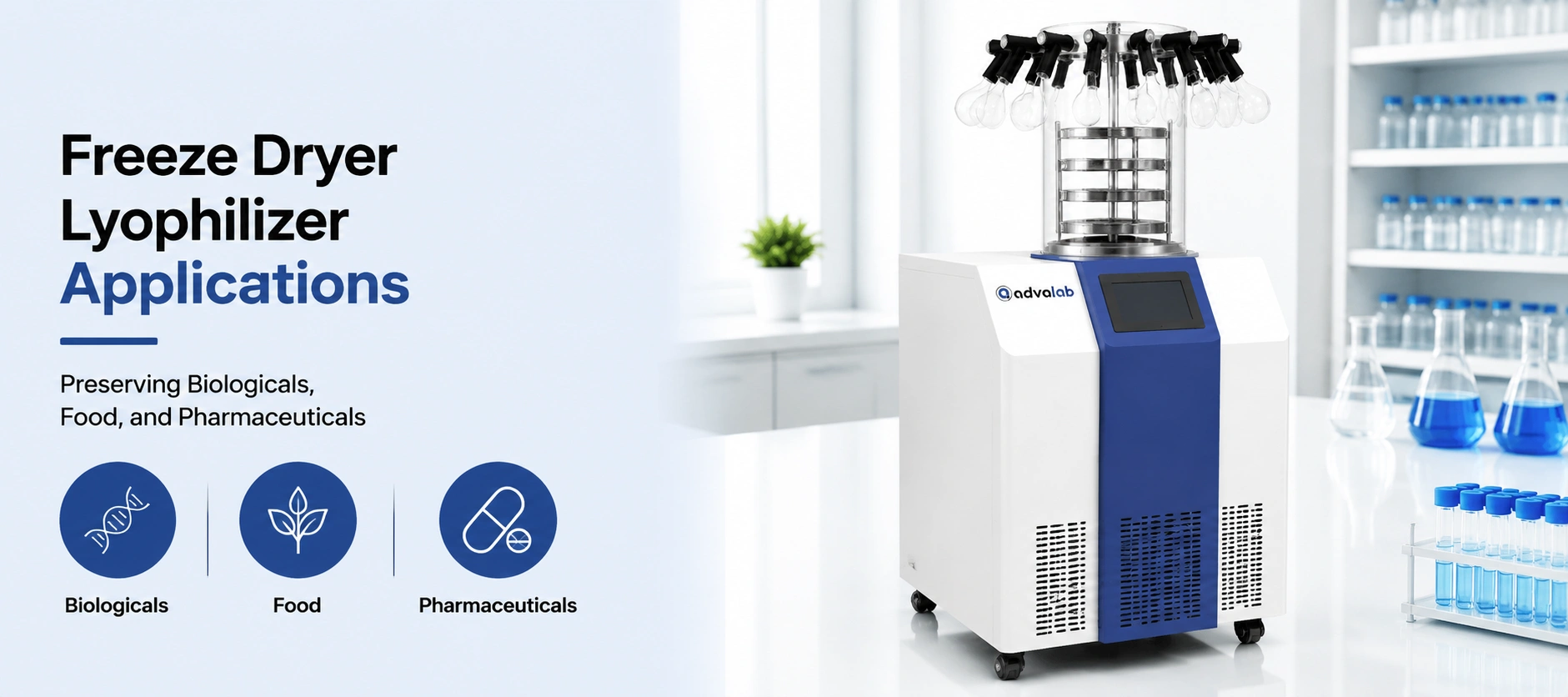
An overview of how freeze drying equipment protects sensitive material by removing water at low temperature, and where laboratories, hospital units, research centres and advanced labs put this process to work.
A Freeze Dryer works on sublimation rather than evaporation. The material is frozen first, then placed under a strong vacuum so that the ice inside it turns directly into vapor without passing through a liquid phase. A condenser nearby traps that vapor as ice, keeping it away from the sample chamber. This two-step approach, primary drying followed by a secondary drying stage that removes any remaining bound water, is what lets a lyophilization machine preserve structure and activity that a heat-based drying method would damage.
Because the sample never warms past its frozen state during the main drying phase, a vacuum freeze dryer is often the preferred route for material that would break down, denature or lose potency under conventional heat. Teams comparing shelf area, condenser capacity and load size across current models can look through the floor-type freeze dryer range to see how these figures scale with unit size.
The gentle nature of sublimation drying means a laboratory freeze dryer shows up wherever a material needs to lose moisture without losing what makes it useful in the first place. Three areas account for most of that demand.
Enzymes, cell cultures, serum, plasma and microbial cultures often lose activity when dried with heat. A freeze dryer in laboratory settings keeps these materials stable at room temperature for storage or shipping without the cold chain a liquid form would need.
Freeze dryers for food work extend to fruit, herbs, dairy and ready-meal components used in shelf-life and rehydration studies. The process keeps flavor, color and nutrient content closer to the fresh material than air-drying or freezing alone.
Vaccines, biologics and injectable formulations are frequently freeze-dried into a powder that is reconstituted with a liquid just before use, extending shelf life for material that would otherwise need constant refrigeration.
A freeze dry machine is not the only way to remove moisture from a sample, and the right choice depends on how heat-sensitive the material is and how much throughput a lab needs.
| Method | Typical Cycle Time | Where It Fits | Trade-off |
|---|---|---|---|
| Freeze drying (lyophilization) | 12 – 48 hours | Heat-sensitive biologicals, pharmaceuticals and delicate food samples | Longer cycle time and a vacuum system to run |
| Spray drying | Minutes, continuous | Large-volume powder production from liquid feed | Heat exposure can affect sensitive material |
| Hot-air drying | Several hours | Bulk food or material with lower heat sensitivity | Structure and nutrient content shift more than freeze drying |
| Vacuum drying (no freezing step) | 4 – 12 hours | Moderately heat-sensitive samples that do not need sublimation | Less protective than freeze drying for very fragile material |
Choosing a vacuum freeze drying machine without checking a few practical details tends to surface later as longer cycle times or samples that do not dry evenly.
A freeze dryer depends on two readings staying accurate throughout a cycle: chamber vacuum pressure and shelf temperature. Drift in either one changes how the sublimation front moves through the material, which can stretch drying time or leave moisture behind in the final product. Checking the vacuum gauge against a separate reference gauge, and verifying shelf temperature at a few points across the tray, catches this before it shows up as an inconsistent batch.
For biological and pharmaceutical work in particular, building this check into a routine schedule rather than only running it after a problem appears makes it far easier to trace an off result back to the equipment rather than the formulation itself.
Freeze dryers lyophilizers sit within a broader group of drying and preservation equipment that spans benchtop, pilot-scale and floor-standing configurations. Buyers comparing options within this category typically look at shelf area, condenser capacity, minimum achievable temperature and how the unit handles vials, trays or bulk material differently across formats.
Floor-standing configurations built for larger batch volumes are grouped on the floor-type freeze dryer page, which is a reasonable starting point for labs outgrowing a benchtop unit. For teams comparing freeze drying against other bench instruments more broadly, the wider catalogue sits on the advalab home page.
Compare shelf area, condenser capacity and temperature range across the current range.
Explore Freeze Dryers