
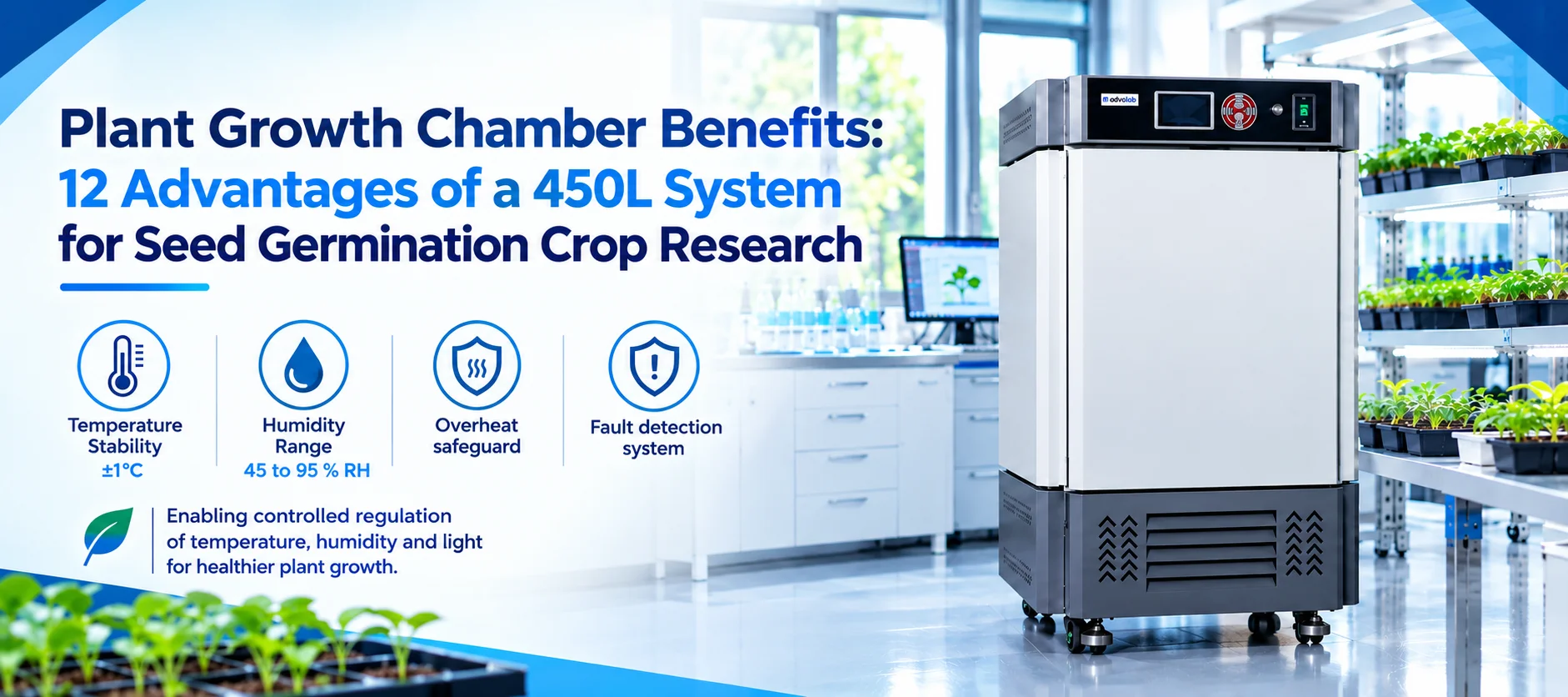
Seeds, seedlings and microbial cultures respond to small shifts in warmth, moisture and light. This explains how a plant growth chamber holds those conditions steady, what its parts do, where it is used and what to check before choosing one.
A seed wakes when it takes up water, finds a suitable temperature and has oxygen around it. Light then steers the seedling toward photosynthesis, while humidity governs how fast leaves lose water. Researchers who ask how does plant growth work in practice soon find that each factor changes the result, and that a window ledge or an open bench cannot hold them still.
A plant growth chamber closes that gap. It is an insulated cabinet that sets temperature, humidity and light on purpose, so one experiment can be repeated by another team months later.
Catalogs use several names for this family of equipment. A plant growth cabinet or plant growth incubator usually describes a unit with programmable climate, a seed germination chamber is the same hardware run at germination settings, and a plant humidity chamber puts the focus on moisture control. The phrase plant incubator growth chamber also appears in listings, and the plant growth chamber laboratory is where all of these names meet.
The plant growth chamber working principle is a closed control loop. A technician enters set points for each phase, and microprocessor-based control compares them with the readings inside the cabinet. It then adjusts heating, cooling, steam humidification and lighting until the two agree. Because light-phase and dark-phase temperatures can differ, the program changes set points on schedule, which is how a day-night cycle is reproduced.
Plant growth chamber diagram: from set points to controlled conditions, with readings fed back.
The worked example here is the Plant Growth Chamber ADPGC-510 from Advalab, a 450 L unit. Each card covers a different capability, so you can judge which ones your protocols actually need.
With the lights on, set points run from 10 to 65 °C; with them off, from 5 to 65 °C, so cool germination and warm incubation can share one cabinet.
Digital microprocessor-based control holds temperature within ±1 °C, so repeated runs begin from the same thermal baseline.
Moisture can be set between 45 and 95% RH, which covers drier protocols as well as near-saturated seedling trials.
A ±3% RH figure lets treatments differ only in the variable under study, not in hidden moisture swings.
Light output ranges from 0 to 18,000 lx, with separate temperature settings for light and dark phases.
An interior of 680 × 600 × 1100 mm holds many trays or culture vessels, keeping related samples under identical conditions.
Up to thirty programmable steps stage temperature, humidity and light across a protocol, including overnight and weekend hours.
Automatic refill, a low water alert and one-touch drainage take most of the routine reservoir work off the operator.
Anti-frost technology and auto-defrost limit ice build-up during long cold runs, while compressor safety protects the cooling circuit.
An overheat safeguard, fault detection and protection against power loss guard samples when something goes wrong out of hours.
USB ports, an RS485 interface and printer support export data, and real-time SMS alerts report chamber status or a malfunction.
A magnetic-sealed double-glass door improves insulation and lets staff inspect samples without opening the cabinet; the steel body has an electrostatic powder coating.
Plant science departments, hospital laboratories, research centres and advanced laboratories share one requirement: conditions that do not wander. Each plant growth chamber application below depends on that stability, and the plant growth chamber uses listed here are the ones named on the ADPGC-510 product page.
Application map: one controlled cabinet supports several research lines.
Teams needing a lights-free climate or a wider simulation envelope can look at the neighbouring environmental chambers designs, which share the same logic of set points and feedback.
Advalab lists several plant growth chamber sizes. Capacity is the first filter, and the temperature and humidity windows are the second.
| Model | Capacity | Temperature range | Humidity range |
|---|---|---|---|
| ADPGC-507 | 150 L | 10 to 65 °C with lights on; 5 to 65 °C with lights off | 45 to 95% RH |
| ADPGC-504 | 350 L | 10 to 65 °C with lights on; 5 to 65 °C with lights off | 45 to 95% RH |
| ADPGC-505 | 450 L | 10 to 65 °C with lights on; 5 to 65 °C with lights off | 45 to 95% RH |
| ADPGC-510 | 450 L | 10 to 65 °C with lights on; 5 to 65 °C with lights off | 45 to 95% RH |
| ADPGC-511 | 2244 L | 3 to 45 °C (working temperature 5 to 35 °C) | See product page |
For the ADPGC-510, the product page also lists ±1 °C temperature stability, ±3% RH humidity stability, illuminance of 0 to 18,000 lx and 1400 W power consumption. The plant growth chamber range page shows all models in one place.
The ADPGC-510 belongs to the environmental chambers category, which groups equipment that holds temperature, humidity and light at set conditions so real-world environments can be simulated. The category covers humidity, plant growth, illuminating and climate chambers, including the artificial climate chamber line.
Buyers who evaluate options in this category usually look at:
Hazel Daniels
Specialty: Healthcare Technology & Laboratory Equipment
Writing Style: Professional, informative, and reader-friendly
Bio: Hazel Daniels specializes in writing about healthcare technology, laboratory equipment, and scientific applications. presents technical information in simple language, highlighting practical uses and industry developments.
The full specification table, features and application notes for the unit discussed above are on its product page.
Explore Plant Growth Chamber ADPGC-510