
A cold storage room starts to sweat, a balance drifts and a powder cakes overnight. This article explains how a desiccant dehumidifier works and what to check before choosing one.
Moisture is a quiet problem. A bottle of hygroscopic powder gains water, a balance reading shifts after the door opens, and condensation settles on metal parts in a cool storage area. Many compressor dehumidifiers slow down or frost over when a room gets cold, which is exactly when some stores need them.
The question is how to keep humidity low where a cold coil struggles. A desiccant unit removes moisture with a rotating wheel instead, and the Advalab ADDHU-505 publishes its capacity, working temperature, airflow, power, protection rating and size, so a team can judge the fit before ordering.
A Desiccant Dehumidifier suits a laboratory only when those figures match the room and the materials in it. This article explains the working principle, typical uses, a sample routine and the mistakes to avoid, and then the next step: confirm the open points with the supplier and review the full listing.
Many people ask how Desiccant Dehumidifier works in practice, and the desiccant dehumidifier working principle is short to state. Moist air passes across a slowly rotating wheel coated with a moisture-attracting material. The material captures water vapor, and the air leaves drier. The Advalab listing describes this as adsorption technology, not refrigeration, and it removes moisture even at sub-zero temperatures.
A second air stream then dries the wheel again so it can keep working. That continuous loop is why a desiccant dehumidifier how it works explanation always involves a wheel in motion. The listing adds that the ADDHU-505 uses a continuous rotary desiccant wheel with optimized airflow pathways that minimize pressure losses and thermal waste, and that it supports internal heat recovery for reactivation.
Illustrative diagram, not to scale: a continuous rotary desiccant wheel captures vapor from room air and is dried again in a separate air stream.
Uncontrolled moisture shows up in a few predictable ways:
A dehumidifier that dries the air itself, with stated temperature and airflow figures, addresses these points, provided the published numbers match the room.
Each benefit below ties to a specification or feature published for the ADDHU-505.
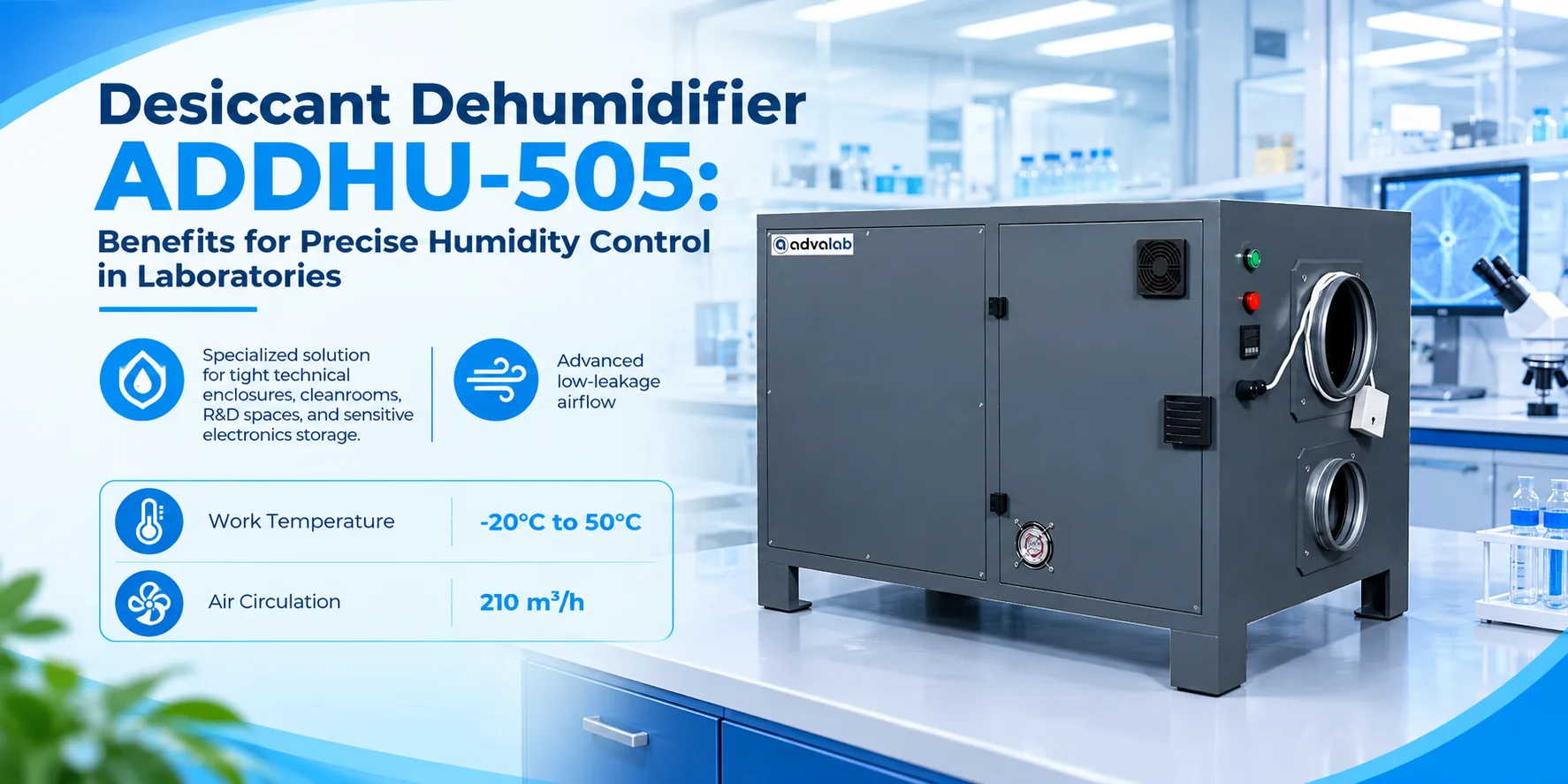
The working temperature runs from minus twenty to fifty degrees Celsius.
The unit removes zero point six kilograms of moisture per hour at twenty degrees Celsius and sixty percent relative humidity.
Air circulation is two hundred ten cubic meters per hour, which suits small rooms and enclosures.
A continuous rotary desiccant system runs without batch changeovers.
The listing says the rotary mechanism does not rely on condensation and needs no defrost cycles.
The unit carries an IP44-rated protection level.
The compact design suits height-restricted ceiling or floor installations.
A removable service panel, a belt-free rotary mechanism and simple filter checks keep upkeep light.
Optimized airflow paths and internal heat recovery limit wasted energy.
The listing notes that desiccant dehumidifiers operate quietly with fewer moving parts.
Infographic: capacity, temperature, airflow, power and size figures from the ADDHU-505 listing.
The Advalab listing names these settings, in which an industrial Desiccant Dehumidifier or a compact unit such as the ADDHU-505 protects materials and equipment:
Teams that compare a Commercial Desiccant Dehumidifier with a compressor model weigh the lowest room temperature, the moisture load, the room volume and how much space is available. The desiccant dehumidifier industrial range also includes larger models, covered in the comparison below.
The listing does not publish an operating procedure, so follow the supplier manual for exact steps. People who ask how to use desiccant dehumidifier equipment will find that a routine usually follows a short sequence:
Match these published figures against your own room and materials before shortlisting a dehumidifier:
| Model | Capacity at 20 °C, 60 % RH | Air circulation |
|---|---|---|
| ADDHU-501 | Zero point two six kilograms per hour | Sixty-five cubic meters per hour |
| ADDHU-502 | Zero point five two kilograms per hour | One hundred eight cubic meters per hour |
| ADDHU-505 | Zero point six kilograms per hour | Two hundred ten cubic meters per hour |
| ADDHU-503 | Three kilograms per hour | Six hundred cubic meters per hour |
| ADDHU-504 | Seven point five kilograms per hour | One thousand one hundred cubic meters per hour |
All five models list the same working temperature of minus twenty to fifty degrees Celsius, so the choice comes down to capacity, airflow and room size.
Infographic: desiccant dehumidifier models in the Advalab range, from the published listings.
The dehumidifiers category at Advalab covers three families: the commercial dehumidifier range, the desiccant dehumidifier range and the industrial dehumidifier range. Commercial models are listed in liters per day with a working range of five to thirty-eight degrees Celsius, while desiccant models are listed in kilograms per hour down to minus twenty.
When laboratories compare options in this category, they typically weigh capacity, working temperature range, airflow, energy use and noise, and features such as auto defrost and programmable humidity setpoints. To review all families side by side, explore the full dehumidifiers range, or see the wider laboratory equipment catalog on the Advalab home page.
The Desiccant Dehumidifier ADDHU-505 pairs a capacity of zero point six kilograms per hour, a working range down to minus twenty degrees Celsius, an airflow of two hundred ten cubic meters per hour and an IP44 protection rating in a compact unit. It sits between the smaller ADDHU-501 and ADDHU-502 and the larger ADDHU-503 and ADDHU-504, and it suits technical enclosures, cleanrooms, R&D spaces and electronics storage.
The listing also marks limits. It gives no supply voltage or achievable humidity level, and its current rating needs checking, so plans that require those points call for confirmation with the supplier.
Hazel Daniels
Specialty: Healthcare Technology & Laboratory Equipment
Writing Style: Professional, informative, and reader-friendly
Bio: Hazel Daniels specializes in writing about healthcare technology, laboratory equipment, and scientific applications. She presents technical information in simple language, highlighting practical uses and industry developments.
Review the published capacity, temperature, airflow, power and size details for this desiccant dehumidifier and compare them against your own room and materials.
Explore Desiccant Dehumidifier ADDHU-505