
Ice looks like the simplest item in a laboratory, until it fails. Cubes bruise delicate tubes and leave air pockets around vials, shared ice buckets melt before the run ends, and a trip to another floor for a refill breaks the cold chain at the worst moment.
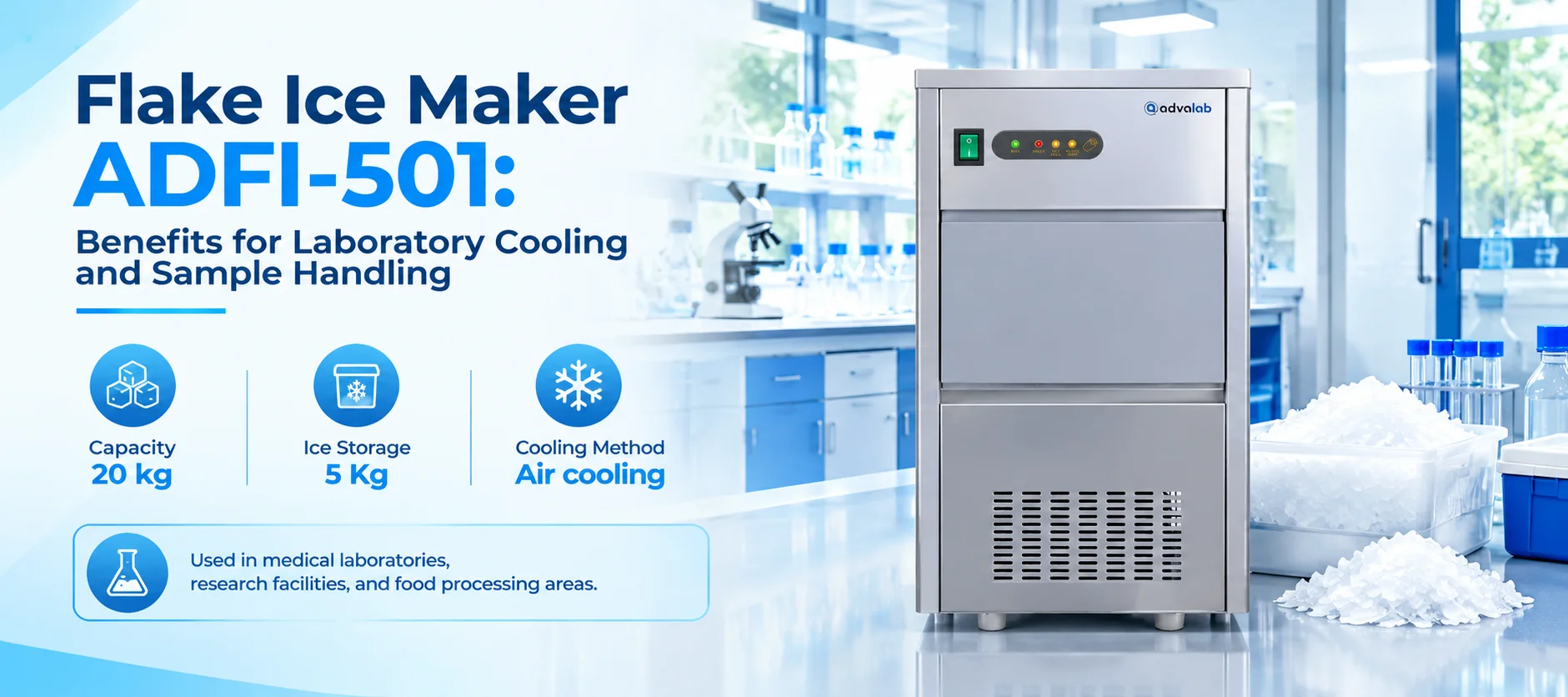
One answer is a unit that makes soft, thin ice at the bench. The Advalab ADFI-501 publishes its capacity, storage bin, cooling method, voltage, size and weight, so a team can judge the fit before ordering.
A Flake Ice Maker suits a laboratory only when its output and bin match the cooling work done each day. This article explains the working principle, ten published benefits, typical uses, how flake ice differs from cubes, a sample routine and the mistakes to avoid, and then the next step: confirm the open points with the supplier and review the full listing.
The listing and the range notes describe the process in plain steps. A refrigeration system freezes water onto a rotating drum, and as the drum turns, a blade or scraper lifts the frozen layer away as thin flakes. The flakes fall into an insulated bin and wait there until they are needed. The cycle continues as long as water is supplied and the machine is maintained.
That is why a snow flake ice machine produces a different product from a cube unit. Flakes are thin and pliable, so they pack around tubes, bottles and trays instead of leaving gaps. The ADFI-501 uses an air-cooled refrigeration system with an eco-friendly refrigerant and runs automatically, so staff collect ice from the bin and do not have to manage the freezing.
Illustrative diagram, not to scale: the freeze, scrape and store sequence the listing describes for a flake ice maker.
Bagged or tray ice causes problems that are easy to overlook:
Each benefit below ties to a specification or feature published for the ADFI-501.
The unit makes soft, thin ice that cools quickly and is easy to shape.
The listing gives a capacity of twenty kilograms, and the product notes describe it as up to twenty kilograms in twenty-four hours.
A storage bin holds five kilograms of ice for the next use.
The unit measures three hundred thirty by five hundred three by six hundred seven millimeters.
The exterior is corrosion-resistant stainless steel.
The unit runs automatically, so staff only collect the ice.
An air-cooled system with an eco-friendly refrigerant produces the ice.
The product notes say the unit stops when water runs low.
The product notes describe an alert and an automatic stop when the bin is full.
The product notes list overload protection for internal parts against power surges.
Infographic: capacity, storage, power and size figures from the ADFI-501 listing.
The Advalab listing says the ADFI-501 is used in laboratories, medical facilities and food industries for preserving samples and perishable items, and its applications note names medical laboratories, research facilities and food processing areas. The product notes add biomedical storage, hospital settings, seafood preservation, small commercial kitchens and beverage cooling.
Searches for a flake ice machine commercial or flake ice machine industrial model usually concern tonnage. The ADFI-501 is a bench-scale unit, and the range includes far larger machines, covered in the comparison below. A flake ice maker laboratory team should size the unit to its bench, not to a plant.
Advalab also lists cube ice makers, so the choice is real. Flake ice suits tasks that need contact with an irregular surface, such as wrapping a tube rack or cooling a tray of vials, because the pieces are thin and fill gaps. Cube ice suits drinks and larger containers where slow melting matters more than contact.
For sample handling and reagent cooling, a flake ice machine for laboratory use is usually the more natural choice, and the listing points to the same use. A team that needs both can place a flake unit at the bench and keep cube ice for the break room.
The listing does not publish an operating procedure, so follow the supplier manual for exact steps. A routine usually follows a short sequence:
Match these published figures against your own daily requirement and bench before shortlisting a flake ice maker machine:
| Model | Capacity | Ice storage | Cooling method |
|---|---|---|---|
| ADFI-501 | Twenty kilograms | Five kilograms | Air cooling |
| ADFI-503 | Fifty kilograms | Ten kilograms | Air cooling |
| ADFI-504 | Eighty-five kilograms | Twenty kilograms | Air cooling |
| ADFI-507 | One hundred fifty kilograms | Twenty-five kilograms | Air cooling or water cooling |
| ADFI-514 | One thousand five hundred kilograms | Three hundred twenty kilograms | Air cooling |
The ADFI-501 is the smallest model in this table, while the ADFI-514 is a three-phase industrial-scale machine. The product notes for the ADFI-503 mention a thirty kilogram bin, but its specification table lists ten kilograms, so confirm the bin size with the supplier. Capacity periods are stated only for some models, so ask for the time basis of each figure.
Infographic: flake ice makers from the published listings. The ADFI-501 and ADFI-504 pages describe capacity per day.
The ice makers category at Advalab covers two families: the flake ice maker range and the cube ice makers range. Flake machines make soft, thin ice for cooling samples and perishable items, while cube machines make larger pieces for drinks and coolers.
When laboratories compare options in this category, they typically weigh ice shape, daily capacity, bin size, cooling method, voltage and footprint. To review both families side by side, explore the full ice makers range, or see the wider laboratory equipment catalog on the Advalab home page.
The Flake Ice Maker ADFI-501 pairs a capacity of twenty kilograms and a five kilogram bin with an air-cooled system, a stainless steel exterior and a compact countertop body. It suits medical and research laboratories that need soft ice at the bench.
Hazel Daniels
Specialty: Healthcare Technology & Laboratory Equipment
Writing Style: Professional, informative, and reader-friendly
Bio: Hazel Daniels specializes in writing about healthcare technology, laboratory equipment, and scientific applications. She presents technical information in simple language, highlighting practical uses and industry developments.
Review the published capacity, storage, cooling, voltage and size details for this flake ice maker and compare them against your own daily requirement and bench.
Explore Flake Ice Maker ADFI-501