
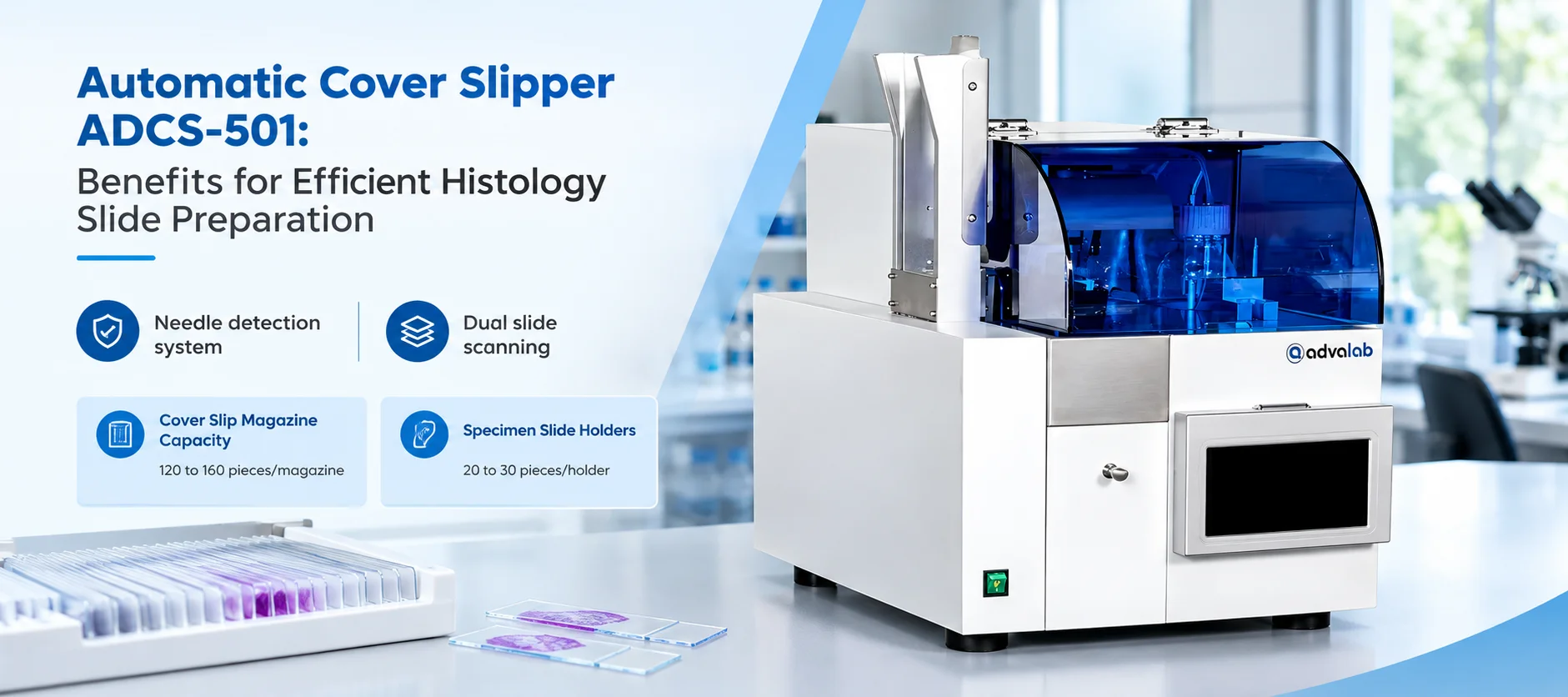
Slides that wait at the coverslipping bench hold up each report behind them. This article explains how an automatic cover slipper works and what to check before choosing one.
A tray of stained tissue slides can be ready in good time and still wait for the final step. At the coverslipping bench, mounting medium goes on by hand, air bubbles hide under the glass, thin cover glass breaks, and a trained technician stays tied to a repetitive task while reports queue behind it.
An automated cover slipper takes that step off the bench. The Advalab ADCS-501 publishes its throughput, magazine and holder capacity, glass and slide sizes, footprint and features, so a laboratory can judge the fit before ordering.
An Automatic Cover Slipper suits a laboratory only when those figures match its slide volume, its glass format and its bench. This article explains how it works, what it is used for, how a typical run goes and which mistakes to avoid, and then the next step: confirm the open points with the supplier and review the full specifications.
How Automatic Cover Slippers work is easiest to follow as a short cycle. A stained slide leaves its holder, mounting medium is applied, a cover glass is lowered into place, and the finished slide moves into an output magazine. The operator loads the holders and magazines and selects the settings on the touchscreen.
An Automatic Cover Slipper machine repeats the same motion for each slide. A hand-coverslipped batch rely on grip and timing, while an automated glass coverslipper applies the movement from the first slide to the last. The ADCS-501 adds an adjustable sealing glue, a needle detection system, dual slide scanning and storage detection alarms around that cycle.
Illustrative layout, not to scale: slides move from the holders to the working station, receive mounting medium and cover glass, and leave in output magazines.
Slide quality problems usually begin at a few points:
When volume grows, these faults add up, which is why many laboratories compare an automated coverslipper against hand work before adding staff.
Each benefit below ties to a specification or feature published for the ADCS-501.
The listing gives two hundred to four hundred specimen slides per hour.
Each cover slip magazine holds one hundred twenty to one hundred sixty cover slips for continuous loading.
Each holder carries twenty to thirty slides, so loading is done in batches.
Each output magazine takes thirty finished slides.
The amount of mounting medium can be set to suit the slide.
A needle detection system is listed as part of the unit.
The listing names dual scanning of slides during processing.
Storage detection alarms alert the operator about storage.
The FAQ adds a large suction fan with a replaceable activated carbon filter.
Live guidance helps the operator through each step.
Infographic: capacity, size and weight figures from the ADCS-501 listing.
The Advalab listing names pathology and histology laboratories as the main settings. In practice, an automatic coverslipper fits these areas:
The listing does not publish an operating procedure, so follow the supplier manual for exact steps. A typical run on an automatic cover slipper device follows this order:
Match these published figures against your own slides, glass and bench before shortlisting any coverslipper machine:
Infographic: what the listing states and what still needs a supplier answer.
| Point | Hand coverslipping | Automated coverslipper |
|---|---|---|
| Mounting medium | Applied by hand | Adjustable sealing glue |
| Loading | One slide at a time | Holders and magazines |
| Checks | Visual only | Needle detection, dual scanning and alarms |
| Staff time | Tied to the bench | Free for staining and review |
The cover slippers category at Advalab brings together instruments that place cover glass on prepared specimen slides. The range includes the automatic cover slipper format, which the ADCS-501 belongs to, and the mini cover slipper format, such as the Mini Cover Slipper ADMCS-501.
When laboratories compare options in this category, they typically weigh throughput, magazine and holder capacity, cover glass and slide format, sealing and detection features, interface and footprint. To review all formats side by side, explore the cover slippers category, or see the wider laboratory equipment catalog on the Advalab home page.
The Automatic Cover Slipper ADCS-501 pairs a throughput range of two hundred to four hundred slides per hour with continuous-loading magazines, adjustable sealing glue, needle detection, dual slide scanning and a color touchscreen. It suits pathology and histology laboratories that want steady, repeatable slide preparation without adding hours to the day.
Hazel Daniels
Specialty: Healthcare Technology & Laboratory Equipment
Writing Style: Professional, informative, and reader-friendly
Bio: Hazel Daniels specializes in writing about healthcare technology, laboratory equipment, and scientific applications. She presents technical information in simple language, highlighting practical uses and industry developments.
Review the published throughput, capacity, size and feature details for this automatic cover slipper and compare them against your own slide volume and bench.
Explore Automatic Cover Slipper ADCS-501