
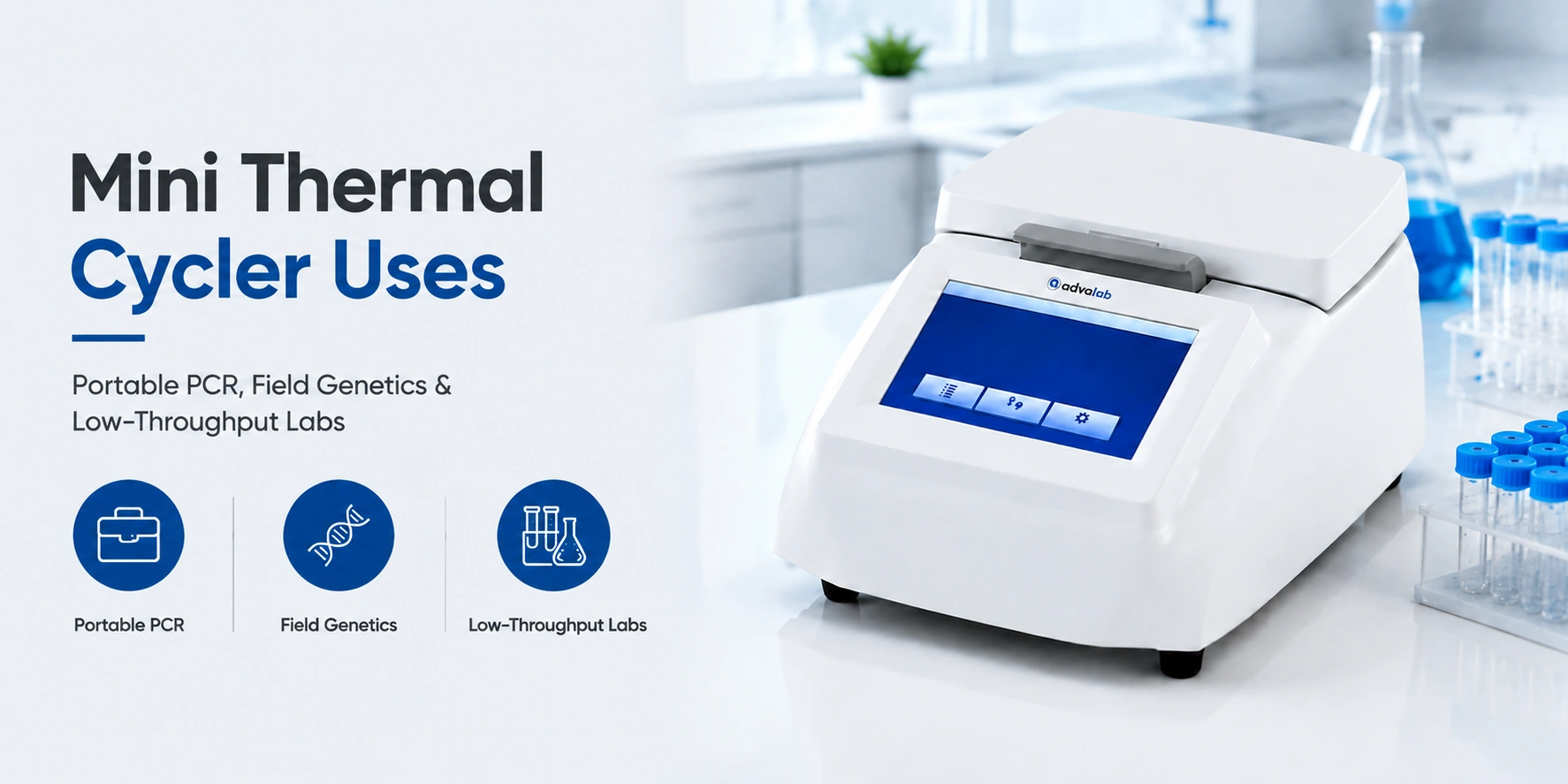
A working overview for laboratory, hospital, and research centre teams on where a Mini Thermal Cycler fits into small-scale amplification work, from a field genetics kit to a low-throughput bench running only a handful of samples at a time.
A Mini Thermal Cycler scales a pcr machine down to a footprint and power draw suited to travel cases, small clinics, and benches that never need a large block. Rather than a compromise version of a full-size instrument, it is a purpose-built pcr laboratory equipment option for settings where sample counts stay low and portability matters more than raw batch size. Labs comparing block capacity and battery options often start from the mini thermal cycler line on the mini thermal cycler page before choosing a unit suited to field or low-throughput work.
A thermal cycler amplifies DNA by repeating three temperature stages across a sample block: denaturation to separate DNA strands, annealing to let primers bind their target sequence, and extension to build new strands from each primer. A mini thermal cycler digital control unit runs this same three-step cycle on a smaller block, typically holding somewhere between eight and sixteen samples rather than the ninety-six a full-size unit might handle. Reduced block mass lets a mini unit reach cycling temperatures with a smaller power draw, which is part of what makes battery or low-power field operation possible on some models.
Cycle stages: denaturation, primer annealing, strand extension, repeated on a small block.
A mini thermal cycler system covers several settings where a full-size, high-capacity block would be unnecessary or impractical.
A small footprint and, on some models, battery operation let a mini unit travel between sites rather than staying fixed to one bench.
Species identification and environmental sampling work often needs amplification capability away from a fixed lab, which a compact, transportable unit supports directly.
A small clinic or research group running only a few samples per day gets little benefit from a large block and instead favours a compact unit that still meets daily demand.
A low-cost, compact unit lets a classroom run a hands-on amplification exercise without dedicating a full-size instrument to a single session.
Setup for a small block follows the same broad sequence as any thermal cycler, with a few details specific to a compact design worth extra attention.
Category spans block capacity, portability, power source, and control interface.
Mini thermal cyclers sit within a wider group of amplification and detection equipment, alongside gradient and full-size multi-block thermal cyclers built for higher sample throughput. Buyers comparing options in this category typically weigh block capacity, portability, power source, and ramp speed against the scale of work planned for the instrument. The full mini thermal cycler lineup outlines configurations for field and low-throughput use, and sits alongside the broader laboratory equipment range on advalab's main website, where related molecular biology hardware can also be reviewed.
| Factor | Mini Thermal Cycler | Full-Size Multi-Block Thermal Cycler |
|---|---|---|
| Block capacity | Typically 8 to 16 samples per run | Commonly 96 samples or more per block |
| Portability | Small footprint, some models support battery use | Fixed bench placement, needs a dedicated power outlet |
| Typical setting | Field genetics, low-throughput labs, teaching demonstrations | Central research or diagnostic labs running high sample volumes |
| Ramp speed | Often slower, prioritizing low power draw over cycling speed | Generally faster, suited to time-sensitive high-volume runs |
Log the temperature profile used for each run alongside the primer set, so a failed amplification can be traced back to a setting later.
Charge or check battery-backed units ahead of a field trip rather than assuming they hold charge from a previous session.
Verify tube compatibility before ordering consumables, since small blocks accept a narrower range of formats than larger units.
Clean the block and lid gasket periodically to keep heat transfer consistent across the available wells.
Carry a spare power source or cable for field sessions where a unit runs away from a fixed outlet.
Train new staff on loading balance across the block, since uneven loading can affect results on certain designs.