
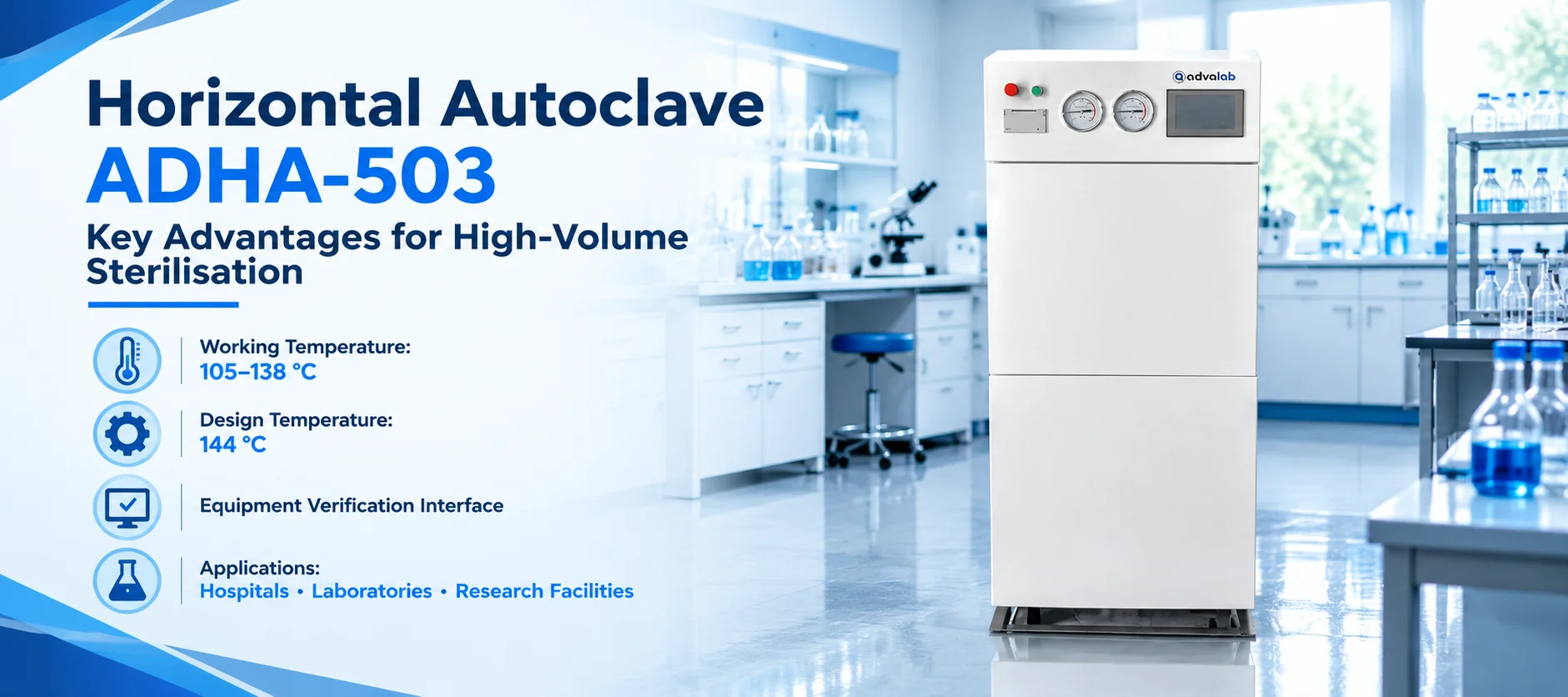
Trays of instruments, stacks of fabrics and racks of glassware add up quickly in a busy hospital or laboratory. This article explains how a horizontal autoclave processes large loads, what its controls and safety parts do, and which details to check before choosing a unit.
A central sterile department or a research facility rarely sterilizes one tray at a time. Surgical sets, linen packs, glassware and culture media arrive in volume, and a small chamber turns that volume into a string of short cycles, each with its own loading, waiting and unloading. Each extra cycle adds handling, and porous loads such as fabrics need steam to reach deep into the pack.
A fully automatic Horizontal Autoclave answers this with one large chamber, programmed cycles and drying built into the process. The questions that remain are about chamber size, door design, controls and the utilities the site must provide. Buyers who search for an autoclave machine horizontal in layout are usually looking for a front-loading chamber that takes loads on a carriage.
A horizontal steam sterilizer autoclave moves a load through a fixed sequence. In pulse vacuum designs, air is pulled out first, because trapped air blocks steam contact. Steam then fills the jacket and chamber, raising pressure and temperature to the working values; on the ADHA-503 the working pressure is 0.245 MPa within a 105 to 138 °C range. After the exposure time, steam exhausts, and a final vacuum stage dries the load.
That sequence is how horizontal autoclave works at any size, and the same outline explains why a chamber with a vacuum pump and a steam jacket handles wrapped and porous loads better than a simple gravity unit.
Process stages: air removal, steam admission, exposure, exhaust and vacuum drying.
Ten Advantages, Explained
The worked example is the Horizontal Autoclave ADHA-503 from Advalab, a front-loading unit with a 398 L chamber. Each card covers a different advantage, so you can weigh which ones your department needs.
The horizontal chamber measures 620 mm across and 1320 mm deep, and its steam jacket keeps the walls hot during the cycle.
Vacuum drying at −0.086 MPa draws moisture off the load, so wrapped packs and fabrics leave the chamber dry.
A wide sterilization range with temperature uniformity below ±2.0 °C lets one unit serve instruments, fabrics and liquids.
A disc gear door with an electric lock stays closed under pressure, and the unit is available with a single or double door.
Pneumatic or self-expanding door seals let the buyer match the seal to the way the door is used.
A touch screen with a microcomputer runs program selection, so operators start a cycle without manual valve work.
Fabric, instruments, liquid, Bowie-Dick, leak test and custom programs cover routine loads and chamber checks.
The controller tracks F0 value and temperature against time, which shows how much lethality each load actually received.
Sterilization records and reports document each run for audits and handover between shifts.
A dedicated verification interface supports validation work without opening the chamber.
Horizontal Autoclave uses center on three primary functions: sterilizing surgical instruments, fabrics and culture media. The same Horizontal Autoclave machine uses its programs for glassware and liquids too, and a Horizontal Autoclave sterilizer earns its floor space where cycles run several times a day. The typical settings are:
Departments with lighter or movable loads can look at the wider range of autoclaves before committing to a floor-standing chamber.
Good results rely on how the chamber is packed. Wrapped items need a porous wrap, such as sterilization wrap or muslin, that lets steam through, and they should not be overwrapped. Leave space around packs for steam to circulate, and avoid overloading, which blocks penetration.
Biohazard waste belongs in autoclavable bags or containers, and only in a cycle that has been validated for it.
Usually suitable
Check before loading
Load diagram: materials that usually suit steam, and materials that need a check first.
A chamber of this size draws on several utilities. The ADHA-503 lists a 3-phase, 5-wire AC 380 V 50 Hz supply, a system load of 2 kW or less plus an optional 18 kW built-in steam generator, and consumption of up to 25 kg of steam and 200 kg of water per cycle. Supply pressures are 0.1 to 0.2 MPa for water, 0.4 to 0.7 MPa for air and 0.3 to 0.7 MPa for steam.
The optional steam generator also needs routine care:
Advalab lists five horizontal models. Chamber volume is the first filter, and the temperature range is the second.
| Model | Chamber volume | Detail |
|---|---|---|
| ADHA-507 | 150 L | Ø 440 × 1000 mm; 0.22 MPa, 134 °C |
| ADHA-501 | 280 L | Temperature range 105 to 135 °C |
| ADHA-502 | 360 L | Temperature range 105 to 135 °C |
| ADHA-503 | 398 L | Ø 620 × 1320 mm; 105 to 138 °C |
| ADHA-506 | 500 L | Temperature range 105 to 135 °C |
Volume chart: chamber capacity in liters, by model.
The horizontal autoclave range page lists all models, and the ADHA-503 catalog carries the full specification sheet.
The ADHA-503 sits inside Advalab's autoclaves category, which sorts steam sterilizers by form and capacity. Four lines make up the category:
Hazel Daniels
Specialty: Healthcare Technology & Laboratory Equipment
Writing Style: Professional, informative, and reader-friendly
Bio: Hazel Daniels specializes in writing about healthcare technology, laboratory equipment, and scientific applications. She presents technical information in simple language, highlighting practical uses and industry developments.
www.linkedin.com/in/hazel-daniels-4a108b444
The full specification table, features and application notes for the unit discussed above are on its product page.
Explore Horizontal Autoclave ADHA-503