
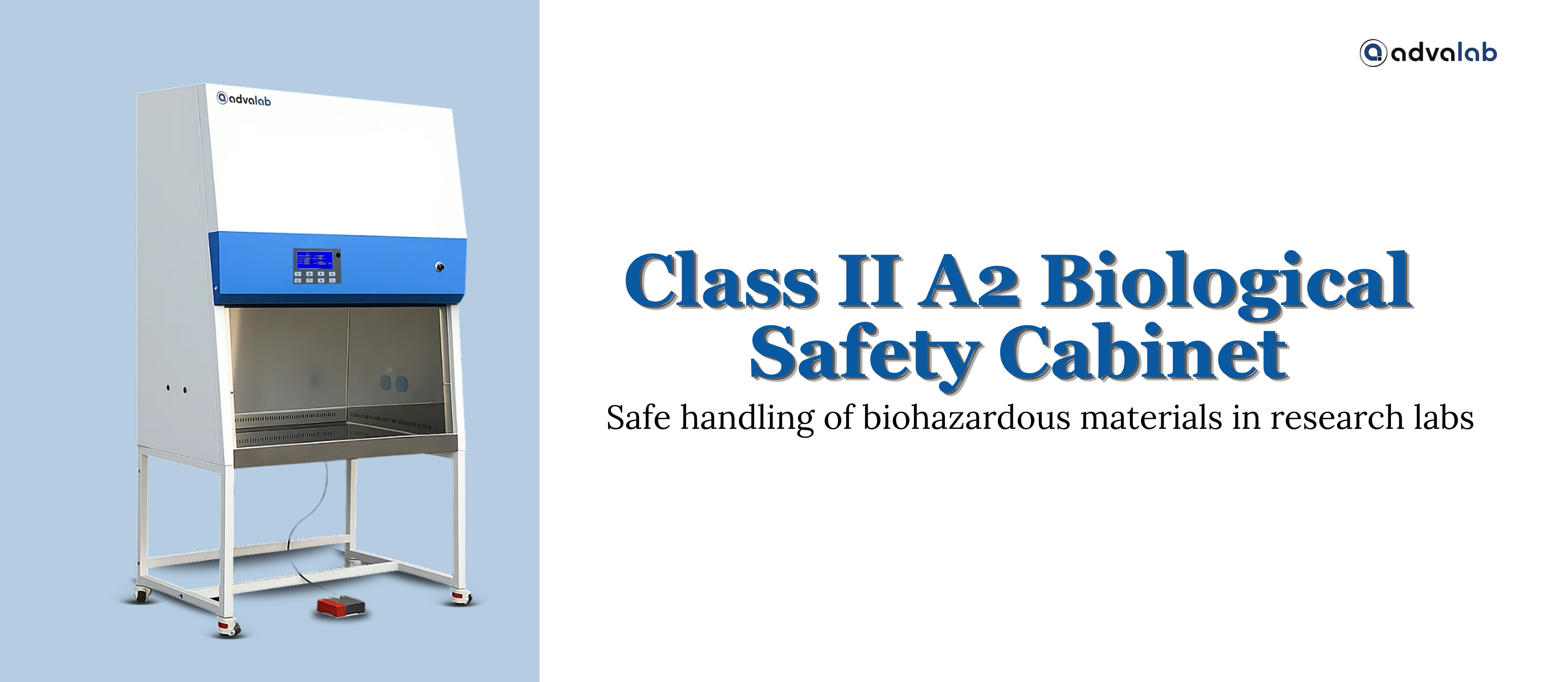
A Biological Safety Cabinet (BSC) is a ventilated enclosure designed to provide personnel, product, and environmental protection during the manipulation of infectious agents, cell cultures, and other biohazardous materials. Unlike a chemical fume hood — which protects only the operator from chemical vapours — a biosafety cabinet protects all three parties simultaneously through a combination of inward airflow (personnel protection), downward HEPA-filtered laminar airflow (product protection from room-borne contamination), and HEPA-filtered exhaust (environmental protection from work zone aerosols).
The classification of biosafety cabinets — Class I, Class II (Types A1, A2, B1, B2), and Class III — reflects both the protection level provided and the airflow design used to achieve it. The class II type A2 biological safety cabinet is the most widely specified configuration in biomedical research, pharmaceutical manufacturing, and clinical microbiology laboratories. It provides all three protection modes, recirculates 70% of cabinet air through the work zone after HEPA filtration, and exhausts 30% through a HEPA-filtered exhaust — either to the room or to a building exhaust duct. The ADBC-501 from Advalab meets NSF/ANSI 49 and EN 12469 performance requirements for this cabinet class.
Biosafety cabinet types differ in the degree of operator protection, the ability to handle volatile toxic chemicals or radionuclides, and whether a hard-ducted exhaust is mandatory. Selecting the correct class prevents both under-protection for the hazard level and unnecessary over-specification that adds installation complexity.
Personnel and environmental protection only. No product protection (unfiltered room air enters work zone). Used for low-to-moderate risk agents without sterility requirement.
Triple protection. 70% air recirculated, 30% HEPA-exhausted. Standard for BSL-2 and most BSL-3 applications. Can exhaust to room or duct. Current page subject.
100% total exhaust — no recirculation. Mandatory hard-duct. Appropriate when volatile toxic chemicals or radionuclides are used with biohazardous agents simultaneously.
Totally enclosed, gas-tight glove box. Maximum containment for BSL-4 agents. All operations via attached gloves; supply and exhaust both HEPA-filtered, exhaust double-HEPA.
The airflow architecture of a class 2 type A2 biological safety cabinet is more complex than either a fume hood or a laminar flow clean bench. Understanding each airflow component clarifies why specific NSF/ANSI 49 test parameters — inflow velocity, downflow velocity, cabinet integrity, and HEPA filter efficiency — are required to validate cabinet performance.
Airflow Path — Type A2 Cabinet Schematic
| Parameter | Value / Range |
|---|---|
| Cabinet Class | Class II Type A2 (series class II A2) |
| Interior Width (work zone) | 1200 mm (also available: 900 mm, 1500 mm, 1800 mm) |
| Interior Depth | 600 mm |
| Average Inflow Velocity | ≥ 0.38 m/s (75 ft/min) at sash opening |
| Average Downflow Velocity | 0.25 – 0.30 m/s |
| Air Split Ratio | 70% recirculation / 30% exhaust |
| HEPA Filter Efficiency | ≥ 99.99% @ 0.3 µm (supply and exhaust) |
| Personnel Protection | KI-discus test: ≤ 0.1 µg KI/min escape |
| Product Protection | Viable particle test: ≤ 1 colony per exposure plate |
| Cabinet Integrity | Positive-pressure plenum test: ≤ 0.000001 tracer gas escape |
| Exhaust Configuration | HEPA-to-room (standard) or thimble/canopy-to-duct (optional) |
| Sash Type | Vertical-sliding tempered glass, counterbalanced |
| UV Lamp | 253.7 nm germicidal UV (30W), interlocked with sash |
| Interior Lighting | LED, ≥ 1000 lux at work surface |
| Noise Level | ≤ 65 dB(A) at operator position |
| Electrical Supply | 230V / 50 Hz (configurable) |
The Class II A2 Biological Safety Cabinet is the standard containment instrument for BSL-2 work and the starting specification for many BSL-3 applications. The following environments represent the primary deployment contexts for the ADBC-501.
USP <797> (sterile compounding) and EU GMP Annex 1 (aseptic manufacturing) require that compounding of sterile preparations occurs within ISO 5 (Class 100) air — the cleanliness level provided by the downflow zone of a Class II A2 BSC. Pharmaceutical compounding pharmacies, hospital pharmacy departments, and biopharmaceutical aseptic fill-finish suites use the ADBC-501 to prepare parenteral preparations, ophthalmic products, and cell therapy formulations under combined sterility and containment conditions. The downflow HEPA filter provides the ISO 5 background while the inflow prevents operator exposure to potent biological drug substances.
Hospital and reference microbiology laboratories processing clinical specimens potentially containing Mycobacterium tuberculosis, Staphylococcus aureus MRSA, Salmonella, and Hepatitis B/C require the Class II A2 BSC as the standard work surface for specimen manipulation, culture setup, and identification procedures. The class II A2 biological safety cabinet provides the containment required by the CDC/NIH Biosafety in Microbiological and Biomedical Laboratories (BMBL) guidance for Risk Group 2 agents, which correspond to BSL-2 agents in the US classification framework.
CAR-T cell manufacturing, mesenchymal stem cell expansion, and viral vector production (lentivirus, adeno-associated virus) require simultaneous containment of the viral vector and sterility of the cell product. The Class II A2 BSC addresses both requirements: the downflow zone maintains the cell culture in an ISO 5 aseptic environment while the inflow and HEPA-filtered exhaust contain viral aerosols generated during handling of viral supernatant, transduction steps, and fill operations.
University and research institute laboratories conducting mammalian cell culture, recombinant virus work, and primary tissue culture work routinely specify the Class II A2 BSC as the primary aseptic workspace. Beyond containment, the ISO 5 downflow zone significantly reduces mycoplasma contamination rates, cross-contamination between cell lines, and fungal contamination events that generate significant research waste when they occur in uncontrolled open bench environments.
Vaccine manufacturing for influenza, rabies, yellow fever, and other viral vaccines involves propagating viruses in cell culture substrates (Vero, MDCK, embryonated eggs) and harvesting viral fluid. These operations generate viral aerosols during media changes, harvest, and clarification steps. The ADBC-501 provides the Class II containment specified by WHO and national regulatory agencies for BSL-2 vaccine manufacturing, protecting both operators and the cell culture product through the combined inflow barrier and HEPA-filtered downflow.
Cytotoxic chemotherapy preparation requires both sterility (for the patient product) and operator protection from drug exposure. Some Class II A2 cabinets — when hard-ducted — are used for cytotoxic compounding under institutional protocols, with the inflow protecting the pharmacist from aerosols generated during reconstitution of lyophilised cytotoxic products. However, facilities using volatile drug formulations must evaluate whether a Class II B2 (total exhaust) cabinet or a purpose-designed containment primary engineering control (CPEC) per USP <800> provides more appropriate protection for their specific drug hazard assessment.
Advalab offers the biological safety cabinet product range spanning Class II Type A2 units in widths from 900 mm to 1800 mm for BSL-2 and BSL-3 containment applications, and Class II Type B2 total-exhaust configurations for operations involving volatile hazardous compounds alongside biological agents. All models share a common blower design, sash counterbalance mechanism, and digital airflow monitoring architecture compliant with NSF/ANSI 49.
The ADBC-501 is the 1200 mm standard-width Class II A2 unit — the most widely specified interior width for dual-operator or single-operator work with larger apparatus. For a complete configuration comparison across interior widths and exhaust options, visit the ADBC models page.
ADBC Series
Single-operator unit from Advalab for space-constrained BSL-2 environments. Ideal for smaller research laboratories and hospital pharmacy aseptic preparation areas where bench space limits the standard 1200 mm installation.
NSF/ANSI 49 and EN 12469 compliant, dual-operator width, HEPA-to-room or canopy exhaust, digital airflow monitor. Current page subject.
100% exhaust, no air recirculation, hard-duct required. Specified for simultaneous handling of biological agents with volatile cytotoxic drugs, volatile radionuclides, or other hazardous chemicals that cannot be re-circulated through the work zone.
The most frequent specification decision point is the biosafety cabinet Class II Type A2 vs B2 choice. The wrong selection creates either an under-protected work environment or unnecessarily complex and costly building exhaust infrastructure. The following comparison covers the key decision parameters.
| Characteristic | Class II Type A2 — ADBC-501 | Class II Type B2 | Class I |
|---|---|---|---|
| Personnel protection | ✓ | ✓ | ✓ |
| Product (sample) protection | ✓ | ✓ | ✗ |
| Environmental protection (HEPA exhaust) | ✓ | ✓ | ✓ |
| Air recirculation in work zone | 70% (HEPA-filtered) | None (100% exhaust) | None |
| Hard-duct exhaust required | Optional (canopy or HEPA-to-room) | Mandatory | Mandatory |
| Volatile chemical use (small quantities) | Acceptable (with canopy duct) | ✓ (full quantities) | ✓ |
| Suitable for BSL-2 | ✓ | ✓ | ✓ |
| Suitable for BSL-3 | ✓ (with negative pressure room) | ✓ | ✗ |
| Building HVAC impact | Low (canopy adds ~30% exhaust) | High (100% exhaust from room) | Moderate |
The Class II Type B2 cabinet is specified when volatile toxic chemicals must be used simultaneously with biological agents and cannot be substituted with non-volatile alternatives. The Class II A2 is appropriate for pure biological work and for operations involving trace quantities of volatile chemicals when hard-ducted with a canopy exhaust connection — the configuration that maintains the 0.38 m/s inflow and allows the small volatile chemical load to exit through the building exhaust rather than being recirculated.
Biosafety cabinet procurement involves decisions that directly affect containment performance and regulatory compliance for the entire service life of the equipment — typically 10–15 years. These are the six most frequently encountered specification errors.
A horizontal or vertical laminar flow clean bench provides ISO 5 product protection by directing HEPA-filtered air over the work surface and out toward the operator. It provides zero personnel or environmental protection — biological aerosols generated on the work surface are directed directly at the operator's face. Using a laminar flow bench for BSL-2 agent handling is a fundamental containment failure. The Class II A2 BSC provides ISO 5 product protection AND inflow protection for the operator simultaneously, which a clean bench cannot.
A 900 mm interior width accommodates a single operator comfortably. A 1200 mm width allows two operators working simultaneously or single-operator work with large apparatus such as a cell culture incubator insert, multiple flask formats, or CO₂ monitoring equipment. Specifying the smallest available width to save space creates workflow bottlenecks and increases the frequency with which operators reach deeply into the cabinet, disrupting the inflow air curtain at the sash opening.
A Class II A2 BSC exhausting HEPA-filtered air to the room adds no net exhaust to the laboratory HVAC balance — the exhaust air returns to the room and is recirculated by the building system. However, selecting a canopy or thimble connection to the building exhaust system adds a 30% exhaust load (approximately 150–250 m³/h for a 1200 mm unit) to the building HVAC balance without adding corresponding make-up air. This must be accommodated by the building mechanical design before installation, or cabinet performance will be compromised.
NSF/ANSI 49 specifies that a cabinet must meet performance criteria when located at least 30 cm from any wall, 30 cm from any doorway, and away from high-velocity HVAC supply diffusers. Supply air diffusers positioned directly above or in front of the cabinet face create crossdrafts that can disrupt the inflow air curtain and allow escape of internal aerosols. Cabinet placement relative to room airflow patterns must be assessed as part of the site evaluation before installation — not after the cabinet is in service.
Factory type tested at an NSF-registered laboratory for KI-discus personnel protection, viable particle product protection, cabinet integrity, filter efficiency, and electrical safety — with available for procurement documentation.
Continuous monitoring of inflow velocity with audible and visual alarm when velocity falls below the NSF 49 minimum threshold. BMS dry-contact output connects to building monitoring for remote alarm logging per EN 12469 requirements.
High-intensity LED panel provides uniform, shadow-free illumination at the work surface without the UV emission or heat output of fluorescent alternatives — reducing UV-induced media degradation and operator fatigue during extended work sessions.
The 253.7 nm UV lamp automatically deactivates when the sash is raised above the safe working position, preventing UV exposure to the operator. UV run-time is logged by the microcontroller to track lamp ageing and prompt timely replacement before germicidal effectiveness degrades below useful levels.
The factory-fitted canopy exhaust collar allows connection to a building exhaust duct via an unconnected canopy gap — maintaining atmospheric break between the cabinet exhaust and duct to prevent building pressure variations from affecting cabinet inflow velocity. Required when trace volatile chemicals are used.
The work surface and interior walls are fabricated from 304 stainless steel with coved (rounded) corners that eliminate 90° angles where biological material can accumulate and resist decontamination — a surface design requirement for chemical decontamination procedures including formaldehyde fumigation and hydrogen peroxide vapour decontamination.
Review full specifications, interior width options, exhaust configurations, and NSF/ANSI 49 type test documentation on the Advalab product page.