
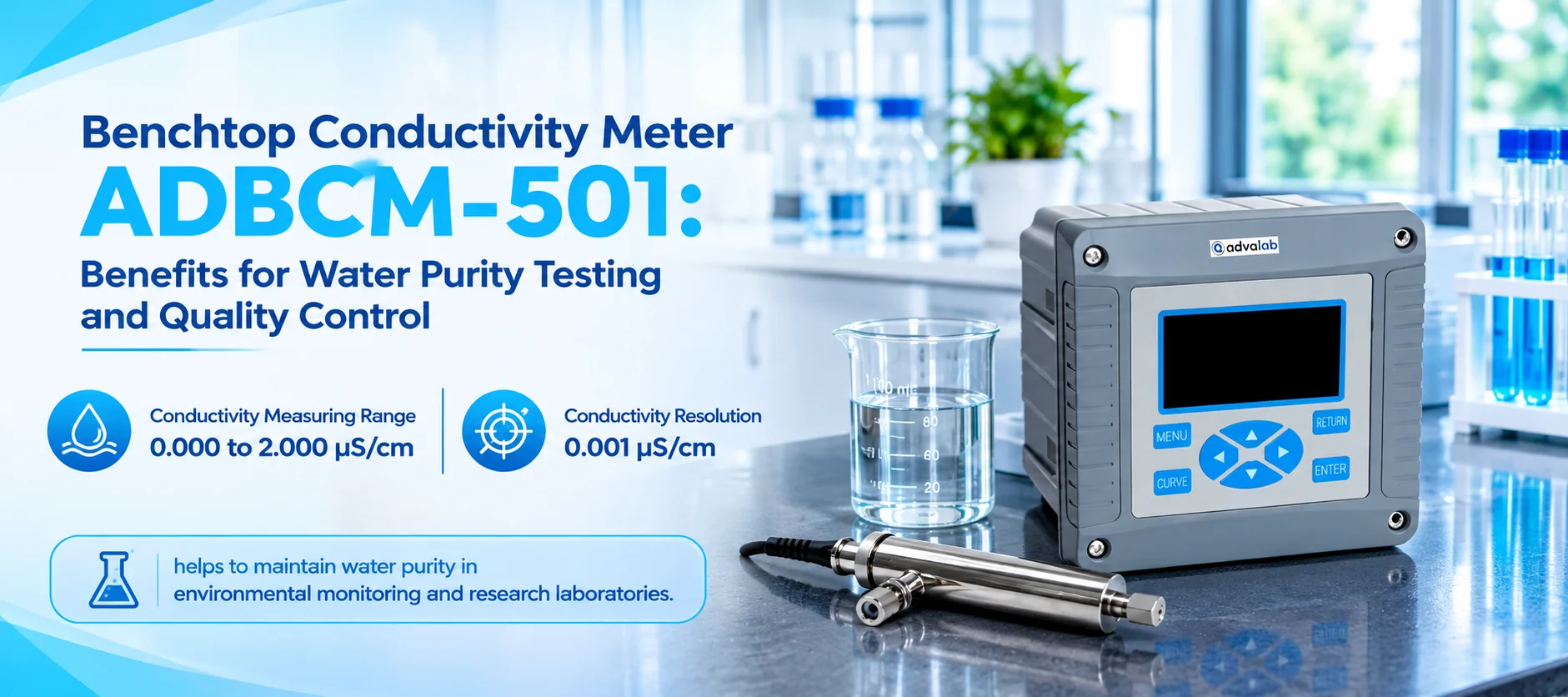
A reading of pure water climbs while the display is still settling. A few degrees of temperature drift change the number again. A meter with a coarse display step cannot tell clean water from water that has just started to pick up contamination. Laboratories and treatment plants meet these problems whenever water quality is judged at the low end of the scale. The Benchtop Conductivity Meter ADBCM-501 lists a 0.000 to 2.000 µS/cm range, a 0.001 µS/cm display step, and Pt1000 temperature sensing, which raises a practical question: what do those figures mean for water purity work, and what should be confirmed before choosing a meter?
A Benchtop Conductivity Meter is a laboratory instrument that measures how well a liquid carries electric current, which reflects the amount of dissolved ions in it. A cell dipped in the sample feeds a signal to the meter, which converts it to conductivity and displays the result with temperature correction.
Terms such as Benchtop Conductivity Meter, conductivity meter benchtop, and benchtop conductivity meter lab all describe this instrument class. A Benchtop Conductivity Meter digital model, such as the ADBCM-501 with its 128 × 64 dot matrix LCD, adds numeric readouts and outputs that analog meters lack. Many laboratories also use it as a benchtop tds meter, because total dissolved solids can be estimated from the conductivity reading.
The conductivity meter principle rests on ion movement. Dissolved ions carry charge through a liquid, so more ions mean more current for the same applied voltage. The meter measures that current flow, multiplies it by the cell constant of the electrode, and reports conductivity. The sequence runs in five stages.
The electrode applies an alternating voltage to the sample.
Dissolved ions carry current between the electrode surfaces.
The meter reads the current and applies the cell constant.
A temperature sensor adjusts the value to a reference temperature.
Conductivity and related readings appear on the screen.
Temperature correction matters because conductivity rises with temperature, by roughly 2% per degree Celsius for many natural waters. The ADBCM-501 listing names a composite electrode with automatic temperature compensation, a Pt1000 temperature sensor, and a compensation range of 0 to 60 °C.
Conductivity is the base measurement, and the other readings are derived from it. Resistivity is its inverse, so 1 µS/cm equals 1 MΩ·cm. Total dissolved solids and salinity come from conversion factors applied to the conductivity value. The graphic shows the ranges the ADBCM-501 lists for each reading.
0.000 to 2.000 µS/cm
Base measurement
0.0 to 20.00 MΩ·cm
Inverse of conductivity
0.0 to 10000.0 mg/L
Estimated with a factor
0.0 to 9999.99 ppm
Converted from conductivity
A 2.000 µS/cm conductivity corresponds to a very small TDS value, so the listed TDS and salinity ranges are far wider than the conductivity range could produce. Confirm which ranges apply to each reading.
The table lists values published on the ADBCM-501 product page and explains how each one affects planning.
| Parameter | ADBCM-501 listing | Why it matters |
|---|---|---|
| Conductivity range | 0.000 to 2.000 µS/cm | Sets the working window; the description also mentions 0.00 to 20.00 µS/cm |
| Display step | 0.001 µS/cm | Smallest change the display can show; not the same as accuracy |
| Conductivity accuracy | ±1.5% F.S. | Closeness to the true value, stated against full scale |
| Repeatability | ≤1.2% F.S. | How closely repeat readings of one sample agree |
| TDS range | 0.0 to 10000.0 mg/L | Range for the estimated dissolved solids reading |
| Salinity range | 0.0 to 9999.99 ppm | Range for the converted salinity reading |
| Resistivity range | 0.0 to 20.00 MΩ·cm | Suits ultrapure water, where resistivity is the usual unit |
| Temperature sensor | Pt1000; compensation 0 to 60 °C; error ±0.5 °C | Corrects readings to a reference temperature |
| Sample limits | 5 to 60 °C; pressure below 0.6 MPa | Defines what the cell can be exposed to |
| Ambient limits | 5 to 45 °C; ≤ 85% RH, non-condensing | Defines where the meter body can be placed |
| Display and memory | 128 × 64 dot matrix LCD; data kept over 10 years without power | Supports clear readouts and retained settings |
| Protection | IP65 | Indicates resistance to dust and water jets |
| Outputs | Electrically separated current output (0 to 10 mA, 0 to 20 mA, optional 4 to 20 mA; load below 750 Ω); RS485 | Connects the meter to recorders or control systems |
| Alarm relays | 2 normally open points; AC 220 V/3 A or DC 30 V/3 A, user settable | Switches external alarms or devices on set limits |
| Dimensions (W × H × D) | 145 × 120 × 150 mm; panel cut-out 215 × 138 × 138 mm | Determines bench or panel placement |
| Weight | 0.64 kg net; 1.7 kg gross | Affects handling and mounting |
The ADBCM-501 listing names water treatment, power plants, chemical processing, pharmaceutical manufacturing, food processing, environmental monitoring, and research laboratories. Low-range conductivity does a different job in each.
Conductivity after purification stages shows when a membrane or resin bed is losing performance, long before other tests would flag it.
Boiler and condensate water is kept very pure, so a small rise in conductivity is an early warning of ingress.
Process and rinse water is checked against limits set by the product and the facility, so low-end accuracy matters.
Laboratory water is verified before use, and field samples are screened for dissolved ion content.
A benchtop conductivity meter lab routine matters most at low conductivity, where contamination from the air or the container can exceed the true signal. A typical sequence follows.
The listing does not publish an operating procedure, so the supplier manual remains the source for calibration and electrode care.
Selection starts with the lowest conductivity the work must measure, not with the number of features. Meters differ in range, accuracy, and outputs across the full conductivity meter range, so define the sample and the limit first.
| Requirement | Consider |
|---|---|
| Water below 2 µS/cm, such as purified or ultrapure water | Low-end range, display step, and the electrode cell constant |
| Continuous monitoring with alarms | Relay outputs and settable alarm limits |
| Data sent to a recorder or control system | Current output options and RS485 |
| Warm or pressurized samples | Sample temperature and pressure limits, and the compensation range |
| Panel or enclosure installation | Panel cut-out size and protection class |
| Quick spot checks away from the bench | A handheld meter rather than a benchtop meter |
The benchtop conductivity meter range covers fixed installations, while handheld meters serve a different purpose. The table sets the two formats side by side.
| Feature | Benchtop or panel meter | Handheld meter |
|---|---|---|
| Typical setting | Laboratory bench or fixed panel | Field work and spot checks |
| Power and portability | Mains-powered; fixed position | Battery-powered; carried to the sample |
| Outputs and alarms | ADBCM-501: current output, RS485, two alarm relays | Usually a display only, sometimes data logging |
| Calibration and stability | Multi-point calibration and steadier readings are typical | Simpler calibration; readings suit screening |
| Suited to | Low-range water and continuous monitoring | Quick checks across many sample points |
The ADBCM-501 belongs to a category built around accurate ion measurement with automatic temperature compensation, used in water treatment, environmental monitoring, and quality control testing. The range currently listed under it is the benchtop conductivity meters range.
When comparing options in this category, teams usually weigh measuring range, display step, accuracy, temperature compensation, outputs, protection class, and sensor type. The full set of models is listed on the conductivity meters page, and further laboratory equipment is available from the Advalab home page.
A benchtop conductivity meter earns its place when water quality is judged at levels where small errors change the decision. The ADBCM-501 pairs a 0.000 to 2.000 µS/cm range, Pt1000 temperature sensing, and current, RS485, and relay outputs. Matching range, accuracy at the low end, electrode, and output needs to the water being tested turns a specification list into a sound selection.
Hazel Daniels
Specialty: Healthcare Technology & Laboratory Equipment
Writing Style: Professional, informative, and reader-friendly
Bio: Hazel Daniels specializes in writing about healthcare technology, laboratory equipment, and scientific applications. She presents technical information in simple language, highlighting practical uses and industry developments.