
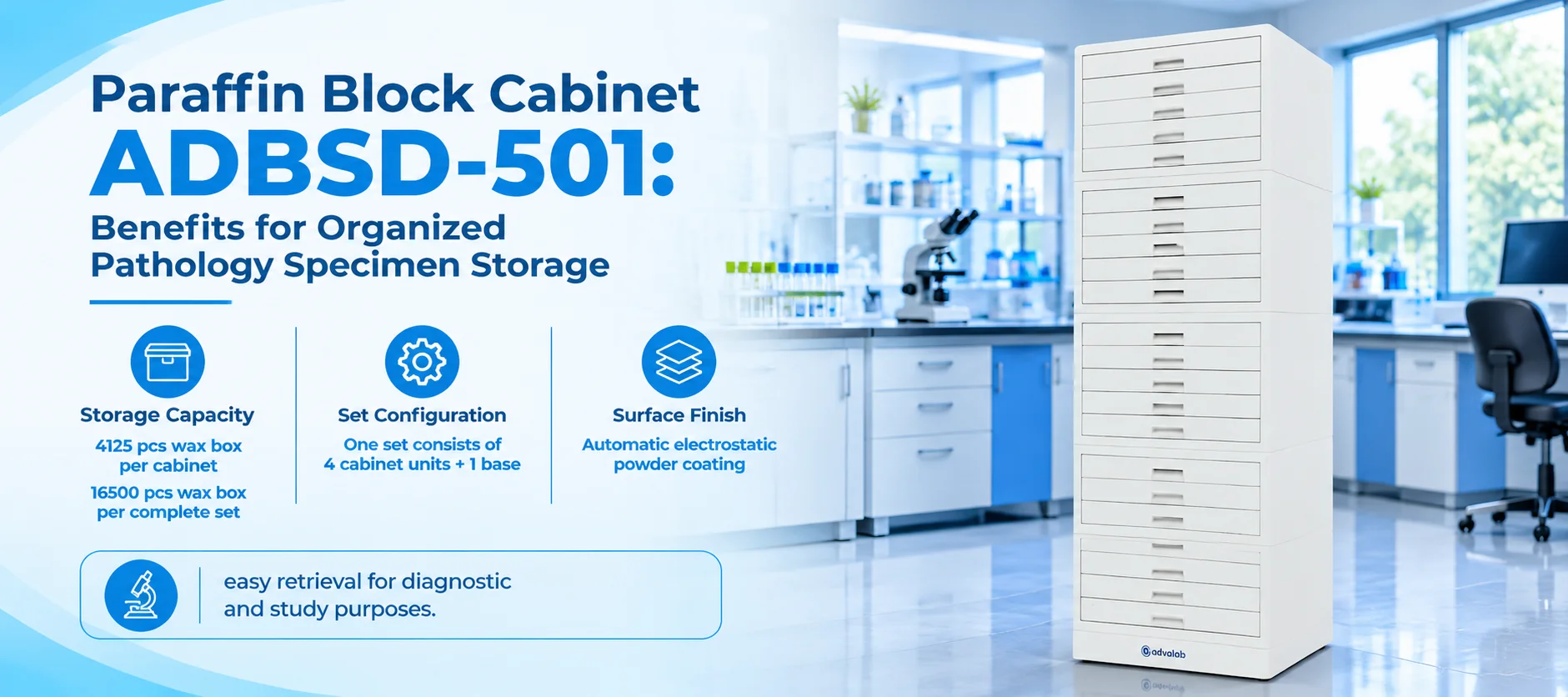
A Paraffin Block Cabinet is a drawer-based storage unit that holds paraffin-embedded tissue blocks upright in labeled grooves, so each specimen has a fixed place and can be retrieved without disturbing its neighbors. As a paraffin block storage cabinet, it serves pathology and research laboratories where blocks must stay intact and traceable for later re-cutting and study.
Compared with loose boxes or open trays, a tissue block storage cabinet separates, labels, and protects blocks in a single arrangement, which is why it sits at the center of most histopathology archives.
Paraffin wax block uses begin at the microtome. After tissue is processed, it is embedded in paraffin wax, and the hardened block supports the specimen while thin sections are cut for slides. The block then takes on a second job: it stays as the source material for further sections, additional stains, and later tests, so it is kept for years instead of discarded.
That second job is the reason storage matters. Wax softens with warmth, blocks stick or deform under pressure, and a block filed in the wrong place is effectively lost. Storage that keeps blocks apart, upright, and in a known order protects the specimen and shortens the search.
Chipped edges and blocks fused face to face.
Softened wax and deformed cutting faces.
Slow searches and blocks that are misfiled.
Dust settling on blocks and rough handling.
How a paraffin block cabinet works comes down to five design details listed for the ADBSD-501:
A complete set is four cabinets on one base. The diagram shows how the listed heights add up.
The table lists values published on the ADBSD-501 product page and explains how each one affects planning.
| Parameter | ADBSD-501 listing | Why it matters |
|---|---|---|
| Capacity | About 4,125 blocks per cabinet; up to 16,500 per complete set | Sets the archive size one cabinet or one stack can hold |
| Drawer system | 5 drawers per cabinet; 12 adjustable grooves per drawer | Lets groove spacing follow the block or cassette size |
| Cabinet size | 515 × 480 × 360 mm; 26 kg | Defines shelf, bench, or floor footprint for one unit |
| Complete set size | 515 × 480 × 1510 mm; 105.5 kg | Determines ceiling clearance and floor loading |
| Base unit | 515 × 480 × 70 mm; 1.5 kg | Carries the stack and sets its starting height |
| Material | 0.8 mm cold-rolled steel sheet | Gives the body its rigidity under a full load |
| Finish | Automatic electrostatic powder coating, ivory | Protects the exterior against wear and scratches |
The listed capacity is approximate, and the real count changes with the size of the blocks or cassettes in use. Confirm the counting basis with the supplier before sizing an archive.
The ADBSD-501 listing names pathology and research laboratories. The need differs between them, and each shapes how the cabinet is used.
Diagnostic archives are searched for re-cuts, additional stains, and consultations. Fast, accurate retrieval matters most here, so a strict filing order carries more weight than raw capacity.
Study collections are filed by project or cohort and pulled in batches. Grouping a whole study within neighboring drawers keeps batch retrieval short.
Archives grow with each working day and must stay traceable for years. Stackable units let the archive grow upward without taking more floor area.
Reference blocks for training need to be reachable by many people. Clear drawer labels let a new user find a block without knowing the archive history.
Paraffin block cabinet use works well when the routine is the same for each operator on the team. A typical sequence follows.
The listing does not publish an operating procedure, so the supplier manual remains the source for assembly and handling details. Wax softens with warmth, so a cool, dry, level room away from heat sources suits the cabinet.
Start with a count before choosing a unit. Add the blocks in storage today to the number expected over the next several years, then compare the total with the listed capacity. The graphic shows how the ADBSD-501 figures scale from one drawer to a full set.
The drawer figure divides the cabinet capacity by five drawers. It is arithmetic, not a listed value.
Then plan the floor. A complete set stands 1,510 mm tall, weighs 105.5 kg on a 515 × 480 mm footprint, and needs clearance to pull each drawer fully out. Laboratories that also file reagents, glassware, or gas cylinders can compare options across the wider laboratory storage cabinet range before settling the room layout.
The paraffin block cabinet range lists two models, and the published figures call for a careful read.
| Parameter | ADBSD-501 | ADBSD-502 |
|---|---|---|
| Capacity | About 4,125 per cabinet; up to 16,500 per set | 12,000 per cabinet |
| Cabinet size | 515 × 480 × 360 mm | 515 × 480 × 360 mm |
| Cabinet weight | 26 kg | 26 kg |
| Complete set size | 515 × 480 × 1510 mm | 515 × 480 × 1510 mm |
| Complete set weight | 105.5 kg | 79.5 kg |
Both models list the same cabinet dimensions, yet the capacity figures differ by nearly three times. Ask the supplier to confirm what each figure counts, including block size and whether it applies per cabinet or per set, before comparing.
The ADBSD-501 listing also notes that its dimensions align with other pathology storage systems. The slide storage cabinets ADSSD-501 and ADSSD-503 list the same 515 × 480 × 360 mm cabinet size, so laboratories that archive blocks and slides together should ask whether the two stack in matching columns.
The ADBSD-501 belongs to a category with five ranges: gas cylinder storage cabinets, chemical storage cabinets, glassware storage cabinets, slide storage cabinets, and paraffin block cabinets. Each range answers a different storage problem, from hazardous materials to specimen archives.
When comparing options in this category, teams usually weigh internal layout, capacity, body material and finish, door or drawer type, ventilation, footprint, weight, and whether units stack. The full set of models is listed on the laboratory storage cabinets page, and further laboratory equipment is available from the Advalab home page.
A Paraffin Block Cabinet earns its place once an archive grows past what boxes and trays can hold in order. The ADBSD-501 combines five drawers, adjustable grooves, card slots, and stackable units for pathology and research laboratories. Matching listed capacity, block size, floor space, and filing routine to the archive turns a specification list into a sound selection.
Hazel Daniels
Specialty: Healthcare Technology & Laboratory Equipment
Writing Style: Professional, informative, and reader-friendly
Bio: Hazel Daniels specializes in writing about healthcare technology, laboratory equipment, and scientific applications. She presents technical information in simple language, highlighting practical uses and industry developments.
www.linkedin.com/in/hazel-daniels-4a108b444