
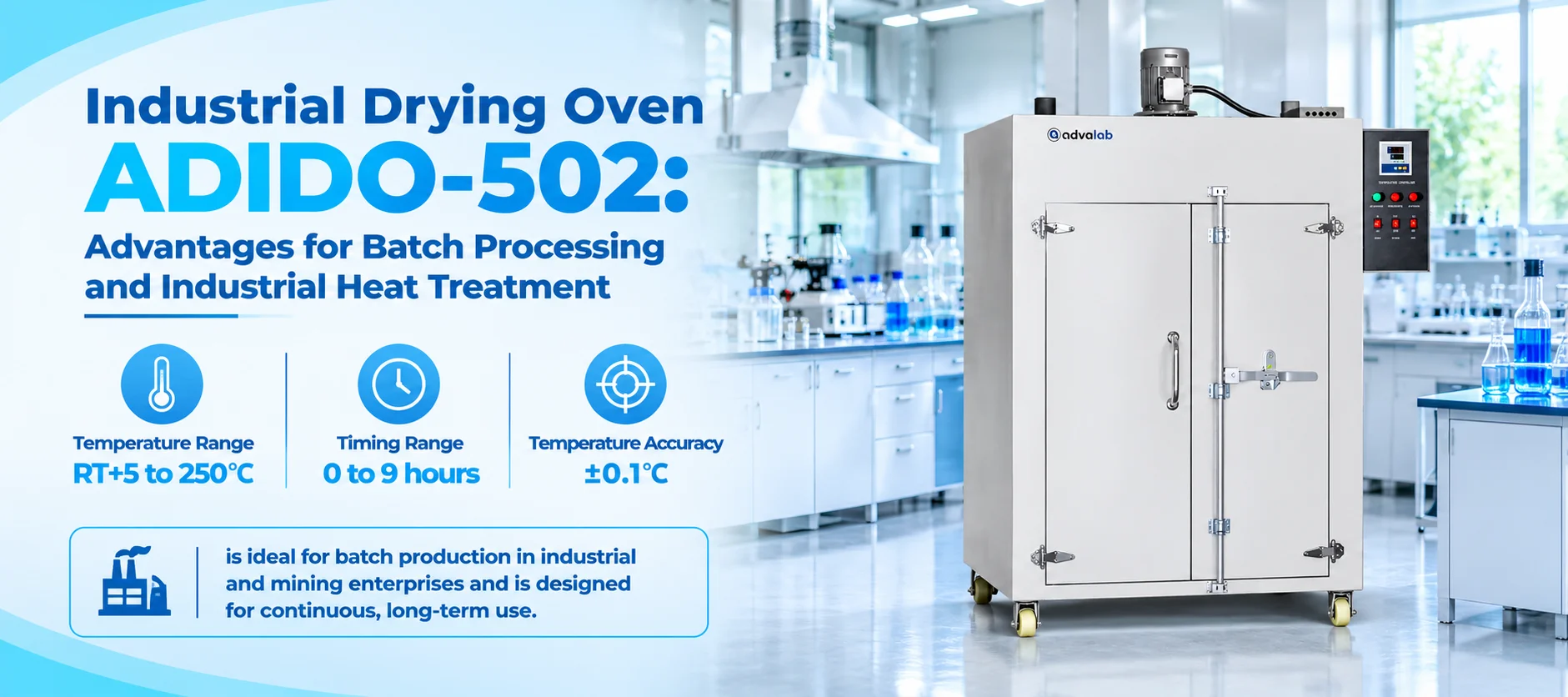
A tray comes out of the oven dry on the surface and damp at the core. A production batch has to be split across several small runs because the chamber is too small. A temperature drift ruins a heat-sensitive load that took hours to prepare. These are routine problems wherever drying and curing happen at batch scale, and most of them trace back to chamber size, airflow, and temperature control. The Industrial Drying Oven ADIDO-502 lists a range of RT+5 to 250 °C, ±0.1 °C accuracy, and a chamber sized for large batches, which raises a practical question: what should be checked before a batch process is built around it? The sections below cover the working principle, the specifications, and the planning mistakes that slow drying work down.
An Industrial Drying Oven is a temperature-controlled chamber that removes moisture or solvents from materials, or cures and heat-treats them, using heated air held at a set temperature. An oven for industrial use differs from a bench model mainly in chamber size, power, and the amount of material it can process in a single cycle.
Searches for a drying oven industrial setting often use related names such as industrial oven dryer and heating drying oven. They describe the same family of equipment, and what separates one model from another is chamber size, temperature range, and airflow design rather than the name on the catalog page.
How an Industrial Drying Oven works follows a closed loop. Heating elements warm the chamber air, airflow carries that heat across the load, and moisture leaving the material is exhausted through a vent. A temperature sensor reports back to the controller, which switches heating up or down to hold the setpoint until the timer ends the cycle.
Temperature and timer are entered at the controller.
Elements raise the chamber air temperature.
Moving air carries heat across trays and parts.
Moisture or solvent vapor leaves the load.
Vapor exits through the vent while the sensor feeds back.
The ADIDO-502 listing mentions adjustable airflow and a microprocessor temperature controller. It does not describe the fan layout, so ask the supplier how air moves through the chamber when tray spacing or load density matters.
Drying and heat treatment appear far beyond the laboratory. The ADIDO-502 listing names electronics, pharmaceuticals, and the food industry for curing and heat treatment, and describes the oven as suited to batch production in industrial and mining enterprises.
Drying powders, granules, raw materials, and finished products.
Moisture removal before assembly and cure steps.
Drying and heat treatment of ingredients and samples.
Batch drying of materials and metal parts.
Curing and heat treatment of coated components.
The table lists values published on the ADIDO-502 product page and explains how each one affects planning.
| Parameter | ADIDO-502 listing | Why it matters |
|---|---|---|
| Temperature range | RT+5 to 250 °C | Sets the highest drying or curing temperature available |
| Timing range | 0 to 9 hours | Limits the length of a single programmed cycle |
| Temperature accuracy | ±0.1 °C | Describes how closely the controller reading follows the setpoint |
| Fluctuation | ±2% | Describes variation in the chamber around the setpoint |
| Internal volume | 120 L | Indicates working capacity for a batch |
| Internal dimensions (H × W × D) | 1200 × 900 × 800 mm | Determines tray and part sizes that fit |
| Overall dimensions (H × W × D) | 2000 × 1450 × 1000 mm | Determines floor space and door clearance |
| Power consumption | 4 to 6 kW | Informs electrical supply planning |
| Weight | 214 kg net; 221 kg gross | Affects handling and floor loading |
| Chamber material | Stainless steel (per product description) | Supports cleaning and corrosion resistance |
A sound and light alarm system, a separate limit for the temperature controller, and an explosion-proof lock with blast door, one unit each. Accessories matter most for unattended runs and for loads that release vapors.
Accuracy and fluctuation answer different questions, so read them together and ask how fluctuation is measured. Confirm the usable chamber volume, the voltage options, and the exact accessory list with the supplier before finalizing a purchase order.
An industrial vacuum oven lowers the pressure inside the chamber, which lets moisture and solvents leave at a lower temperature than they would in open air. That suits heat-sensitive materials. A heated-air oven relies on temperature and airflow instead, which suits robust materials and larger loads. The ADIDO-502 listing describes heated, air-based drying and publishes no vacuum specification.
| Feature | Heated-air industrial oven | Industrial vacuum oven |
|---|---|---|
| Drying mechanism | Heat and moving air | Reduced pressure combined with heat |
| Temperature needed | Higher for the same moisture load | Lower for the same moisture load |
| Typical suitability | Bulk, robust materials and metal parts | Heat-sensitive or solvent-bearing samples |
| Chamber scale in this range | Large batch chambers | Smaller chambers; ADFB-505 lists 25 L and ADFB-506 lists 54 L |
For materials that degrade near the oven's working temperature, the vacuum oven range is worth comparing before a heated-air unit is chosen.
A drying oven for pharmaceutical work handles materials where residual moisture affects stability and processing, such as raw materials, powders, granules, and finished products. A pharmaceutical drying oven therefore needs more than a high temperature rating.
Check accuracy, fluctuation, and uniformity together. Facility procedures may call for documented temperature mapping of the chamber.
A stainless steel chamber resists corrosion and wipes clean, which lowers the chance of carry-over between batches.
A separate limit and an alarm protect a load if the main controller fails during an unattended cycle.
A 9 hour timer covers most drying cycles. Longer dwell schedules call for a model with a longer timer range.
Choosing an industrial drying oven to use is only the first step. A typical routine for batch drying follows these steps.
The listing does not publish an operating procedure, so the supplier manual remains the source for startup and maintenance details. Materials that release flammable vapors need an oven rated for that duty, and the explosion-proof lock and blast door appear in the optional accessories for that reason. Confirm suitability with the supplier first.
Start with the load: the largest tray or part, the number of trays per cycle, and the airflow gap each one needs. Compare those against the internal dimensions rather than relying on a single volume figure. The graphic below collects the planning numbers listed for the ADIDO-502.
The footprint of 1450 × 1000 mm carries 214 kg before loading, about 148 kg per square meter on average, and point loads under the feet are higher than that average. A level, solid floor, a dedicated electrical supply matched to the listed power, and room for exhaust and door swing complete the site check. Laboratories weighing oven types side by side can browse the full laboratory oven range before settling the layout.
The industrial drying oven range lists several models with the same working temperature range. The two below show where the differences sit.
| Parameter | ADIDO-502 | ADIDO-503 |
|---|---|---|
| Temperature range | RT+5 to 250 °C | RT+5 to 250 °C |
| Timing range | 0 to 9 hours | 0 to 9999 minutes |
| Temperature accuracy | ±0.1 °C | ±0.1 °C |
| Fluctuation | ±2% | ±2% |
| Internal dimensions (H × W × D) | 1200 × 900 × 800 mm | 1000 × 600 × 500 mm |
| Overall dimensions (H × W × D) | 2000 × 1450 × 1000 mm | 1750 × 1130 × 700 mm |
| Power consumption | 4 to 6 kW | 4 to 6 kW |
| Net weight | 214 kg | 150 kg |
Temperature range, accuracy, fluctuation, and power match across the two. Chamber size, timer range, and weight are what change. Other models, including ADIDO-501, ADIDO-504, ADIDO-506, ADIDO-507, ADIDO-508, and ADIDO-509, list the same temperature range and accuracy, so each product page should be checked for chamber dimensions before a shortlist is made.
The ADIDO-502 belongs to a category with five ranges: industrial drying ovens, natural convection ovens, forced air drying ovens, vacuum ovens, and high temperature ovens. Listed temperature ranges run from about 250 °C in the natural convection range to 500 and 600 °C in the high temperature range, and listed chamber sizes run from 25 L in the vacuum range to 960 L in the forced air range.
When comparing options in this category, teams usually weigh maximum temperature, chamber volume, airflow type, vacuum capability, timer range, accuracy, footprint, and power draw. The full set of models is listed on the laboratory ovens category page, and further laboratory equipment is available from the Advalab home page.
An industrial drying oven earns its place when batch size, drying time, and temperature behavior outgrow what a bench oven can offer. The ADIDO-502 pairs a RT+5 to 250 °C range, ±0.1 °C accuracy, and a large chamber for batch drying and heat treatment. Matching chamber dimensions, timer range, accessories, and site conditions to the process turns a specification list into a sound selection.
Hazel Daniels
Specialty: Healthcare Technology & Laboratory Equipment
Writing Style: Professional, informative, and reader-friendly
Bio: Hazel Daniels specializes in writing about healthcare technology, laboratory equipment, and scientific applications. She presents technical information in simple language, highlighting practical uses and industry developments.
www.linkedin.com/in/hazel-daniels-4a108b444