
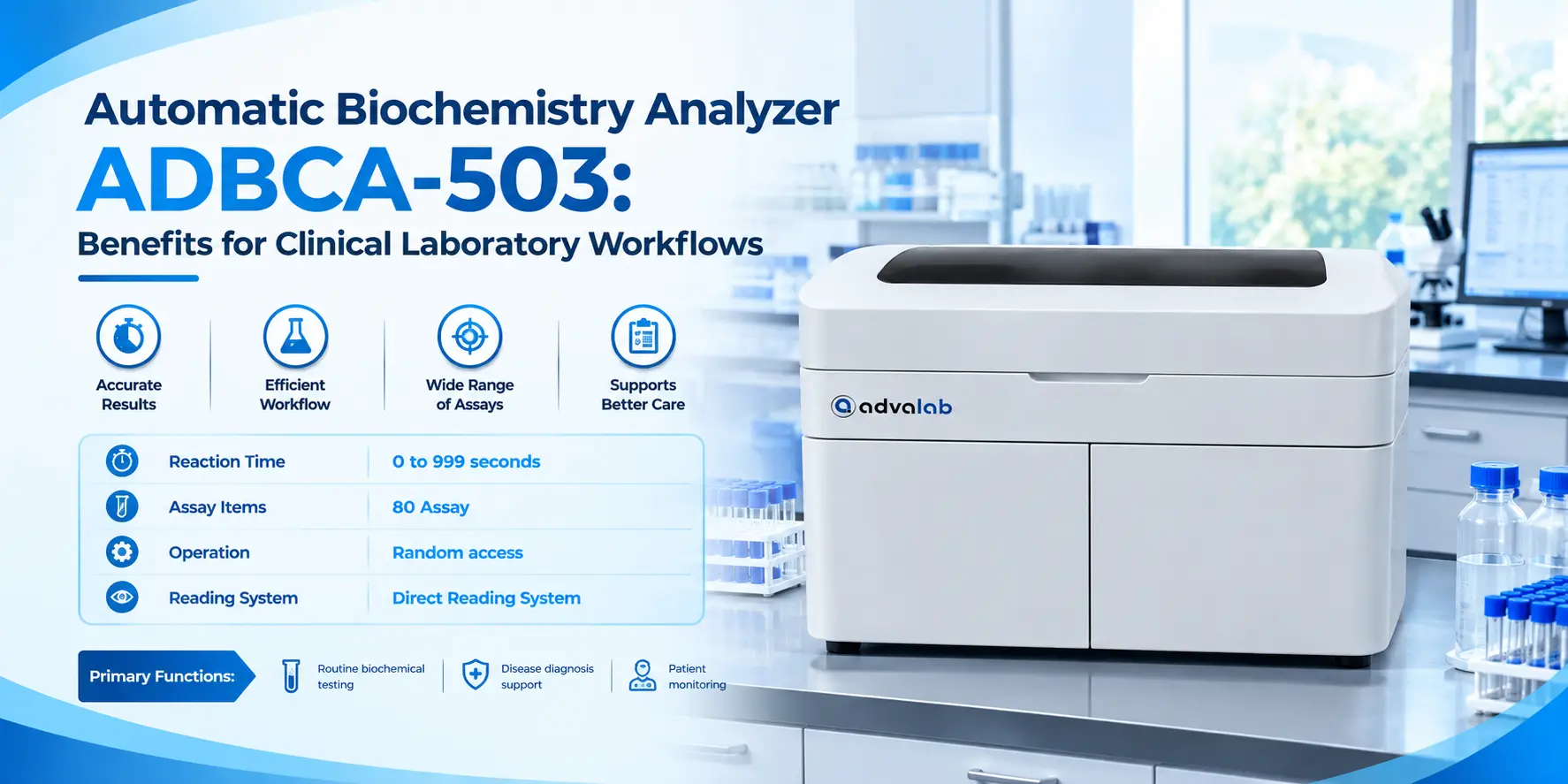
A busy chemistry laboratory requires a smooth sample workflow, accurate timing, and timely results to support efficient testing. Here is how automation supports each of those needs, and what to check before choosing an instrument.
Manual pipetting, hand-timed reactions, and repeated runs for out-of-range results consume technician hours that a laboratory rarely has to spare. Samples queue behind one another, an urgent request interrupts the batch, and each repeat uses more sample and reagent than the first run.
The Advalab Automatic Biochemistry Analyzer ADBCA-503 is an Automatic Biochemistry Analyzer designed to take over that repetitive work. It is a random access instrument that runs up to 400 tests per hour across 80 assay items.
A fully Automatic Biochemistry Analyzer takes over pipetting, mixing, reading, and washing, then reports a concentration for each requested test. It measures chemical substances in samples such as blood and serum, and it replaces many manual steps with a controlled sequence.
Catalogs list the same equipment under several names: a biochemistry fully automatic machine, an auto analyser machine, or an automated biochemistry analyser. Readers who type “fully Biochemistry Analyzer” into a search box are usually looking for this automated type.
The ADBCA-503 measures chemistry through photometric absorbance. A halogen lamp sends light through the reaction mixture, the detector records how much light the mixture absorbs, and the amount of absorbance relates to the amount of the substance being measured. End point, kinetic, fixed time, and immunoturbidimetric methods cover reactions that finish at different speeds.
The probe adds 1 to 100 µl of sample and 1 to 400 µl of reagent for each reaction.
The mixture incubates in a cuvette for 0 to 999 seconds.
A halogen lamp passes light at 340 to 810 nm through the cuvette.
The detector reads absorbance and registers changes as small as 0.0001 A.
Calibration converts absorbance into a concentration, and quality control rules apply.
Read the five steps in order, from dispensing to reporting.
The listing describes routine biochemical testing, support for disease diagnosis, and patient monitoring as the primary functions. In practice those functions appear in four situations.
Liver function, kidney function, lipid profile, glucose, and enzyme panels run from one instrument.
Random access lets an urgent sample enter the queue without regrouping the whole batch.
Repeat measurements follow a patient's response over time.
Hospitals, diagnostic centers, pathology and research labs, and mid-size clinical laboratories.
Most delays inside an analyzer start at the probe or the cuvette, so those two places carry the main protections. The reagent and sample probe has a liquid level sensor, a collision sensor, a Teflon coating, and automatic washing. An 8-channel automatic washing system cleans the reaction cuvette between tests.
When a result falls outside the measuring range, or when the sample runs short, the instrument can dilute and retest the sample. A calibrator auto diluting function is also listed.
Quality control runs at three levels, low, normal, and high, through a Levey-Jennings program, so drift becomes visible before it reaches patient results. Calibration modes include linear, non-linear, and K factor. The listing states a repeatability of CV ≤ 2% and an absorbance accuracy of ±0.0003 A across 0 to 2.5 A.
These figures matter because chemistry results inform treatment. A laboratory manager can place them next to internal acceptance limits before the instrument arrives.
The tiles below summarize the headline figures published for this automatic biochemistry analyzer, and the bars show how wide the sample and reagent ranges are. Full detail sits on the product page.
Volume ranges are shown on a 0 to 400 µl scale.
Related models share the same sample volume range. The ADBCA-501 lists 2 × 36 reagent positions, while the ADBCA-502 lists 2 × 40.
Laboratories sometimes weigh a floor-model analyzer against a compact dry analyzer, and the full range of biochemistry analyzers from Advalab covers both formats. The two serve different workflows, and the Dry Biochemistry Analyzer ADDBA-501 is the compact example.
| Feature | Automatic analyzer (ADBCA-503) | Dry analyzer (ADDBA-501) |
|---|---|---|
| Format | Floor-model instrument with reagent positions | Compact unit that reads a test card |
| Sample | 1 to 100 µl per test, 0.1 µl steps | 45 µl of serum, whole blood, or plasma |
| Speed | Up to 400 tests per hour | Result in 3 minutes or less |
| Typical setting | Hospital and diagnostic laboratories with steady volumes | Primary care, emergency, and point-of-care testing |
Advalab, a manufacturer of laboratory equipment based in the United States, groups its chemistry instruments under one family that includes automatic biochemistry analyzers and dry biochemistry analyzers. Each member reads a sample with light, yet the format, the throughput, and the setting differ.
When options inside the family are evaluated, laboratories usually weigh throughput, reagent capacity, sample volume, available methods and calibration modes, quality control tools, data handling, and the floor space required. The complete biochemistry analyzer range makes those points easy to review side by side.
Hazel Daniels
Specialty: Healthcare Technology & Laboratory Equipment
Writing Style: Professional, informative, and reader-friendly
Bio: Hazel Daniels specializes in writing about healthcare technology, laboratory equipment, and scientific applications. Presents technical information in simple language, highlighting practical uses and industry developments.
www.linkedin.com/in/hazel-daniels-4a108b444