
The shared autoclave is busy, far away or too large for the room. This article explains what a portable autoclave does and what to check before choosing one.
Sterile instruments are needed on a schedule that a shared sterilization room cannot always meet. A queue forms at the large unit, tools wait on a cart, and small clinics or teaching labs may have no room for a floor-standing machine at all. Each delay pushes the next procedure back.
The question is how to bring steam sterilization closer to the work. The Advalab ADPA-505 publishes its sterilizing volume, working pressure and temperature, timer range, safety pressure and overall size, so a team can judge the fit before ordering.
A Portable Autoclave suits a laboratory only when those figures match its loads and its space. This article explains the working principle, ten published benefits, typical uses, a sample routine and the mistakes to avoid, and then the next step: confirm the open points with the supplier and review the full listing.
Searches for a Portable Autoclave diagram lead to a picture that is easy to describe. A heater warms water at the base of the chamber, the water turns to steam, and the steam fills the chamber and builds pressure around the load. This is the working principle of any portable steam sterilizer: steam under pressure carries heat to the surface of instruments quickly, at a controlled temperature, for a set time.
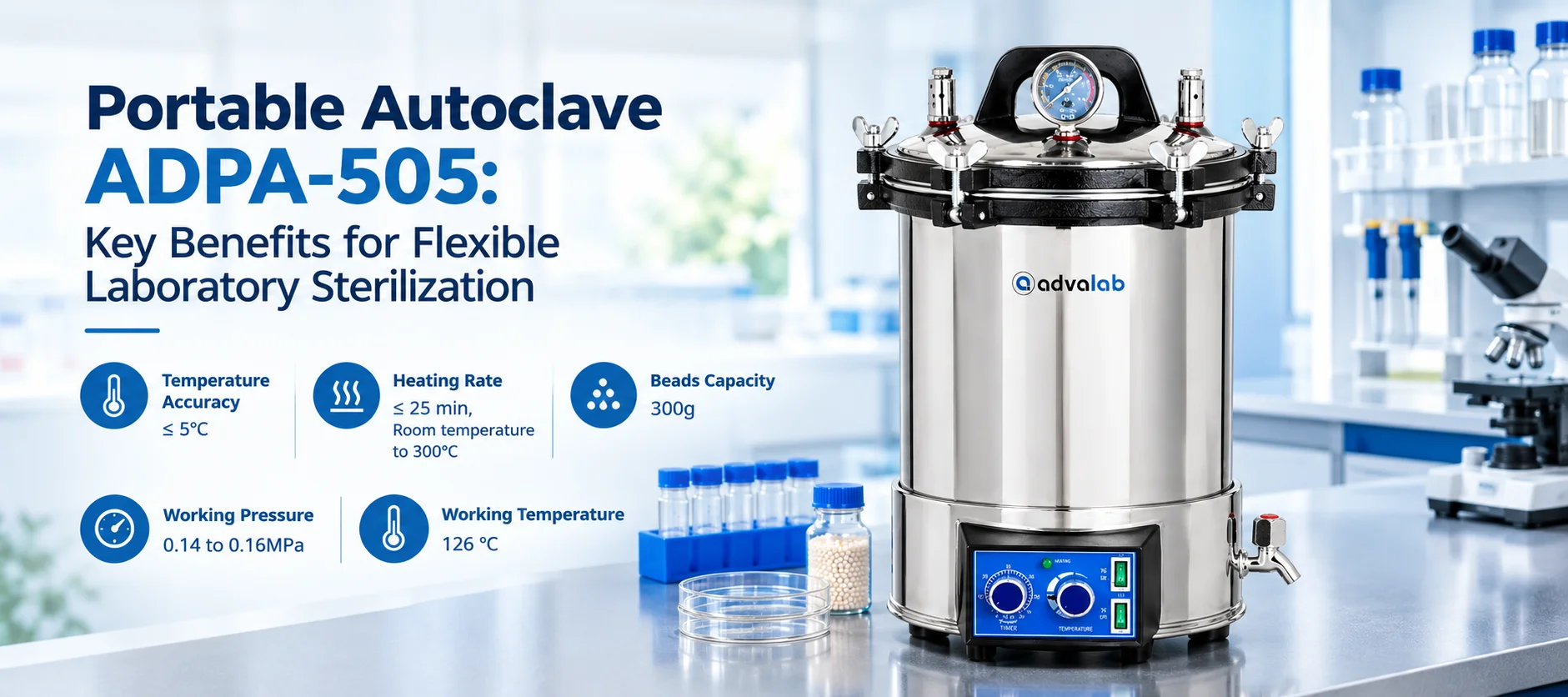
The ADPA-505 listing states a working pressure of zero point one four to zero point one six megapascals and a working temperature of one hundred twenty-six degrees Celsius. It also lists steam release valves, which prevent overpressure, and a water level indicator for monitoring the water.
Illustrative cross-section, not to scale: a heater boils the water, steam builds pressure around the load, and a valve releases excess steam.
Delays usually come from a few predictable points:
A portable autoclave machine with stated pressure, temperature and size figures addresses these points, provided the published numbers match your loads.
Each benefit below ties to a specification or feature published for the ADPA-505.
The sterilizing volume is eighteen liters, listed with a chamber size of two hundred eighty by two hundred sixty millimeters.
The unit works at zero point one four to zero point one six megapascals.
The working temperature is one hundred twenty-six degrees Celsius.
The adjustment range runs from one hundred five to one hundred twenty-six degrees Celsius.
The timer range is zero to sixty minutes.
Temperature uniformity is listed within plus or minus one degree Celsius.
The maximum safety pressure is zero point one six five megapascals.
The listing says they prevent overpressure and support safe operation.
It lets the operator monitor the water level for safe use.
A compact structure eases transport and storage, and the listing describes stainless steel for durability and corrosion resistance.
Infographic: volume, temperature, pressure, timer and power figures from the ADPA-505 listing.
Teams that search for portable autoclave uses can use the Advalab listing as a reference. It names these settings for the ADPA-505:
The listing FAQ adds that a portable autoclave can treat metal tools, glassware, rubber items and heat- and moisture-resistant cloth, in general terms. Teams that run a portable autoclave lab should check each material against the supplier manual.
The listing does not publish an operating procedure, so follow the supplier manual for exact steps. A portable autoclave steam sterilizer routine usually follows a short sequence:
The FAQ describes cycles of fifteen to thirty minutes in general, plus ten to thirty minutes for heat-up and cooling, but it does not give a cycle time for this model.
Match these published figures against your own loads and room before shortlisting a portable pressure steam sterilizer:
| Model | Sterilizing volume | Timer range | Overall size (L × W × H) |
|---|---|---|---|
| ADPA-501 | Eighteen liters | Zero to ninety-nine minutes | Four hundred ten by four hundred ten by six hundred thirty millimeters |
| ADPA-502 | Eighteen liters | Zero to ninety-nine minutes | Four hundred ten by four hundred ten by seven hundred fifty millimeters |
| ADPA-504 | Twenty-four liters | Not listed | Four hundred ten by four hundred ten by six hundred thirty millimeters |
| ADPA-505 | Eighteen liters | Zero to sixty minutes | Four hundred ten by four hundred ten by five hundred twenty millimeters |
| ADPA-508 | Eighteen liters | Not listed | Four hundred ten by four hundred ten by four hundred thirty millimeters |
All five list a working pressure of zero point one four to zero point one six megapascals and a working temperature of one hundred twenty-six degrees Celsius, so the choice comes down to chamber volume, timer range and height.
Infographic: portable autoclave models in the Advalab range, from the published listings.
The autoclaves category at Advalab spans four families: the portable autoclave range, the benchtop autoclave range, the vertical autoclave range and the horizontal autoclave range. Portable units suit small loads and tight spaces, while the other families scale up in chamber size and format.
When laboratories compare options in this category, they typically weigh chamber volume, working pressure and temperature, timer range, safety features, footprint and power supply. To review all families side by side, explore the full autoclaves range, or see the wider laboratory equipment catalog on the Advalab home page.
The Portable Autoclave ADPA-505 pairs an eighteen-liter chamber, a working pressure of zero point one four to zero point one six megapascals, a working temperature of one hundred twenty-six degrees Celsius and a timer of up to sixty minutes in a compact unit. It suits microbiology research, teaching spaces, laboratories and clinics that sterilize modest loads close to the work.
Hazel Daniels
Specialty: Healthcare Technology & Laboratory Equipment
Writing Style: Professional, informative, and reader-friendly
Bio: Hazel Daniels specializes in writing about healthcare technology, laboratory equipment, and scientific applications. She presents technical information in simple language, highlighting practical uses and industry developments.
Review the published volume, pressure, temperature, timer and size details for this portable autoclave and compare them against your own loads and room.
Explore Portable Autoclave ADPA-505