
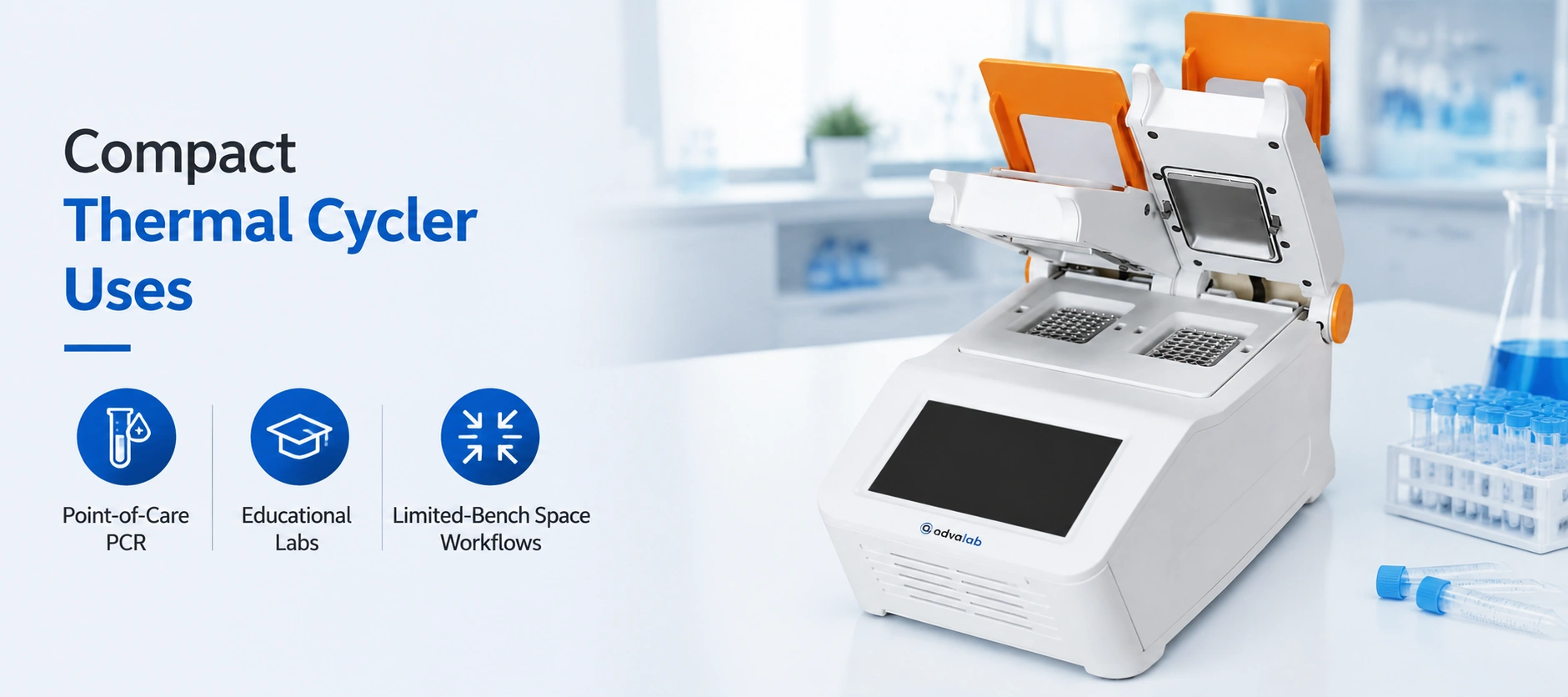
A working overview for laboratory, hospital, and research centre teams on where a compact Thermal Cycler fits into daily amplification work, from a bedside diagnostic check to a teaching lab running several student groups on one bench.
A Thermal Cycler drives a PCR reaction through repeated temperature changes, and a compact model brings that capability into settings where a full-size floor unit would not fit. That smaller footprint is why a thermal cycler lab bench in a small clinic, a teaching classroom, or a shared research space often runs a compact block instead of a larger multi-block system. Teams comparing block capacity and ramp speed across models often start from the thermal cycler line on the Thermal Cyclers page before choosing a unit sized to typical sample throughput.
A pcr instrument cycles a sample block through three temperature stages repeated dozens of times. Denaturation, typically near 95°C, separates double-stranded DNA into single strands. Annealing, at a lower temperature specific to the primers in use, lets short primer sequences bind to their matching target regions. Extension, usually around 72°C, is where the enzyme builds a new complementary strand from each primer. A thermocycler machine repeats this three-step cycle enough times to amplify a target sequence from a small starting amount into a quantity large enough to detect or sequence afterward. Ramp speed, how quickly the block moves between these temperatures, affects both cycle time and how sharply defined the amplified product turns out to be.
Cycle stages: denaturation, primer annealing, strand extension, repeated across cycles.
Thermal cycler uses extend beyond a central research lab, with compact units supporting several settings where space or sample volume does not call for a larger system.
A small block near patient care areas supports diagnostic testing without sending samples to a separate central lab, shortening turnaround for results that inform treatment decisions.
Teaching settings often run several compact units side by side so student groups can each complete a PCR exercise without queuing for one shared machine.
Shared or crowded benches favour a smaller footprint that still handles typical daily sample counts without dedicating a full station to one instrument.
Portable setups supporting outbreak response or field surveillance rely on a compact, transportable thermal cycler system rather than fixed lab infrastructure.
Getting consistent amplification from a smaller unit follows much the same sequence as a larger thermal cycler equipment setup, with a few space-related details worth extra attention.
Category spans block capacity, ramp speed, gradient function, and control interface.
Thermal cyclers and pcr machines sit within a wider group of amplification and detection equipment, alongside real-time PCR systems and related molecular biology instruments. Buyers comparing options in this category typically weigh block capacity, ramp speed, gradient capability, and whether a compact or full-size footprint suits the space available. The full Thermal Cycler lineup outlines configurations for bench and shared-lab use, and sits alongside the broader laboratory equipment range on advalab's main website, where related molecular biology hardware can also be reviewed.
| Factor | Compact Thermal Cycler | Full-Size Benchtop Thermal Cycler |
|---|---|---|
| Footprint | Small enough for a shared or crowded bench | Needs a dedicated section of bench space |
| Block capacity | Suited to small batches, often 16 to 32 samples | Handles larger batches, commonly 96 samples or more |
| Typical setting | Point-of-care testing, teaching labs, field work | Central research or diagnostic labs running high sample volumes |
| Gradient function | Available on some models, often limited compared with larger units | Commonly included for broad primer optimization work |
Log the temperature profile used for each run alongside the primer set, so a failed amplification can be traced back to a setting later.
Clean the block and lid gasket periodically to prevent residue from affecting heat transfer across tube positions.
Verify tube or plate compatibility before ordering consumables, since block wells vary slightly between compact models.
Space units apart on a shared bench so exhaust heat from one does not affect the readings of a neighbouring instrument.
Run a periodic temperature verification check to confirm the block still reaches programmed setpoints accurately.
Train new staff on loading balance across the block, since uneven loading can affect results on certain designs.