
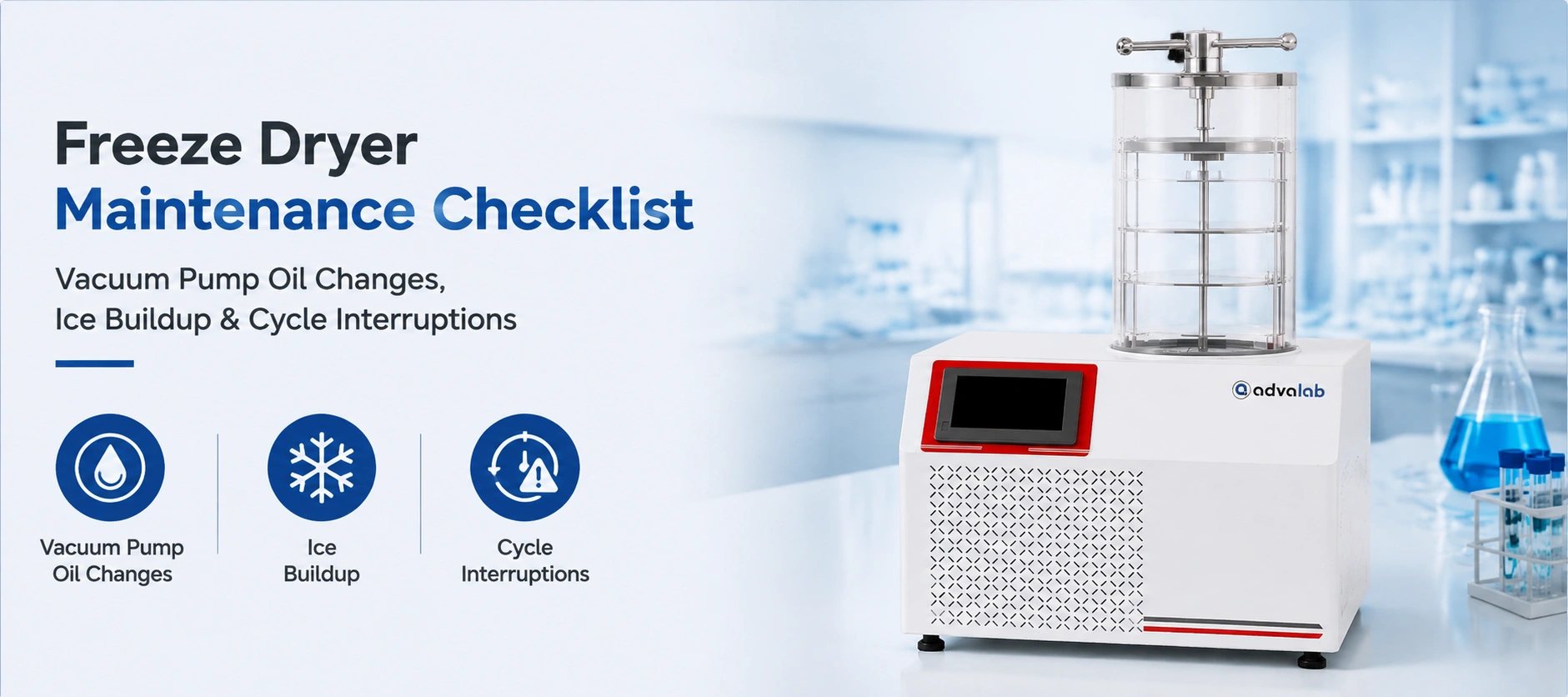
A working checklist for laboratories, hospital units, research centres and advanced labs looking to keep a freeze dryer in laboratory or production settings running through full cycles without unplanned stops.
The vacuum pump on a Freeze Dryer is the part most likely to shorten a cycle's effectiveness if it is left unattended. This holds for a benchtop unit as much as a larger lyophilization machine or floor-standing freeze dry machine. Oil-sealed rotary vane pumps pick up moisture and process vapor over repeated cycles, and that contamination gradually raises the lowest pressure the pump can reach. Once the achievable vacuum level drifts too far from where the process needs to sit, primary drying slows down even though nothing else on the unit has changed.
A practical rule of thumb is to check oil color and clarity after each extended cycle and change it on a fixed interval rather than waiting for a visible problem, since discolored oil is usually a lagging indicator rather than an early one. Teams weighing pump specification against chamber size across current models can review the floor-type freeze dryer range to see how pump capacity scales with unit size.
A lab freeze dryer pulls water vapor out of the sample and traps it as ice on the condenser coil, and that ice layer grows with each cycle until it is cleared. This is normal operation for any vacuum freeze dryer, but left unmanaged it changes how the unit performs in a few predictable ways.
A thick ice layer insulates the coil from the refrigerant behind it, lowering how much additional vapor the condenser can capture during a run.
A condenser that is left to build up ice over many cycles needs a longer defrost period between runs, cutting into the time the unit is available for the next batch.
Ice does not always build up evenly across the coil, and an uneven layer can leave part of the condenser working harder than the rest during later cycles.
Some of the maintenance points above are specific to sublimation drying rather than freeze dry equipment in particular. They apply just as much to freeze dryers for food production as they do in a pharmaceutical or research setting, since pump wear and ice buildup do not depend on what is being processed. Looking at upkeep side by side with other drying approaches puts the checklist in context.
| Method | Main Upkeep Point | How Often It Needs Attention | Typical Fault Sign |
|---|---|---|---|
| Freeze drying (lyophilization) | Vacuum pump oil and condenser ice | Oil checked after each extended cycle | Slower primary drying, weaker vacuum draw |
| Spray drying | Nozzle clogging and chamber residue | Between production runs | Uneven particle size in output |
| Hot-air drying | Airflow uniformity and filter condition | Periodic filter checks | Uneven drying across trays |
| Vacuum drying (no freezing step) | Seal integrity and pump oil | Similar interval to freeze drying | Vacuum level that will not hold steady |
A cycle that stops or alarms before completion is rarely a single fault. A short list of causes accounts for most of these interruptions on a vacuum freeze drying machine.
Freeze dryers lyophilizers sit within a broader group of drying and preservation equipment, and a laboratory freeze dryer's maintenance points vary somewhat between benchtop, pilot-scale and floor-standing formats simply because pump size and condenser capacity scale with the unit. Buyers comparing options within this category typically weigh how much of that upkeep they can handle in-house against how large a batch they need to run.
Floor-standing configurations built for larger batch volumes and correspondingly larger pumps are grouped on the floor-type freeze dryer page. For teams comparing freeze drying equipment against other bench instruments more broadly, the wider catalogue sits on the advalab home page.
Look through pump capacity, condenser size and shelf area before narrowing down a model.
Explore Freeze Dryers