
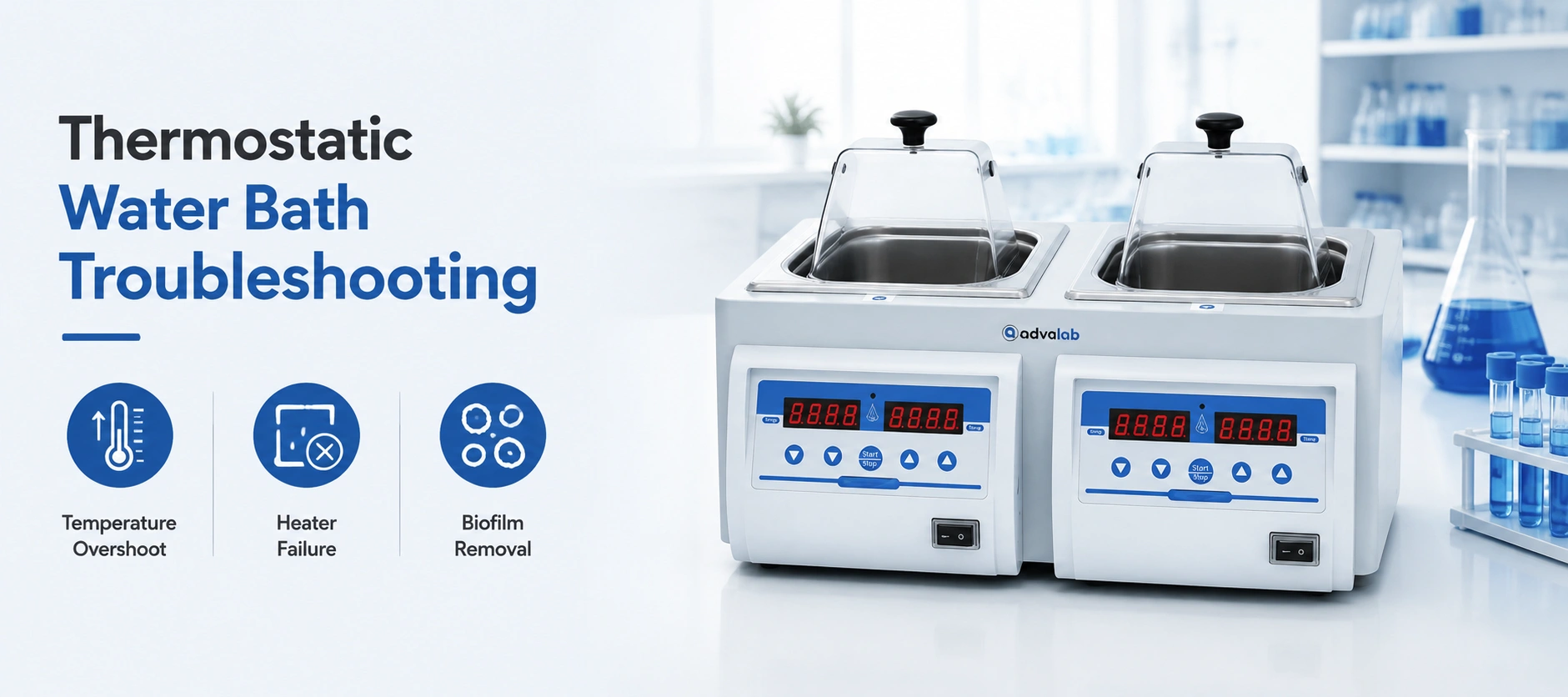
A working reference for laboratory, hospital, and research centre teams on reading overshoot and heater warning signs on a Thermostatic Water Bath, before a temperature-sensitive sample or assay is affected mid-run.
Most faults on a Thermostatic Water Bath trace back to one of three areas: a control loop that lets temperature swing past its set point, a heater element that no longer delivers consistent output, or biological film building up inside the tank. Each shows a distinct pattern rather than a single generic symptom, which makes it possible to narrow the cause down before assuming a part needs replacing. Labs sourcing a replacement heater or sensor often start from the thermostatic water bath line on the Thermostatic Water Bath page to check which parts are available for a given model.
A thermostatically controlled water bath reads tank temperature continuously and compares it against the set point, switching the thermostatic water bath heater on and off, or modulating its output, to keep the reading close to that target. A well-tuned control loop corrects small deviations quickly without letting temperature swing noticeably above or below the set point. When that correction lags or over-corrects, the reading can climb past the target before the heater cuts back, which is the starting point for most overshoot complaints raised about a laboratory water bath in daily use.
Control loop: temperature sensor, set point comparison, heater output, correction feedback.
A reading that climbs noticeably above the set point before settling back down, or one that never fully settles, usually points to how the control loop is responding rather than a heater fault.
A probe reading localised heat near the element rather than the bulk water temperature reacts faster than the tank actually warms, causing the heater to overshoot before the true temperature catches up. Repositioning the sensor away from the heater element usually corrects this.
Still water can develop hot pockets near the heater that the sensor does not detect until they mix into the wider tank, producing a delayed overshoot. Adding gentle circulation, where the unit supports it, spreads heat more evenly.
Settings suited to an empty or lightly loaded tank can overshoot once a full rack of samples changes how the tank responds to heating. Adjusting control sensitivity, where available, helps match the setting to typical load size.
A relay that no longer switches cleanly can leave the heater on slightly longer than commanded, adding a small but consistent overshoot to each cycle. This points toward a control component needing attention rather than a settings change.
A bath that heats slowly, stalls well below set point, or shows no temperature rise at all usually points to the heater element or its power path rather than the control logic.
Confirming a heater fault starts with checking the water level is above the minimum line, followed by a visual check for scale on the element, before assuming the heater itself has failed outright.
Standing warm water is a setting where biological film can build up steadily, particularly in tanks that stay filled between uses.
When a temperature complaint appears without an obvious cause, a short check narrows things down faster than adjusting settings or replacing parts by guesswork.
Category spans tank capacity, temperature range, circulation type, and control display.
A thermostatic water bath sits within a wider group of laboratory heating and incubation equipment, alongside dry block heaters, circulatory, and incubators that share similar heater and sensor maintenance concerns. Buyers comparing replacement heaters or a new unit typically weigh sensor placement, circulation type, and tank cleaning access across the thermostatic water bath line, laid out in full on the Thermostatic Water Bath category page. The wider heating and incubation equipment range sits alongside it on advalab's main website, where related lab hardware can also be reviewed.
| Factor | Routine Tank Cleaning | Reactive Cleaning |
|---|---|---|
| Biofilm buildup | Cleared before it becomes visible or affects samples | Often only addressed once film is already noticeable |
| Sample risk | Lower chance of contamination reaching submerged vessels | Established film raises the chance of carryover to samples |
| Heater condition | Cleaning intervals often catch early scale before it thickens | Scale can build alongside biofilm until a fault forces a full clean |
| Downtime pattern | Short, planned cleaning breaks between runs | Deeper cleaning needed once film is established, taking longer |
Set a fixed tank cleaning interval based on how often the bath is used, rather than waiting for visible film.
Check sensor position after any maintenance that involves removing and refitting it, since a shifted probe can reintroduce overshoot.
Keep a spare heater element on hand for labs running the bath across long, continuous working days.
Empty and dry the tank when it will sit unused for more than a few days, rather than leaving standing water.
Log setpoint versus actual temperature at the start of each run to catch drifting overshoot early.
Train staff to recognise the difference between slow heating and no heating, since the two point to different likely causes.