
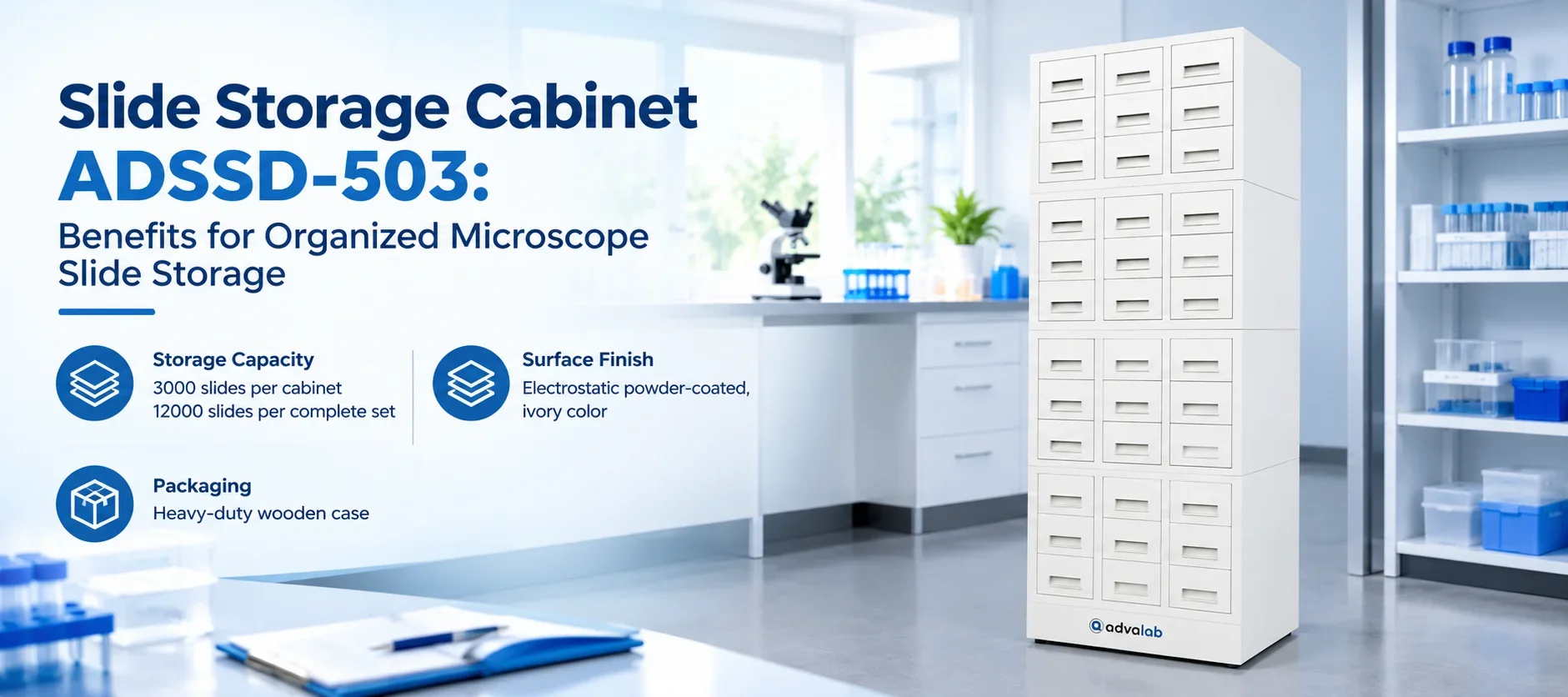
Microscope slides pile up fast. Pathology and research laboratories keep thousands of them, often in cardboard boxes or open trays where slides lean, scratch and collect dust. Finding a single case means opening several containers, and a dropped tray can break a whole row.
A purpose-built cabinet fixes the order. The Advalab ADSSD-503 publishes its capacity, drawer count, material, finish, dimensions and weight, so a team can judge the fit before ordering.
A Slide Storage Cabinet suits a laboratory only when its published figures match the collection it must hold. This article explains the working principle, published benefits, typical uses, a sample routine and the mistakes to avoid, and then the next step: confirm the open points with the supplier and review the full listing.
People who ask how slide storage cabinets work want a short answer. Each cabinet holds drawers, and each drawer holds adjustable grooves that keep slides upright and apart. The Advalab listing says the ADSSD-503 has five smoothly gliding drawers with adjustable grooves and a smooth-sliding mechanism with auto-homing for safe operation.
Upright placement reduces the surface that touches a neighbor, which lowers the chance of scratches, and the listing adds that this layout supports ventilation and drying. Stacking cabinets on the base extends capacity without a larger floor footprint. For a wider view of storage options, browse the laboratory storage cabinets range.
Illustrative flow, not to scale: the general drawer cycle of a slide storage cabinet, using the features named in the ADSSD-503 listing.
Without a dedicated cabinet, collections degrade for a few predictable reasons:
A sliding cabinet organizer with fixed grooves and a stated capacity addresses these points, provided its published figures match the collection.
Each benefit below ties to a specification or feature published for the ADSSD-503.
A single module holds as many as three thousand microscope slides.
A complete set holds around twelve thousand slides.
Five drawers per cabinet carry adjustable grooves for systematic arrangement.
The drawers glide smoothly, and auto-homing supports safe and convenient operation.
Upright slides allow ventilation and drying and reduce contact surfaces.
The cabinet uses zero point eight millimeter cold-rolled steel sheet.
An electrostatic powder-coated ivory finish gives a refined, long-lasting surface.
Modules combine vertically without taking more floor space.
Infographic: capacity, drawer, material, weight and size figures from the ADSSD-503 listing.
The Advalab listing says the ADSSD-503 suits pathology, histology and research laboratories, offering safe slide arrangement, quick retrieval, improved workflow and protection from dust and physical damage. A slide storage cabinet in laboratory work typically serves these cases:
The listing does not publish an operating procedure, so follow the supplier manual for exact steps. A routine for filing slides in a cabinet usually follows a short sequence:
Match these published figures against your collection before shortlisting a slide storage cabinet:
| Model | Drawer layout | Listed capacity | Cabinet size (L × W × H) |
|---|---|---|---|
| ADSSD-501 | Nine drawers per cabinet | Thirteen thousand seven hundred fifty slides per cabinet | Five hundred fifteen by four hundred eighty by three hundred sixty millimeters |
| ADSSD-502 | Seventy-two sections plus a base | Five thousand slides per cabinet | Four hundred three by four hundred seventy-eight by one hundred twenty-five millimeters |
| ADSSD-503 | Five drawers per cabinet | Three thousand slides per cabinet | Five hundred fifteen by four hundred eighty by three hundred sixty millimeters |
| ADSSD-504 | Six drawers per cabinet | Up to nine thousand slides | Four hundred sixty by five hundred fifty by four hundred twenty millimeters |
The four models differ in drawer layout, listed capacity and cabinet size, and the capacity figures use different bases, so compare them with the supplier before you decide.
Infographic: slide storage cabinet models by listed capacity. The listings use different bases, so confirm each figure with the supplier.
The laboratory storage cabinets category at Advalab covers units that store materials in an organized way, including the slide storage cabinet range, glassware, chemical and gas cylinder cabinets. Each family suits a different type of item, so the right one follows what the laboratory stores.
When laboratories compare options in this category, they typically weigh capacity, material, drawer or shelf layout, footprint and ease of cleaning. To review all cabinet types side by side, explore the full laboratory storage cabinets range, or see the wider laboratory equipment catalog on the Advalab home page.
The Slide Storage Cabinet ADSSD-503 pairs five smoothly gliding drawers and adjustable grooves with a capacity of three thousand slides per cabinet and twelve thousand per complete set. It suits pathology, histology and research laboratories that want an ordered, dust-protected archive.
Hazel Daniels
Specialty: Healthcare Technology & Laboratory Equipment
Writing Style: Professional, informative, and reader-friendly
Bio: Hazel Daniels specializes in writing about healthcare technology, laboratory equipment, and scientific applications. She presents technical information in simple language, highlighting practical uses and industry developments.
Review the published capacity, drawer, material and size details for this slide storage cabinet and compare them against your own collection.
Explore Slide Storage Cabinet ADSSD-503