
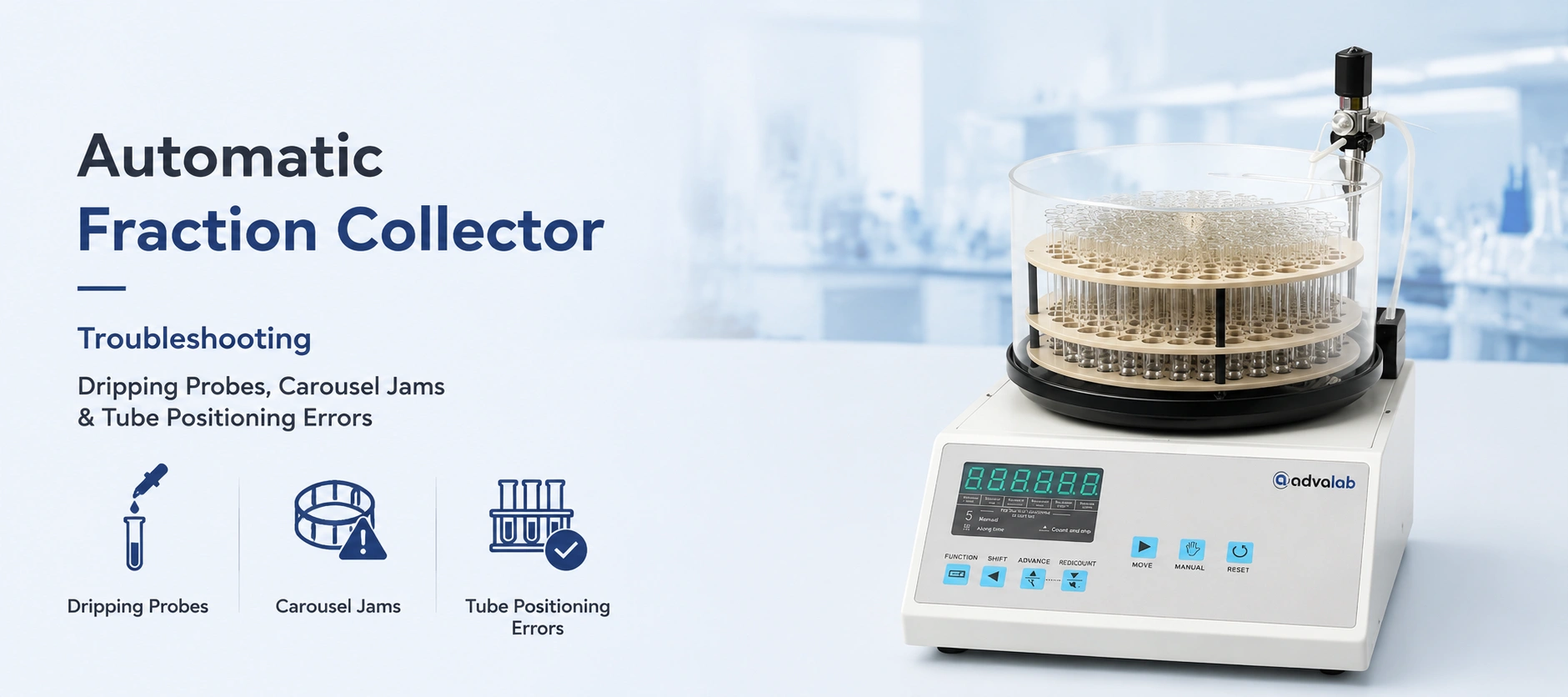
A working reference for laboratory, hospital, and research centre teams on reading the early signs of probe, carousel, and positioning problems on an Automatic Fraction Collector, before a run is interrupted or fractions are lost.
Most disruptions on an Automatic Fraction Collector trace back to one of three areas: the collection probe that lowers into each tube, the carousel or rack that indexes between positions, or the alignment routine that tells the arm where each tube sits. None of these failures happen without warning signs, and catching them early keeps a run from finishing with missed fractions or cross-contaminated tubes. Labs comparing replacement units or spare parts often start from the automatic fraction collector line on the Automatic Fraction Collectors page to check which probe and carousel components are serviceable on a given model.
Understanding how Automatic Fraction Collector works helps narrow down where a fault is likely sitting. The probe or outlet line delivers eluate into a tube held in a carousel or rack. A stepper motor moves the carousel to the next indexed position once a trigger condition, whether time, volume, or a detector peak, tells the control module to switch. A home or reference sensor confirms the carousel position at the start of a run, and the arm relies on that reference point for each later position throughout the sequence. A fault at any one of these three stages, delivery, indexing, or positioning reference, tends to produce a distinct symptom rather than a generic error.
Fault path: probe delivery, carousel indexing, home sensor reference, tube alignment check.
A probe that continues to drip after it should have stopped delivering liquid is one of the more visible signs something needs attention, and it usually points to one of a few recurring causes.
A valve that no longer seats fully closed lets liquid pass through between collection cycles, often from repeated cycling wearing down the seal over time. Replacing the affected valve seal typically resolves a slow, continuous drip.
Trapped air can cause uneven pressure that pushes liquid out after the pump has stopped. Priming the line fully before a run and checking for loose fittings along the tubing path usually clears this.
A probe tip sitting too close to residual liquid in a tube can wick fluid back up after delivery. Adjusting the probe's resting height in the setup menu often stops this without any part replacement.
Tubing that has hardened or cracked with age can leak at flex points rather than at the tip itself. Running a visual check along the full tubing length helps rule this out before assuming a valve fault.
A carousel that stalls mid-run, grinds, or stops indexing partway through a rack is rarely a single-cause problem, so it helps to work through the mechanical side before assuming a software fault.
Clearing a jam usually starts with powering down, manually checking the carousel rotates freely by hand, and only then reviewing the error log for a repeated stall at the same position, which tends to point to a physical obstruction at that spot rather than a general mechanical fault.
Positioning errors show up as fractions collected into an unexpected tube, or the arm attempting to lower into a position that does not exist on the loaded rack. These trace back almost always to the reference point the system uses at the start of a run.
A home sensor that reads a slightly shifted zero point throws off all later positions calculated from it for the rest of the run.
Selecting a rack profile in software that does not match the physical rack loaded leads the arm to expect tube spacing that is not actually there.
A carousel that slipped during a jam earlier in the run can continue operating with its internal position count out of step with reality.
When a symptom does not point clearly to one cause, working through a short diagnostic sequence narrows things down faster than replacing parts by guesswork. This covers the practical side of automatic fraction collector use once a fault has already appeared mid-run.
Category spans probe assemblies, carousel drives, rack profiles, and control interfaces.
Automatic fraction collectors sit within a wider group of liquid chromatography accessories, alongside detectors, pumps, and column hardware that a probe or carousel fault can sometimes be mistaken for. Buyers reviewing spare components or a full replacement unit typically compare probe type, carousel drive design, and rack compatibility across the automatic fraction collector line, which is laid out in full on the Automatic Fraction Collector category page. The wider chromatography and purification equipment range sits alongside it on advalab's main website, where related detector and pump hardware can also be reviewed.
| Factor | Structured Diagnostic Sequence | Reactive Part Swapping |
|---|---|---|
| Fault isolation | Narrows the cause to probe, carousel, or positioning before any part is touched | Parts are replaced on a guess, sometimes without confirming the actual fault |
| Repeat faults | Root cause is addressed, so the same symptom is less likely to return | Symptom may return quickly if the underlying cause was never identified |
| Downtime pattern | Slightly longer initial check, shorter overall disruption across future runs | Faster in the moment, but often repeated across several later runs |
| Record keeping | Fault position and symptom logged, useful for spotting recurring patterns | Little documentation beyond the part that was swapped |
Keep a log of which carousel position a stall occurred at across several runs, since a repeated position usually points to a localized obstruction.
Recheck probe height after switching tube formats rather than assuming a previous setting still applies.
Keep a spare drive belt and valve seal on hand for labs running the collector across back-to-back sessions.
Re-home the carousel any time it has been moved by hand, even briefly, before resuming an automated run.
Wipe down the carousel track between sample types that leave residue, rather than waiting for a jam to prompt cleaning.
Train staff to record the exact symptom and tube position before restarting a run, since that detail speeds up later diagnosis.