
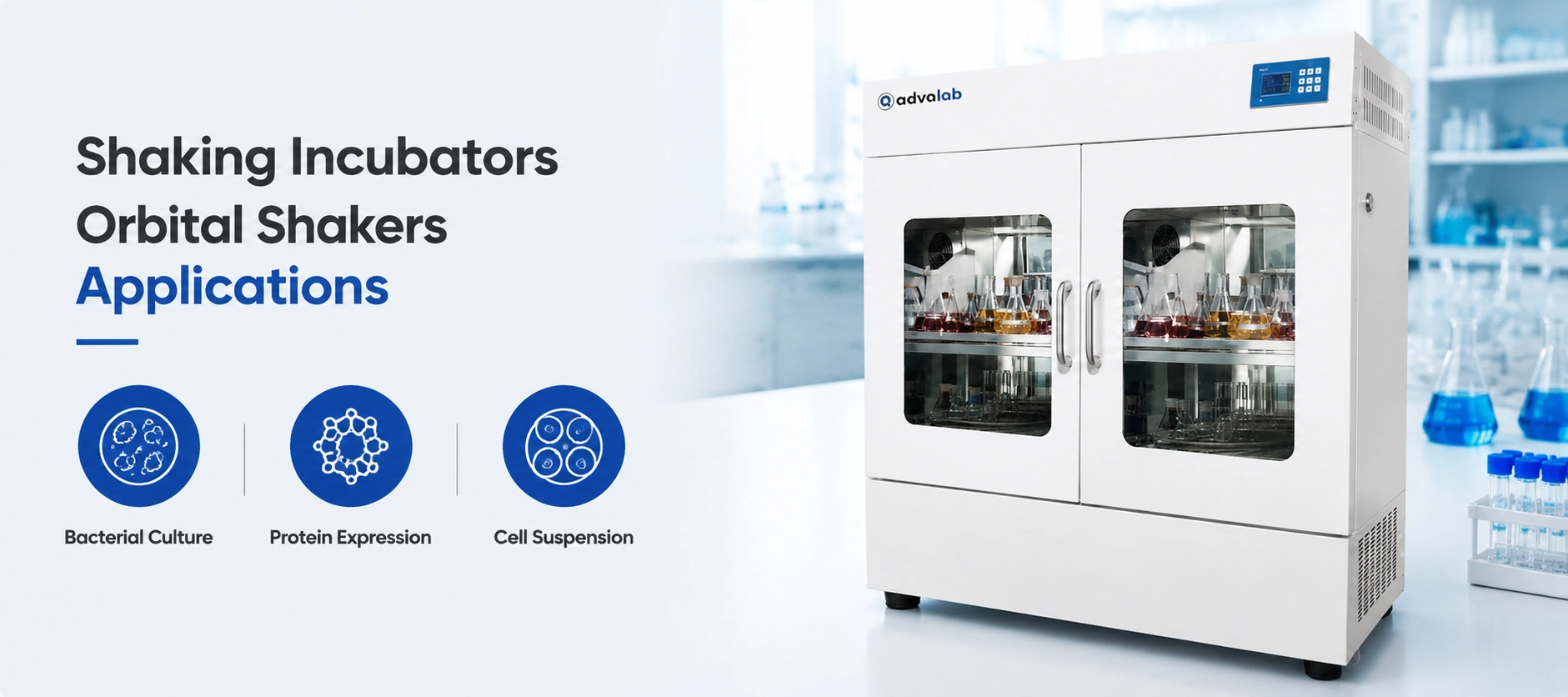
A working overview for laboratory, hospital, and research centre teams on where a Shaking Incubator fits into daily culture work, from growing a bacterial starter culture to expressing recombinant protein at scale.
A Shaking Incubator combines temperature control with continuous orbital motion, keeping liquid cultures aerated and evenly mixed as they grow rather than settling into a still, oxygen-poor layer at the bottom of a flask. This combination is why an orbital shaker incubator sits at the centre of microbiology and cell culture work, supporting growth rates and yields that a still incubator alone cannot match for aerobic organisms. Labs comparing platform size and shaking speed range often start from the shaking incubators line on the shaking incubators page before choosing a unit suited to their typical flask volume.
A laboratory shaker incubator pairs a heated chamber with a shaking platform driven in a circular, or orbital, motion at an adjustable speed and orbit diameter. As the platform moves, liquid inside a flask swirls continuously, increasing the surface area exposed to air and improving oxygen transfer into the culture, which most aerobic microorganisms and cell lines depend on for active growth. Temperature control inside the chamber operates independently of the shaking mechanism, holding cultures at a target temperature while motion continues throughout the incubation period. Some models add refrigeration alongside heating, letting refrigerated shaking incubators hold cultures below ambient temperature for slower growth phases or cold-sensitive work.
Function pairing: heated chamber, orbital shaking platform, continuous aeration and mixing of liquid culture.
Shaking incubator uses extend across several recurring lab tasks, each drawing on the same combination of motion and temperature control.
Overnight starter cultures and larger growth flasks rely on continuous aeration to reach a usable cell density before the next step in a protocol.
Induced expression cultures often need extended shaking at a controlled temperature to balance yield against correct protein folding.
Suspension cell lines grown without a solid surface depend on gentle, consistent motion to stay evenly distributed and adequately oxygenated.
Fermentation-style processes producing enzymes or metabolites benefit from the same aeration and mixing that supports general microbial growth.
Getting consistent growth from a shaking incubator cell culture setup depends on a short setup routine before flasks go in.
Category spans platform capacity, speed range, temperature range, and refrigeration capability.
Shaking incubators sit within a wider group of incubation equipment, alongside static incubators and CO2 incubators built for different culture conditions. Buyers comparing options in this category typically weigh platform capacity, speed and orbit range, temperature range, and whether refrigeration is needed for the work planned. The full shaking incubators lineup outlines configurations for bench and shared-lab use, and sits alongside the broader laboratory equipment range on advalab main website, where related incubation and culture hardware can also be reviewed.
| Factor | Shaking Incubator | Static Incubator |
|---|---|---|
| Aeration | Continuous motion improves oxygen transfer into liquid cultures | No motion, relies on surface exposure alone for gas exchange |
| Culture type | Suited to liquid cultures, suspension cells, and fermentation-style work | Suited to plates, solid media, and cultures that do not need agitation |
| Growth rate | Often faster for aerobic organisms due to improved oxygen availability | Can be slower for aerobic growth without agitation |
| Mechanical complexity | Includes a shaking platform and motor alongside temperature control | Temperature control only, with fewer moving parts |
Log shaking speed and temperature alongside each culture, so a slow-growing batch can be traced back to a setting later.
Check clamp tightness periodically, since repeated vibration can gradually loosen flask fittings over time.
Balance flask placement across the platform rather than clustering them to one side.
Clean spilled culture media from the platform promptly to avoid residue affecting later runs.
Verify chamber temperature periodically with an independent thermometer to catch drift early.
Train new staff on matching shaking speed to organism type, since overly vigorous motion can stress delicate cell lines.