
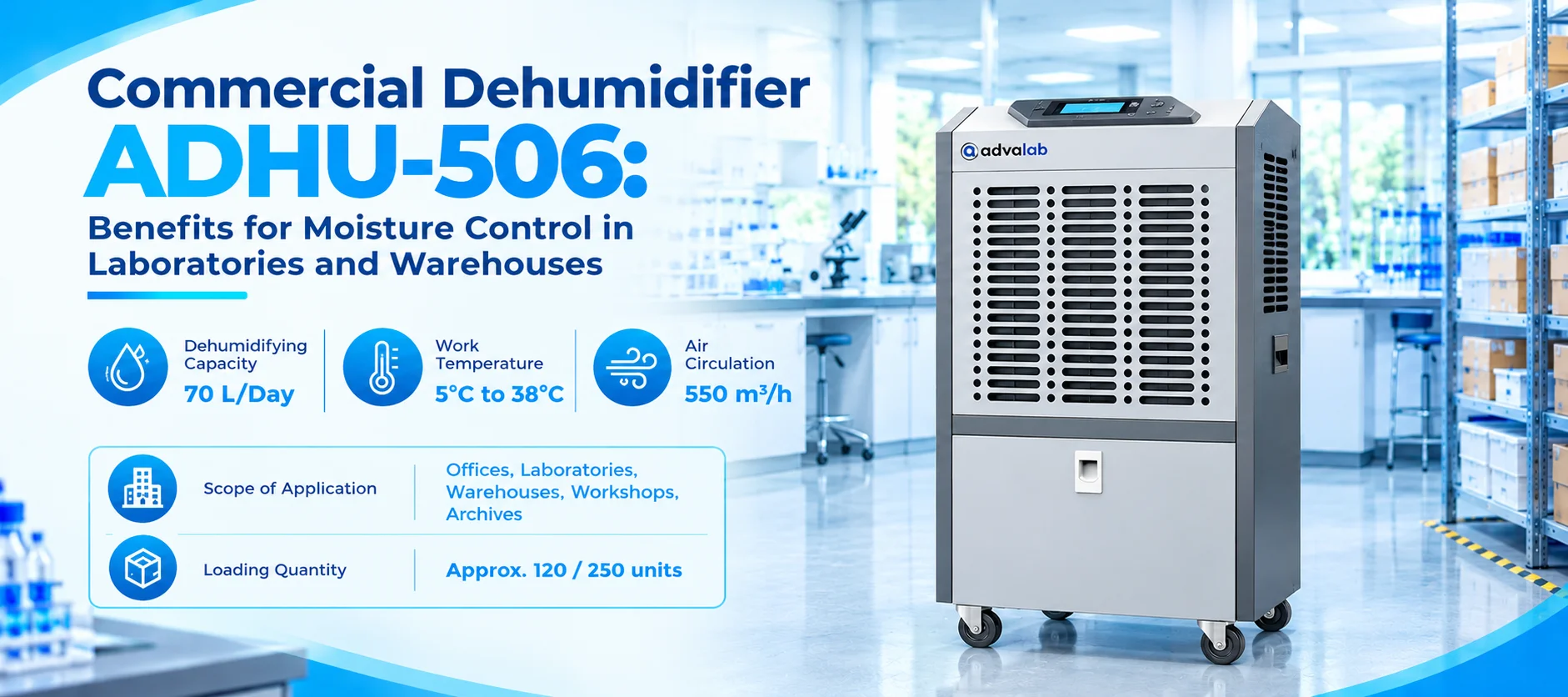
Humidity is easy to ignore until it leaves a mark. Paper archives curl, cardboard packaging softens, metal shelving rusts and electronic equipment picks up condensation when a warm, damp day follows a cool night. Laboratories, pharmaceutical zones and warehouses all keep materials that react to water in the air.
Opening windows rarely helps, because outside air often carries as much moisture as the room. A unit that removes water from the air itself gives staff a controllable alternative, and the Advalab ADHU-506 publishes its capacity, working temperature, airflow, power draw and size so a team can judge the fit before ordering.
A Commercial Dehumidifier suits a space only when those figures match the room and what is stored in it. This article explains the working principle, ten published benefits, typical uses, a sample routine and the mistakes to avoid, and then the next step: confirm the open points with the supplier and review the full listing.
People who search for Commercial Dehumidifier how it works usually want a plain explanation. In a compressor-based unit, a fan draws room air across a cold coil. Water vapor in the air condenses on the coil, runs off as liquid and is collected for drainage. The now cooler, drier air passes over a warm coil, is reheated slightly and returns to the room, so the room air holds less moisture after each pass.
The Advalab listing does not describe the internal parts, so treat this as the general principle of the equipment type. What the listing does confirm is automatic defrost that periodically prevents ice buildup on internal coils, which fits a cold-coil design, along with a compressor delay that protects against rapid cycling. Frost matters because ice on a cold coil blocks airflow, and a defrost cycle clears it.
Illustrative diagram, not to scale: the general principle of a compressor-based unit. The listing does not describe internal parts.
Uncontrolled moisture shows up in a few predictable ways:
The listing itself says the ADHU-506 protects against humidity-induced equipment damage and supports operational stability, provided the published numbers match the room.
Each benefit below ties to a specification or feature published for the ADHU-506.
The unit lists a dehumidifying capacity of seventy liters per day.
The working temperature runs from five to thirty-eight degrees Celsius.
Air circulation is five hundred fifty cubic meters per hour, which moves a room volume through the unit repeatedly.
The listing notes that automatic defrost periodically prevents ice buildup on the internal coils.
A twenty-four-hour programmable timer with power-off memory lets staff set run periods.
Caster wheels allow the unit to be rolled between rooms or storage bays.
The filters can be removed for cleaning, and they guard against dust.
A built-in delay protects against rapid cycling when power returns or settings change.
A fault diagnosis display helps staff identify issues without guesswork.
The listing gives a power consumption of seven hundred fifty watts, so electrical planning starts from a published number.
Infographic: capacity, temperature, airflow, power and size figures from the ADHU-506 listing.
The Advalab listing names offices, laboratories, warehouses, workshops and archives as its scope of application, and its description mentions pharmaceutical zones and equipment rooms. Teams that compare Commercial Dehumidifier equipment with an industrial dehumidifier or an industrial air dehumidifier weigh room volume, moisture load and how often doors open.
Searches for a Commercial Dehumidifier for basement rooms are common, but the listing does not name basements. A basement archive or store can be damp and cool, and the stated working range starts at five degrees Celsius, so confirm the lowest room temperature with the supplier before choosing a unit for that setting.
The listing does not publish an operating procedure, so follow the supplier manual for exact steps. People who look up commercial dehumidifier how to use instructions will find that a routine usually follows a short sequence:
Match these published figures against your own room and materials before shortlisting a dehumidifier:
| Model | Dehumidifying capacity | Air circulation |
|---|---|---|
| ADHU-501 | Fifty-eight liters per day | Five hundred cubic meters per hour |
| ADHU-502 | Ninety liters per day | Nine hundred fifty cubic meters per hour |
| ADHU-505 | Seventy liters per day | Five hundred cubic meters per hour |
| ADHU-506 | Seventy liters per day | Five hundred fifty cubic meters per hour |
| ADHU-509 | One hundred fifty-eight liters per day | One thousand fifty cubic meters per hour |
| ADHU-510 | One hundred sixty-eight liters per day at thirty degrees Celsius and eighty percent humidity | Two thousand cubic meters per hour |
The ADHU-505 and ADHU-506 list the same capacity, and the ADHU-506 adds a little airflow. Only the ADHU-510 listing states its rating conditions, so compare capacities across models with care and ask the supplier to confirm the conditions for the rest.
Infographic: commercial dehumidifier models from the published listings. The ADHU-510 figure is rated at 30 °C and 80 % RH; the other listings do not state rating conditions.
The dehumidifiers category at Advalab covers three families: the commercial dehumidifier range, the desiccant dehumidifier range and the industrial dehumidifier range. Compressor-based commercial models suit general rooms and storage, while desiccant models are built around a drying wheel for cold or very dry spaces.
When laboratories and warehouses compare options in this category, they typically weigh capacity, working temperature range and energy efficiency, along with features such as auto defrost, low noise and programmable humidity setpoints. To review all families side by side, explore the full dehumidifiers range, or see the wider laboratory equipment catalog on the Advalab home page.
The Commercial Dehumidifier ADHU-506 pairs a capacity of seventy liters per day, a working range of five to thirty-eight degrees Celsius and an airflow of five hundred fifty cubic meters per hour with automatic defrost, a programmable timer and caster wheels. It sits between the ADHU-502 and the larger ADHU-509 and ADHU-510, and it suits laboratories, warehouses, workshops, archives and equipment rooms.
Hazel Daniels
Specialty: Healthcare Technology & Laboratory Equipment
Writing Style: Professional, informative, and reader-friendly
Bio: Hazel Daniels specializes in writing about healthcare technology, laboratory equipment, and scientific applications. She presents technical information in simple language, highlighting practical uses and industry developments.
Review the published capacity, temperature, airflow, power and size details for this commercial dehumidifier and compare them against your own room and materials.
Explore Commercial Dehumidifier ADHU-506