
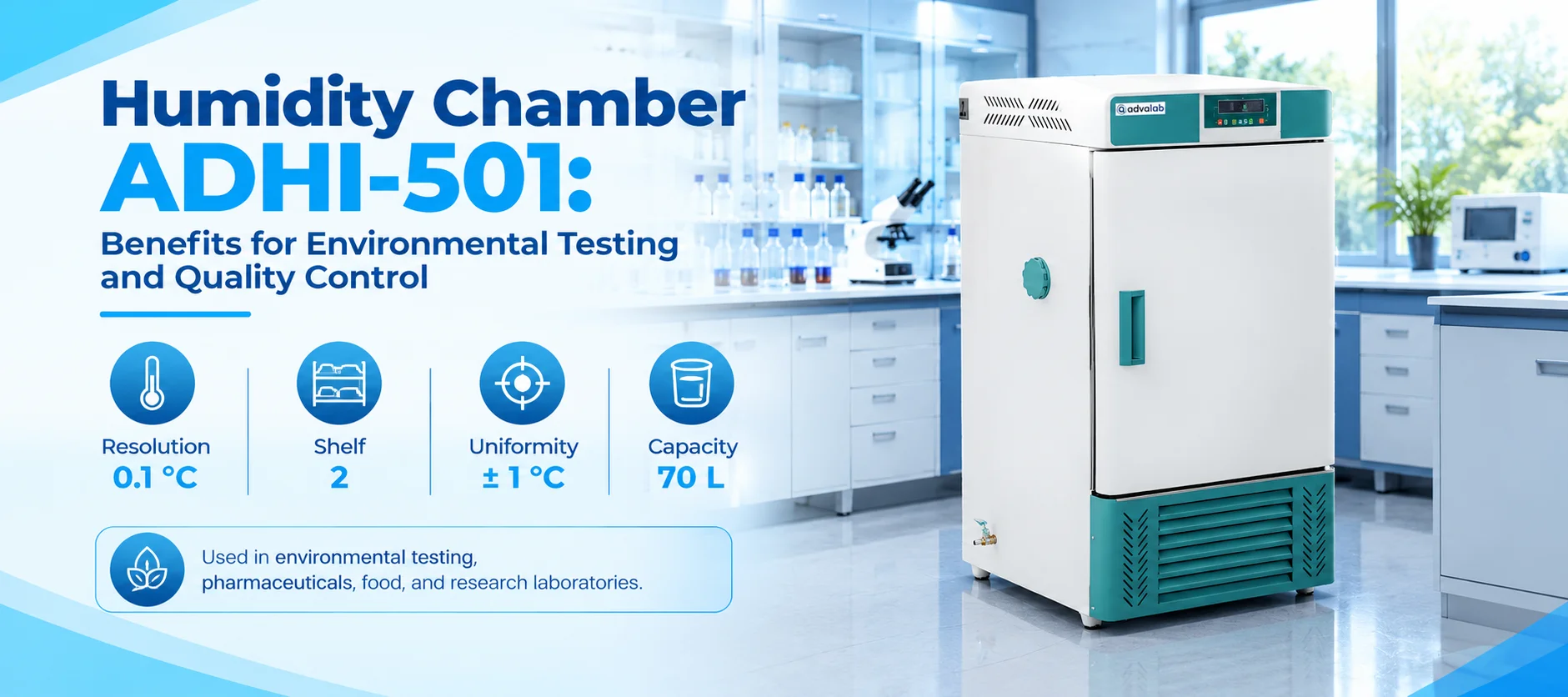
Heat and moisture change how materials behave. Powders cake, adhesives soften, coatings blister and metal parts corrode when damp air reaches them, and a laboratory that cannot reproduce those conditions treats each failure as a mystery. Seasonal swings in the storage area make the problem worse.
The remedy is to hold samples at set conditions for as long as a test needs. The Advalab ADHI-501 publishes its capacity, temperature ranges, uniformity, control system, power and size, so a team can judge the fit before ordering.
A Humidity Chamber suits a laboratory only when its published figures match the test method it must support. This article explains the working principle, ten published benefits, typical uses, a sample routine and the mistakes to avoid, and then the next step: confirm the open points with the supplier and review the full listing.
People who search how humidity chamber works want a short answer. An insulated chamber is sealed from the room, and a controller compares the measured conditions with the set values. It then heats, cools or adds moisture until the chamber matches the setting, and a sensor reports back so the loop can correct itself. The Advalab listing names a microprocessor PID control system, an energy-saving pre-heating and cooling arrangement and an air-cooled hermetic compressor for rapid cooling.
A humidity test chamber is judged by how closely it holds a setting. The ADHI-501 lists a temperature uniformity of plus or minus one degree Celsius and a fluctuation of plus or minus zero point five degrees at high temperature.
Illustrative flow, not to scale: the general control loop of a temperature and humidity chamber. The listing names the PID controller but not the humidifying method.
Without a chamber, testing conditions drift for a few predictable reasons:
A temperature humidity chamber with a stated uniformity, resolution and cooling method addresses these points, provided the published numbers match the test.
Each benefit below ties to a specification or feature published for the ADHI-501.
The chamber holds seventy liters, with two shelves for sample trays.
The temperature range with humidification runs from zero to sixty-five degrees Celsius.
Without humidification, the range runs from ten to sixty-five degrees Celsius.
Uniformity is listed as plus or minus one degree Celsius.
Fluctuation is plus or minus zero point five degrees at high temperature and plus or minus one degree at low temperature.
A resolution of zero point one degree Celsius lets operators read small changes.
A microprocessor PID control system holds the setting.
The stainless chamber is described as scratch-free and chemical resistant.
An easy-to-use LCD screen shows operating parameters, and a self-diagnostic system supports inspection.
The compressor provides rapid cooling with low energy consumption.
Infographic: capacity, temperature, power and size figures from the ADHI-501 listing.
The Advalab listing says the ADHI-501 is commonly used in research facilities, laboratories and the pharmaceutical industry to test samples for quality assurance. Searches for humidity chamber uses usually come down to a few practical cases, and a humidity chamber used in laboratory work typically serves these:
Teams that compare a humidity cabinet laboratory setup with a larger climate chamber weigh the sample volume, the temperature range and the controls their test method needs. A humidity chamber in lab use is a different tool from a room-scale unit, and the seventy liter space suits modest sample loads.
The listing does not publish an operating procedure, so follow the supplier manual for exact steps. A routine for a humidity chamber machine usually follows a short sequence:
Match these published figures against your own test plan before shortlisting a humidity chamber laboratory unit:
| Model | Capacity | Internal size (W × D × H) | Power |
|---|---|---|---|
| ADHI-501 | Seventy liters | Four hundred fifteen by three hundred fifty by five hundred millimeters | One point eight kilowatts |
| ADHI-502 | One hundred fifty liters | Four hundred ninety by four hundred by seven hundred fifty millimeters | Two kilowatts |
| ADHI-503 | Two hundred fifty liters | Five hundred by five hundred by nine hundred fifty millimeters | Two point two kilowatts |
All three list the same temperature ranges, the same uniformity and the same microprocessor PID control, so the choice comes down to capacity, shelf space and power. The listings give no humidity range for any of them.
Infographic: humidity chamber models from the published listings. Capacity and power are the main differences.
The test chambers category at Advalab covers six families: the humidity chamber range, the climate chamber range, the drug test chamber range, the drug stability test chamber range, the illumination chamber range and the salt spray test chamber range. Each one controls a different set of conditions for testing samples.
When laboratories compare options in this category, they typically weigh the conditions controlled, chamber capacity, temperature range, uniformity, control system and footprint. To review all families side by side, explore the full test chambers range, or see the wider laboratory equipment catalog on the Advalab home page.
The Humidity Chamber ADHI-501 pairs a seventy liter stainless chamber and two shelves with a temperature range of zero to sixty-five degrees Celsius with humidification, a uniformity of plus or minus one degree and a microprocessor PID controller. It suits research and pharmaceutical laboratories that run bench-scale environmental tests.
Hazel Daniels
Specialty: Healthcare Technology & Laboratory Equipment
Writing Style: Professional, informative, and reader-friendly
Bio: Hazel Daniels specializes in writing about healthcare technology, laboratory equipment, and scientific applications. She presents technical information in simple language, highlighting practical uses and industry developments.
Review the published capacity, temperature, uniformity, control and size details for this humidity chamber and compare them against your own test plan.
Explore Humidity Chamber ADHI-501